Search our glossary for common terms, acronyms in body armor, manufacturing, military, government, textiles, munitions, trade compliance, quality, and material science. Use the search bar to look up specific categories, titles, or descriptions.
Want to learn more? Check out these links below.
DOD Dictionary of Military and Associated Terms- USG Compendium of Interagency and Associated Terms
NATO Terminology Database- The United Nations Terminology Database
- Military Terms and Jargon
- A Glossary of Selected Fiber and Textile Terms
| Category | Title | Description |
|---|---|---|
| Body Armor | Absolute Humidity | The quantity of water in a given volume of air, often reported in grams per cubic meter |
| Body Armor | Accessory Ballistic Panels | Accessory panels are armor components that are detachable or removable from the primary body armor sample and are intended to provide comparable ballistic protection Examples of accessory panels include groin, coccyx, and side protection panels which are attached to or inserted into the external armor carrier but are not integral to the armor panels or armor sample |
| Body Armor | Angle of Incidence | The angle between the bulletÕs line of flight and the perpendicular to the front surface of the backing material fixture |
| Body Armor | Armor Carrier | A component of the armor sample or armor panel whose primary purpose is to retain the ballistic panel and provide a means of supporting and securing the armor garment to the userÊ Generally, the carrier is not ballistic resistant |
| Body Armor | Armor Conditioning | Environmental and mechanical conditioning of armor prior to ballistic testing which consists of exposure to specified conditions of temperature, humidity, and mechanical damage |
| Body Armor | Armor Panel or Panel | The portion of an armor sample that consists of an external ballistic cover and its internal ballistic panel The word Òpanel,Ó if not preceded by the word Òballistic,Ó refers to an armor panel in this standard (NIJ 010106) |
| Body Armor | Ballistic Panel | The protective component of an armor sample or armor panel, consisting primarily of ballistic resistant materials The ballistic panel is usually enclosed in a non-removable panel cover, which is considered part of the ballistic panel The ballistic panel is normally enclosed within an armor carrier |
| Body Armor | Body Armor | An item of personal protective equipment that provides protection against specific ballistic threats within its coverage area In this standard, the term body armor refers to that which provides coverage primarily for the torso |
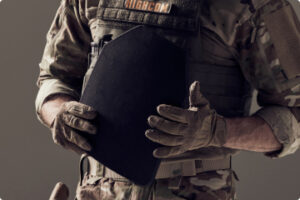
| Body Armor | Plate Inserts | Hard armor plates or semi-rigid plates that are intended to be inserted into pockets of flexible vests and jackets to provide increased protection, particularly to provide protection against rifle threats We sell ballistic plates (Level IIIA) |
| Body Armor | UHMWPE | Ultra High Molecular Weight Polyethylene is odorless, tasteless, and nontoxic It is highly resistant to corrosive chemicals except oxidizing acids; has extremely low moisture absorption and a very low coefficient of friction; is self-lubricating; and is highly resistant to abrasion, in some forms being 15 times more resistant to abrasion than carbon steel Its coefficient of friction is significantly lower than that of nylon and acetal, and is comparable to that of polytetrafluoroethylene (PTFE, Teflon), but UHMWPE has better abrasion resistance than PTFE UHMWPE fibers are used in armor, in particular, personal armor and on occasion as vehicle armor, cut-resistant gloves, bow strings, climbing equipment, fishing line, spear lines for spearguns, high-performance sails, suspension lines on sport parachutes and paragliders, rigging in yachting, kites, and kites lines for kite sports Spectra is also used as a high-end wakeboard line For personal armor, the fibers are, in general, aligned and bonded into sheets, which are then layered at various angles to give the resulting composite material strength in all directions |
| Body Armor | EVA | EVA stands for Ethylene Vinyl Acetate |
| Body Armor | AP | Armor Piercing |
| Body Armor | AREAL DENSITY | The weight of the armored panel in grams per square metre divided by the protection area of the panel It gives an indication of the energy absorption capability of the material |
| Body Armor | BACK FACE DEFORMATION | The term used to describe the effect of a non penetrating projectile on the rear face of a strike plate The extent of allowable deformation is set by the National Institute of Justice in its Standards at 44mm |
| Body Armor | BLUNT TRAUMA | This is the injury caused to the body by back face deformation It can vary from bruising to the destruction of major organs |
| Body Armor | BRV | Bullet Resistant Vest |
| Body Armor | BULLET PROOF | All body armor manufacturers strive to achieve a bullet proof vest For a variety of reasons this is not possible Any armor product will normally be described as Ôbullet resistantÕ because many factors are involved which the manufacturer cannot control |
| Body Armor | CALIBER | The diameter of the bore of a weapon |
| Body Armor | CARRIER | The fabric garment used to carry body armor |
| Body Armor | CERAMIC PLATE | Hard armor is normally made up of a composite of an extremely hard plate often ceramic and a fiber covering The ceramic plates as they are often referred to are made from alumina oxide; silicon carbide or boron carbide These tiles can be very light; strong and often expensive |
| Body Armor | COMPOSITE | A composite describes the practice of combining a variety of materials to achieve the lightest weight; with the greatest capability |
| Body Armor | COVERT ARMOUR | This is armor which is worn under normal clothing or normal clothing which has been modified to carry the soft armor material |
| Body Armor | DENIER | A system for coding filament yarns and fibers; with low numbers representing finer sizes and higher numbers representing heavier yarns Denier represents the weight in grams of 9000 meters of fiber |
| Body Armor | DYNEEMA¨ | A high modulus polyethylene fiber similar to Spectra¨ |
| Body Armor | FBI | The United StatesÊFederal Bureau of Investigation |
| Body Armor | FMJ | Full metal Jacket |
| Body Armor | GRAINS | The Imperial System for measuring the weight of bullets A grain is equivalent to approximately 638mg |
| Body Armor | HARD BODY ARMOUR | armor which is solid and not flexible Generally it incorporates steel or ceramics as part of a composite but can be made from treated fiber as well |
| Body Armor | HPPE | High Performance PolyEthylene |
| Body Armor | JHP | Jacketed Hollow Point |
| Body Armor | JSP | Jacketed Soft Point |
| Body Armor | KEVLAR¨ | Kevlar¨Êis an aramid fiber developed byÊDuPont |
| Body Armor | LRHV | Long Rifle High Velocity |
| Body Armor | LRN | Lead Round Nose |
| Body Armor | MODULUS | This is the measure of stretch or elasticity of a fabric The number associated with modulus is the amount of load in grams it takes to initiate stretch in a 1000 denier yarn; a higher number reflects lower stretch |
| Body Armor | MULTIPLE STRIKES | This is the term used to describe a number of projectiles striking a piece of armor |
| Body Armor | MUSHROOMING | This is one way of describing the appearance of back face deformation It also describes the deformation of the projectile on penetrating armor |
| Body Armor | MSC | Mild steel core |
| Body Armor | NATA | TheÊNational Association of Testing Authorities¨ÊAustralia |
| Body Armor | NIJ | The United StatesÊNational Institute of Justice; whose ballistics testing standards for armor are accepted virtually worldwide |
| Body Armor | OVERT ARMOUR | This is armor worn outside normal clothing and is obvious |
| Body Armor | PARABELLUM 9mm | In 1898 Georg Luger manufactured the first of his famous pistols It was originally built as a 765mm caliber; and was known as the Para Bellum; from the Latin; Si vis pacem para bellum; ÒIf you want peace; prepare for warÓ The pistol was modified to 9mm This ammunition became the most widely used pistol ammunition in the world; and is referred to using the name for the original Luger pistol; Parabellum |
| Body Armor | PSDB | The United Kingdom Police Scientific Development Branch This organization conducted extensive research into stabbingÕs and developed the Standard for Stab Proof armor and the test regime This standard is also used by the National Institute of Justice |
| Body Armor | RN | Round Nose |
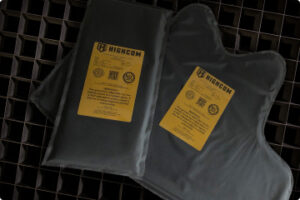
| Body Armor | SAI | Soft armorÊinsert |
| Body Armor | SAPI | Small Arms Protective Insert |
| Body Armor | SOFT BODY ARMOUR | This describes armor made from fabric only It can be a composite containing more than one type of fiber |
| Body Armor | SPALLING | This is another term describing back face deformation It refers to the effect of a projectile on armor; where an amount of the material scales off the back face |
| Body Armor | SPECTRA¨ | A highly modified polyethylene fiber manufactured byÊHoneywell |
| Body Armor | STRIKE PLATE | This is the hard armor insert for body armor It is sometimes referred to as a [ballistic] tile or a ballistic panel |
| Body Armor | SWC | Semi-Wadcutter |
| Body Armor | TACTICAL ARMOUR | This is overt armor; which is further developed for extensive use The carrier is often designed to hold special equipment; in addition to the armor |
| Body Armor | TECHNORA | An aramid fiber; manufactured byÊTeijin Ltd |
| Body Armor | TENSYLON | An Polyethelene fiber; manufactured by and registered trademark ofÊDupont |
| Body Armor | TWARON | An aramid fiber manufactured by Teijin Ltd |
| Body Armor | UD | The abbreviation for uni-directional This describes the orientation of fibers in a crossply laminate; the fibers are aligned in parallel |
| Body Armor | V50 | This is a statistical test; originally developed by theÊUS Army It identifies the velocity at which a projectile has a 50% chance of penetrating the test object |
| Body Armor | VEST | A vest comprises armor inserts and the carrier |
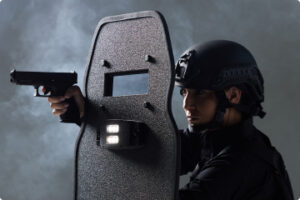
| Body Armor | Hard Ballistic | Hard Ballistic products protect the users from a big variety of threats From pistol to rifle calibers, including certain armor-piercing ammunition |
| Body Armor | Multi-Shot | Multi-Shot rated ballistic armor is engineered and tested to hold multi-direct hits for matching their maximum threat level ratings |
| Body Armor | Stand Alone | Hard Ballistic armor that is rated as Stand Alone will meet their threat level without requiring additional soft ballistic inserts |
| Body Armor | Edge to Edge | Meaning that the actual ballistic protection area covers the entire hard ballistic plate This is an essential feature to law enforcement and military users |
| Body Armor | Multicurve | The unique multidimensional shape provides a better fit to our body contours This feature significantly increases comfort and flexibility while wearing in actions |
| Body Armor | Shelf Life | Regular ballistic armor commonly has 3-5 years shelf life Premium ballistic armor that is designed to match military standards, offers 10 years or more |
| Body Armor | Alumina | Alumina is the most common ceramic that is used in the hard ballistic protective industry It suits militaries perfectly due to its toughness and low costs The only disadvantage is its heavier weight |
| Body Armor | Aramid | A strong and heat-resistant synthetic fiber mainly used in ballistic helmets and soft ballistic inserts It has similar characteristics as UHMWPE but a higher melting point and improved resistance to abrasion |
| Manufacturing | 3D Printing | A specific additive manufacturing technology, however, this term has gained common usage to describe all manner of additive manufacturing SeeÊAdditive Manufacturing |
| Manufacturing | Additive Manufacturing | The construction of complex three-dimensional parts from 3D digital model data by depositing successive layers of material Metal, polymer, and ceramic materials can be used to manufacture parts of a geometry that often cannot be produced by any other manufacturing technology The names of specific additive manufacturing technologies include: 3D printing, layered object manufacturing, selective laser sintering, selective laser melting, LENS, stereolithography, and fused deposition modeling Synonyms include layered manufacturing, solid freeform manufacturing, direct digital manufacturing, rapid prototyping1 |
| Manufacturing | Advanced Manufacturing | Use of innovative technologies to create existing products and the creation of new products Advanced manufacturing can include production activities that depend on information, automation, computation, software, sensing, and networking2 |
| Manufacturing | Agile Manufacturing | Tools, techniques, and initiatives (such as lean and flexible manufacturing) to help a plant and/or organization rapidly respond to their customers, the market, and innovations It can also incorporate Òmass customizationÓ concepts to meet unique customer needs as well as “quick response manufacturing” to reduce lead times across an enterprise3,4 |
| Manufacturing | Automation | Using control systems to operate an apparatus, process, or system with minimal or reduced direct human intervention5 |
| Manufacturing | Bottleneck | A point of congestion in a manufacturing system that arises when parts arrive at a given machine/operation faster than that machine/operation can process them6 |
| Manufacturing | Composites | Materials comprised of two or more components with significantly different physical or chemical properties, that when combined, produce a material that behaves differently from the individual components The individual components remain separate and distinct within the finished structure Examples of engineered composite materials include: carbon fiber-reinforced polymers, metal matric composites, ceramic matrix composites, cement, concrete Wood is an example of a naturally occurring composite material |
| Manufacturing | Computer Numerical Control | The digital control of a physical machine that consists of a series of integrated actuators, power electronics, sensors, and dedicated computer running under a real-time operating system Computer numerical control (CNC) can control multiple machines, usually when they are grouped in a manufacturing cell This is a form of digital automation1 |
| Manufacturing | Computer-Aided Design | “Computer-aided design (CAD) is the use of a wide range of computer-based tools that assist engineers, architects, and other design professionals in their design activities It is the main geometry authoring tool within the Product Lifecycle Management process and involves both software and sometimes special-purpose hardware”1 |
| Manufacturing | Computer-Aided Manufacturing | In general, computer-aided manufacturing (CAM) refers to “the use of computer systems to plan, manage, and control the operations of a manufacturing plant through either direct or indirect computer interface with the plant’s production resources”1ÊComputer-aided manufacturing (CAM) often refers to software that takes the geometric design authored with CAD software as input and outputs manufacturing instructions that are downloaded to automated equipment such as a computer numerically controlled (CNC) machine tool Is also referred to as computer-assisted manufacturing1 |
| Manufacturing | Computer-Integrated Manufacturing | “An approach to integrate production-related information and control entire production processes, automated lines, plants, and networks by using computers and a common database”1 |
| Manufacturing | Continuous-Flow Manufacturing | A manufacturing method in which the materials (dry bulk or fluids) that are being processed are continuously in motion, undergoing mechanical, thermal, and/or chemical treatment This is the opposite of batch production Synonyms include: continuous manufacturing, continuous processing, continuous production, and continuous flow process8 |
| Manufacturing | COVID-19 | Coronavirus (COVID-19) is an illness caused by a virus that can spread from person to person The virus that causes COVID-19 is a new coronavirus that has spread throughout the world COVID-19 symptoms can range from mild (or no symptoms) to severe illness |
| Manufacturing | Cross-Training | Training employees in several skill sets so they can fill in for one another as needed |
| Manufacturing | Digital Manufacturing | Aims to improve product design and manufacturing processes across the board seamless integration of information technology systems across the supply chain Digital manufacturing focuses on reducing the time and cost of manufacturing by integrating and using data from design, production, and product use; digitizing manufacturing operations to improve product, process, and enterprise performance, and tools for modeling and advanced analytics, throughout the product life cycle |
| Manufacturing | Discrete Manufacturing | Producing finished products that can be recognized as distinct physical units via serial numbers or other labeling methods |
| Manufacturing | Flexible Manufacturing System | Integrated group of manufacturing equipment and/or cross-trained work teams that can produce a variety of parts in the mid-volume production range Flexible refers to the systems capability to manufacture different part variants and production quantity can be adjusted in response to changing demand1 |
| Manufacturing | Industry 40 | A term coined in Germany, popularly used in Europe, and equivalent to smart manufacturing SeeÊDigital Manufacturing |
| Manufacturing | Just-in-Time | Just-in-time (JIT) techniques reduce setup times, inventory, and waste, and improve products and reduce manufacturing cycle time Synonyms include: continuous-flow production JIT is a total manufacturing system that was first introduced by Toyota Motor Corporation1 |
| Manufacturing | Lean Manufacturing | A manufacturing practice that aims to reduce wasted time, effort or other resources in the production process |
| Manufacturing | Manufacturing Cost | Includes quality-related costs, direct and indirect labor, equipment repair and maintenance, other manufacturing support and overhead, and other costs directly associated with manufacturing operations |
| Manufacturing | Manufacturing Cycle Time | The time of actual production from the moment a customer order arrives on the plant floor to the completion of all product manufacturing, assembly, and testing |
| Manufacturing | Manufacturing Day | Held annually on the first Friday in October with events that continue throughout the month, MFG Day Ñ Manufacturing Day Ñ helps show the reality of modern manufacturing careers by encouraging thousands of companies and educational institutions around the nation to open their doors to students, parents, teachers and community leaders |
| Manufacturing | Manufacturing USA | The brand name for the National Network for Manufacturing Innovation Program |
| Manufacturing | National Network for Manufacturing Innovation | As a part of the strategy to revitalize American manufacturing, the Revitalize American Manufacturing and Innovation Act of 2014 authorizes the Department of Commerce to establish and convene a nationwide “network” comprised of the individual Manufacturing Innovation Institutes, which can enhance their impacts and further strengthen America’s global competitiveness |
| Manufacturing | North American Industry Classification System | A coding system of the US, Mexican, and Canadian governments that identifies specific economic sectors9 |
| Manufacturing | OEM | Original equipment manufacturer |
| Manufacturing | Planning and Scheduling Technologies | A variety of software-based advanced planning, scheduling, and optimization systems |
| Manufacturing | Process Manufacturing | Manufacturing products such as chemicals, gasoline, beverages, and food products in “batch” quantities |
| Manufacturing | Product-Development Cycle | Often called time to market, this is the period from when design/development work begins to the time that the final product is available for purchase |
| Manufacturing | Rapid Prototyping | Techniques to quickly fabricate a scale model of a physical part or assembly Historically, this term has referred to the use of additive manufacturing to create the part The term is falling out of favor to describe all additive manufacturing technologies because they are seen as being able to do more than just prototyping: ie, they are now being used for production of final parts and assemblies |
| Manufacturing | Robotics | Mechanical or electrical engineering coupled with computer science used to design, construct, operate, and apply robots It also includes the computer systems for their control, sensory feedback, and information processing Where a robot is a reprogrammable, multifunctional manipulator designed to move material, parts, tools, or specialized devices through various programmed motions for the performance of a variety of tasks |
| Manufacturing | Six Sigma | One method of preparing and controlling the compliance of processes and products with predetermined quality standards Six Sigma at many organizations simply means a measure of quality that strives for near perfection Six Sigma is a disciplined, data-driven approach and methodology for eliminating defects (driving toward six standard deviations between the mean and the nearest specification limit) in any process To achieve Six Sigma, a process must not produce more than 34 defects per million opportunities1 |
| Manufacturing | Smart Manufacturing | Aims to reduce manufacturing costs from the perspective of real-time energy management, energy productivity, and process energy efficiency Initiatives will create a networked data driven process platform that combines innovative modeling and simulation and advanced sensing and control Integrates efficiency intelligence in real-time across an entire production operation with primary emphasis on minimizing energy and material use; particularly relevant for energy-intensive manufacturing sectors |
| Manufacturing | Supply-Chain/Logistics Systems | Manufacturing software to optimize scheduling and other activities throughout the supply chain |
| Manufacturing | Total Quality Management | A company-wide approach to improving quality and customer satisfactionÐincluding fast response and service, as well as product |
| Material Science | Amorphous | In general, amorphous means without form In materials science and related fields, an amorphous solid is a substance that lacks the definite structure of a crystal The atoms and molecules in amorphous solids donÕt align in a lattice pattern These substances include glass, gel and thin films Many polymersÊare classified as amorphous |
| Material Science | Chirality | Chiral molecules are those for which there is another identical molecule arranged as a mirror image ConsiderÊchiral moleculesÊas human hands Ð the left is a mirror image of the right Achiral molecules are symmetrical Ð when reflected, their structure is the same Ê |
| Material Science | Crystallinity | The degree to which a substanceÕs molecules and atoms align The more crystallineÊthe substance, the less amorphous it is Highly crystalline materials are harder, tougher, and more durable than amorphous materials Polymers, like polyethylene, have a high degree of crystallinity and are therefore durable materials |
| Material Science | Fluoropolymers | As the name suggests, these are polymers that contain fluorine atoms The original fluoropolymer, tetrafluoroethylene, was discovered by accident and is now known by its brand name, Teflon In general,ÊfluoropolymersÊare high-performance plastics used in a variety of intense fields |
| Material Science | Glass transition temperature | The temperature at which a polymer changes from a hard material to a soft, rubbery substance This isnÕt the same as the melting point, nor is it truly a distinct temperature: It is a range over which the polymer chains increase mobility |
| Material Science | Hydrolysis | The process of breaking chemical bonds using water ÊHydrolysis is a chemical reaction of a substance with waterÊ In contrast, dissolution of a material in water is a physical process |
| Material Science | Melt phase | The fancy way of describing the process when a substance transitions from a crystalline solid to an amorphous liquid Through heat or pressure, the molecules become less ordered and solid material liquefies |
| Material Science | Melting point | The temperature at which the melt phase occurs This temperature will vary from substance to substance |
| Material Science | Molecular weight | A number that is related to the length and number of monomer repeat units that comprise a polymerÊ A polymer material typically has polymer chains of various lengths, not all the same lengthÊ As a result,it is common to talk about the averageÊmolecular weight |
| Material Science | Monomer and co-monomer | AÊmonomerÊis a molecule that can bond with others of the same kind to form a polymer chain Two different monomers that bond together are co-monomers Monomers have polyfunctionality, which means they can form chemical bonds to at least two other monomers |
| Material Science | Morphology | This refers to the physical properties of a substance, like shape, size, composition and phase distribution |
| Material Science | Plasticizers | Substances that may be added to a material to increase its flexibility and resilience Water can be a plasticizer when added to clay Materials scientists can add plasticizing molecules to PVC, for example, to make the plastic more pliable and suitable for different uses |
| Material Science | Polymer | Our namesake, a polymer is a chain of monomers bonded together chemically Some assume polymers are all synthetic, but that isnÕt the case Some naturally-occurring polymers include rubber, which canÊbe enhanced and altered to optimize certain properties With that said, many synthetic materials like plastics and gels are polymers |
| Material Science | Polydispersity | Essentially, the degree to which objects in a mixture have varying size, shape and weight A uniform mixture contains identical objects, whereas a mixture with a high degree of dispersity contains widely different objectsÊ In the case of polymers, polydispersity is a description of the range of molecular weights that exist in the material |
| Material Science | Solvent | A substance that can dissolve another substance Once a substance dissolves into a solvent, the resulting mixture is called a solution |
| Material Science | Tensile strength | The ability of aÊsubstance to resist breaking from a pulling force A material has high tensile strength if it takes a great force to cause it to snap simply by pulling on it A steel beam has high tensile strength, while a wet noodle has low tensile strength |
| Material Science | Thermal stability | A substanceÕs ability to resist breaking down under intense heat The higher the temperature it can withstand, the higher the thermal stability When the heat is too high, it will break chemical bonds and change the substanceÕs properties |
| Material Science | Thermoplastics | Plastics that become pliable under the application of heat and then harden again when cool One key characteristic is that they can be remelted and molded over and over again, unlike thermosets |
| Material Science | Thermosets | Once aÊthermosetÊis produced, it cannot be remelted and molded through heat Any additional heat could only risk damaging the substance If thermoplastics are like ice cream Ð can be melted and solidified over and over again Ð thermosets are like cookies Too much heat and they will burn or char |
| Material Science | Toughness | The materials science equivalent of the ability to take a punch Toughness refers to a substanceÕs ability to absorb energy without suffering structural damage or fracturing |
| Material Science | Viscoelasticity | A substance that demonstrates properties of both a fluid and an elastic solid Silly putty is one example Ð it conforms to its container over time, like a fluid, but it stretches and returns to its original shape, like an elastic solid |
| Material Science | Viscosity | ViscosityÊis the resistance of a material to flowÊ A fluid that is highly resistant to flow, like honey or molasses, has high viscosity Water has low viscosity Ð it flows freely A substanceÕs viscosity may change depending on the temperature |
| Quality | Academic Quality Improvement Project (AQIP) | A forum for higher education institutions to review one anotherÕs action projects |
| Quality | Acceptance number | ÊThe maximum number of defects or defectives allowable in a sampling lot for the lot to be acceptable |
| Quality | Acceptance quality limit (AQL) | ÊIn a continuing series of lots, a quality level that, for the purpose of sampling inspection, is the limit of a satisfactory process average |
| Quality | Acceptance sampling | ÊInspection of a sample from a lot to decide whether to accept that lot There are two types- Attributes sampling and Variables sampling In attributes sampling, the presence or absence of a characteristic is noted in each of the units inspected In variables sampling, the numerical magnitude of a characteristic is measured and recorded for each inspected unit; this involves reference to a continuous scale of some kind |
| Quality | Acceptance sampling plan | ÊA specific plan that indicates the sampling sizes and associated acceptance or nonacceptance criteria to be used In attributes sampling, for example, there are single, double, multiple, sequential, chain and skip-lot sampling plans In variables sampling, there are single, double and sequential sampling plans For detailed descriptions of these plans, see the standard ANSI/ISO/ASQ A3534-2-1993 StatisticsÑVocabulary and SymbolsÑStatistical Quality Control |
| Quality | Accreditation | ÊCertification by a recognized body of the facilities, capability, objectivity, competence and integrity of an agency, service or operational group or individual to provide the specific service or operation needed The term has multiple meanings depending on the sector Laboratory accreditation assesses the capability of a laboratory to conduct testing, generally using standard test methods Accreditation for healthcare organizations involves an authoritative body surveying and verifying compliance with recognized criteria, similar to certification in other sectors |
| Quality | Accreditation body | ÊAn organization with authority to accredit other organizations to perform services such as quality system certification |
| Quality | Accuracy | ÊThe characteristic of a measure |
| Quality | ACLASS Accreditation Services | ÊAn ANSI-ASQ National Accreditation Board company that provides accreditation services for testing and calibration laboratories in accordance with ISO/IEC 17025; reference material producers in accordance with ISO Guide 34; and inspection bodies in accordance with ISO/IEC 17020 |
| Quality | Activity based costing | ÊAn accounting system that assigns costs to a product based on the amount of resources used to design, order or make it |
| Quality | Activity network diagram | ÊAn arrow diagram used in planning |
| Quality | Advanced Product Quality Planning (APQP) | ÊHigh level automotive process for product realization, from design through production part approval |
| Quality | Adverse event | ÊHealthcare term for any event that is not consistent with the desired, normal or usual operation of the organization; also known as a sentinel event |
| Quality | Affinity diagram | A management tool for organizing information (usually gathered during a brainstorming activity) |
| Quality | Alignment | ÊActions to ensure that a process or activity supports the organizationÕs strategy, goals and objectives |
| Quality | American Association for Laboratory Accreditation (A2LA) | ÊAn organization that formally recognizes another organizationÕs competency to perform specific tests, types of tests or calibrations |
| Quality | American Customer Satisfaction Index (ACSI) | ÊReleased for the first time in October 1994, an economic indicator and cross industry measure of the satisfaction of US household customers with the quality of the goods and services available to them This includes goods and services produced in the United States and imports from foreign firms that have substantial market shares or dollar sales ASQ is a founding sponsor of the ACSI, along with the University of Michigan Business School and the CFI Group |
| Quality | American National Standards Institute (ANSI) | ÊA private, nonprofit organization that administers and coordinates the US voluntary standardization and conformity assessment system It is the US member body in the International Organization for Standardization, known as ISO |
| Quality | American National Standards Institute-American Society for Quality (ANSI-ASQ) | ÊOrganization that accredits certification bodies for ISO 9001 quality management systems, ISO 14001 environmental management systems and other industry specific requirements |
| Quality | American Society for Nondestructive Testing (ASNT) | ÊA technical society for nondestructive testing (NDT) professionals |
| Quality | American Society for Quality (ASQ) | ÊA professional, not-forprofit association that develops, promotes and applies quality related information and technology for the private sector, government and academia ASQ serves more than 108,000 individuals and 1,100 corporate members in the United States and 108 other countries |
| Quality | American Society for Quality Control (ASQC) | ÊName of ASQ from 1946 through the middle of 1997, when the name was changed to ASQ |
| Quality | American Society for Testing and Materials (ASTM) | ÊNot-forprofit organization that provides a forum for the development and publication of voluntary consensus standards for materials, products, systems and services |
| Quality | American Society for Testing and Materials (ASTM) International | ÊNot-forprofit organization that provides a forum for the development and publication of voluntary consensus standards for materials, products, systems and services |
| Quality | American Society for Training and Development (ASTD) | A membership organization providing materials, education and support related to workplace learning and performance |
| Quality | American standard code for information interchange (ASCII) | ÊBasic computer characters accepted by all American machines and many foreign ones |
| Quality | Analysis of means (ANOM) | ÊA statistical procedure for troubleshooting industrial processes and analyzing the results of experimental designs with factors at fixed levels It provides a graphical display of data Ellis R Ott developed the procedure in 1967 because he observed that nonstatisticians had difficulty understanding analysis of variance Analysis of means is easier for quality practitioners to use because it is an extension of the control chart In 1973, Edward G Schilling further extended the concept, enabling analysis of means to be used with non-normal distributions and attributes data in which the normal approximation to the binomial distribution does not apply This is referred to as analysis of means for treatment effects |
| Quality | Analysis of variance (ANOVA) | A basic statistical technique for determining the proportion of influence a factor or set of factors has on total variation It subdivides the total variation of a data set into meaningful component parts associated with specific sources of variation to test a hypothesis on the parameters of the model or to estimate variance components There are three models |
| Quality | Andon board | ÊA production area visual control device, such as a lighted overhead display It communicates the status of the production system and alerts team members to emerging problems (from andon, a Japanese word meaning ÒlightÓ) |
| Quality | ANSI ACS X12 | ÊTransaction standards for electronic communication and shipping notification |
| Quality | Appraisal cost | ÊThe cost of ensuring an organization is continually striving to conform to customersÕ quality requirements |
| Quality | Arrow diagram | ÊA planning tool to diagram a sequence of events or activities (nodes) and their interconnectivity It is used for scheduling and especially for determining the critical path through nodes |
| Quality | AS9100 | ÊAn international quality management standard for the aerospace industry published by the Society of Automotive Engineers and other organizations worldwide It is known as EN9100 in Europe and JIS Q 9100 in Japan The standard is controlled by the International Aerospace Quality Group (see listing) |
| Quality | Asia Pacific Laboratory Accreditation Cooperation (APLAC) | A cooperative of laboratory accreditation bodies |
| Quality | Assessment | ÊA systematic evaluation process of collecting and analyzing data to determine the current, historical or projected compliance of an organization to a standard |
| Quality | Assignable cause | ÊA name for the source of variation in a process that is not due to chance and therefore can be identified and eliminated Also called Òspecial causeÓ |
| Quality | Assn for Quality and Participation (AQP) | ÊWas an independent organization until 2004, when it became an affiliate organization of ASQ Continues today as ASQÕs Team and Workplace Excellence Forum |
| Quality | Attribute data | ÊGo/no-go information The control charts based on attribute data include percent chart, number of affected units chart, count chart, count per unit chart, quality score chart and demerit chart |
| Quality | Attributes, method of | ÊMethod of measuring quality that consists of noting the presence (or absence) of some characteristic (attribute) in each of the units under consideration and counting how many units do (or do not) possess it Example |
| Quality | Audit | ÊThe on-site verification activity, such as inspection or examination, of a process or quality system, to ensure compliance to requirements An audit can apply to an entire organization or might be specific to a function, process or production step |
| Quality | Automotive Industry Action Group (AIAG) | A global automotive trade association with about 1,600 member companies that focuses on common business processes, implementation guidelines, education and training |
| Quality | Autonomation | A form of automation in which machinery automatically inspects each item after producing it and ceases production and notifies humans if a defect is detected Toyota expanded the meaning of jidohka to include the responsibility of all workers to function similarlyÑto check every item produced and, if a defect is detected, make no more until the cause of the defect has been identified and corrected Also see ÒjidohkaÓ |
| Quality | Availability | ÊThe ability of a product to be in a state to perform its designated function under stated conditions at a given time |
| Quality | Average chart | A control chart in which the subgroup average, X-bar, is used to evaluate the stability of the process level |
| Quality | Average outgoing quality (AOQ) | ÊThe expected average quality level of an outgoing product for a given value of incoming product quality |
| Quality | Average outgoing quality limit (AOQL) | ÊThe maximum average outgoing quality over all possible levels of incoming quality for a given acceptance sampling plan and disposal specification |
| Quality | Average run lengths (ARL) | ÊOn a control chart, the number of subgroups expected to be inspected before a shift in magnitude takes place |
| Quality | Average sample number (ASN) | ÊThe average number of sample units inspected per lot when reaching decisions to accept or reject |
| Quality | Average total inspection (ATI) | ÊThe average number of units inspected per lot, including all units in rejected lots (applicable when the procedure calls for 100% inspection of rejected lots) |
| Quality | Baka-yoke | A Japanese term for a manufacturing technique for preventing mistakes by designing the manufacturing process, equipment and tools so an operation literally cannot be performed incorrectly In addition to preventing incorrect operation, the technique usually provides a warning signal of some sort for incorrect performance Also see Òpoka-yokeÓ |
| Quality | Balanced plant | ÊA plant in which the capacity of all resources is balanced exactly with market demand |
| Quality | Balanced scorecard | A management system that provides feedback on both internal business processes and external outcomes to continuously improve strategic performance and results |
| Quality | Balancing the line | ÊThe process of evenly distributing both the quantity and variety of work across available work time, avoiding overburden and underuse of resources This eliminates bottlenecks and downtime, which translates into shorter flow time |
| Quality | Baldrige award | ÊSee ÒMalcolm Baldrige National Quality AwardÓ |
| Quality | Baseline measurement | ÊThe beginning point, based on an evaluation of output over a period of time, used to determine the process parameters prior to any improvement effort; the basis against which change is measured |
| Quality | Batch and queue | ÊProducing more than one piece and then moving the pieces to the next operation before they are needed |
| Quality | Bayes’ theorem | A formula to calculate conditional probabilities by relating the conditional and marginal probability distributions of random variables |
| Quality | Benchmarking | ÊA technique in which a company measures its performance against that of best in class companies, determines how those companies achieved their performance levels and uses the information to improve its own performance Subjects that can be benchmarked include strategies, operations and processes |
| Quality | Benefit-cost analysis | ÊAn examination of the relationship between the monetary cost of implementing an improvement and the monetary value of the benefits achieved by the improvement, both within the same time period |
| Quality | Best practice | ÊA superior method or innovative practice that contributes to the improved performance of an organization, usually recognized as best by other peer organizations |
| Quality | Big Q, little q | ÊA term used to contrast the difference between managing for quality in all business processes and products (big Q) and managing for quality in a limited capacityÑtraditionally only in factory products and processes (little q) |
| Quality | Black Belt (BB) | ÊFull-time team leader responsible for implementing process improvement projectsÑdefine, measure, analyze, improve and control (DMAIC) or define, measure, analyze, design and verify (DMADV)Ñwithin a business to drive up customer satisfaction and productivity levels |
| Quality | Blemish | ÊAn imperfection severe enough to be noticed but that should not cause any real impairment with respect to intended normal or reasonably foreseeable use Also see Òdefect,Ó ÒimperfectionÓ and ÒnonconformityÓ |
| Quality | Block diagram | A diagram that shows the operation, interrelationships and interdependencies of components in a system Boxes, or blocks (hence the name), represent the components; connecting lines between the blocks represent interfaces There are two types of block diagrams |
| Quality | Board of Standards Review (BSR) | ÊAn American National Standards Institute board responsible for the approval and withdrawal of American National Standards |
| Quality | Body of knowledge (BOK) | ÊThe prescribed aggregation of knowledge in a particular area an individual is expected to have mastered to be considered or certified as a practitioner |
| Quality | Bottom line | ÊThe essential or salient point; the primary or most important consideration Also, the line at the bottom of a financial report that shows the net profit or loss |
| Quality | Brainstorming | ÊA technique teams use to generate ideas on a particular subject Each person on the team is asked to think creatively and write down as many ideas as possible The ideas are not discussed or reviewed until after the brainstorming session |
| Quality | Breakthrough improvement | A dynamic, decisive movement to a new, higher level of performance |
| Quality | BS 7799 | ÊA standard written by British commerce, government and industry stakeholders to address information security management issues, including fraud, industrial espionage and physical disaster Might become an International Organization for Standardization standard |
| Quality | Business process reengineering (BPR) | ÊThe concentration on improving business processes to deliver outputs that will achieve results meeting the firmÕs objectives, priorities and mission |
| Quality | Calibration | ÊThe comparison of a measurement instrument or system of unverified accuracy to a measurement instrument or system of known accuracy to detect any variation from the required performance specification |
| Quality | Capability | ÊThe total range of inherent variation in a stable process determined by using data from control charts |
| Quality | Capability maturity model (CMM) | A framework that describes the key elements of an effective software process ItÕs an evolutionary improvement path from an immature process to a mature, disciplined process The CMM covers practices for planning, engineering and managing software development and maintenance to improve the ability of organizations to meet goals for cost, schedule, functionality and product quality |
| Quality | Capacity constraint resources | ÊA series of nonbottlenecks (based on the sequence in which jobs are performed) that can act as a constraint |
| Quality | Cascading | ÊThe continuing flow of the quality message down to, not through, the next level of supervision until it reaches all workers Also see ÒdeploymentÓ |
| Quality | CASCO | ÊAn International Organization for Standardization policy development committee for conformity assessment |
| Quality | Cause | ÊAn identified reason for the presence of a defect or problem |
| Quality | Cause and effect diagram | ÊA tool for analyzing process dispersion It is also referred to as the ÒIshikawa diagram,Ó because Kaoru Ishikawa developed it, and the Òfishbone diagram,Ó because the complete diagram resembles a fish skeleton The diagram illustrates the main causes and subcauses leading to an effect (symptom) The cause and effect diagram is one of the Òseven tools of qualityÓ (see listing) |
| Quality | C chart | ÊSee Òcount chartÓ |
| Quality | Cell | An arrangement of people, machines, materials and equipment in which the processing steps are placed next to each other in sequential order and through which parts are processed in a continuous flow The most common cell layout is a U shape |
| Quality | Cellular manufacturing | Arranging machines in the correct process sequence, with operators remaining within the cell and materials presented to them from outside |
| Quality | Centerline | A line on a graph that represents the overall average (mean) operating level of the process |
| Quality | Central tendency | The tendency of data gathered from a process to cluster toward a middle value somewhere between the high and low values of measurement |
| Quality | Certification | The result of a person meeting the established criteria set by a certificate granting organization |
| Quality | CBA | Certified biomedical auditor, ASQ certification |
| Quality | CCT | Certified calibration technician, ASQ certification |
| Quality | CHA | Certified HACCP auditor, ASQ certification |
| Quality | CMQ/OE | Certified manager of quality/organizational excellence, ASQ certification; formerly certified quality manager (CQM) |
| Quality | CQA | Certified quality auditor, ASQ certification |
| Quality | CQE | Certified quality engineer, ASQ certification |
| Quality | CQIA | Certified quality improvement associate, ASQ certification |
| Quality | CQI | Certified quality inspector, ASQ certification; formerly certified mechanical inspector (CMI) |
| Quality | CQPA | Certified quality process analyst, ASQ certification |
| Quality | CQT | Certified quality technician, ASQ certification |
| Quality | CRE | Certified reliability engineer, ASQ certification |
| Quality | CSSBB | Certified Six Sigma Black Belt, ASQ certification |
| Quality | CSSGB | Certified Six Sigma Green Belt, ASQ certification |
| Quality | CSQE | Certified software quality engineer, ASQ certification |
| Quality | Chain reaction | A chain of events described by W Edwards Deming |
| Quality | Chain sampling plan | ÊIn acceptance sampling, a plan in which the criteria for acceptance and rejection apply to the cumulative sampling results for the current lot and one or more immediately preceding lots |
| Quality | Champion | A business leader or senior manager who ensures resources are available for training and projects, and who is involved in periodic project reviews; also an executive who supports and addresses Six Sigma organizational issues |
| Quality | Change agent | ÊAn individual from within or outside an organization who facilitates change in the organization; might be the initiator of the change effort, but not necessarily |
| Quality | Changeover | ÊA process in which a production device is assigned to perform a different operation or a machine is set up to make a different partÑfor example, a new plastic resin and new mold in an injection molding machine |
| Quality | Changeover time | ÊThe time required to modify a system or workstation, usually including both teardown time for the existing condition and setup time for the new condition |
| Quality | Characteristic | ÊThe factors, elements or measures that define and differentiate a process, function, product, service or other entity |
| Quality | Chart | ÊA tool for organizing, summarizing and depicting data in graphic form |
| Quality | Charter | ÊA written commitment approved by management stating the scope of authority for an improvement project or team |
| Quality | Checklist | ÊA tool for ensuring all important steps or actions in an operation have been taken Checklists contain items important or relevant to an issue or situation Checklists are often confused with check sheets (see listing) |
| Quality | Check sheet | ÊA simple data recording device The check sheet is custom designed by the user, which allows him or her to readily interpret the results The check sheet is one of the Òseven tools of qualityÓ (see listing) Check sheets are often confused with checklists (see listing) |
| Quality | Classification of defects | ÊThe listing of possible defects of a unit, classified according to their seriousness Note |
| Quality | Closed-loop corrective action (CLCA) | ÊA sophisticated engineering system to document, verify and diagnose failures, recommend and initiate corrective action, provide follow-up and maintain comprehensive statistical records Code of conduct |
| Quality | Common causes | ÊCauses of variation that are inherent in a process over time They affect every outcome of the process and everyone working in the process Also see Òspecial causesÓ |
| Quality | Company culture | ÊA system of values, beliefs and behaviors inherent in a company To optimize business performance, top management must define and create the necessary culture |
| Quality | Complaint tracking | ÊCollecting data, disseminating them to appropriate persons for resolution, monitoring complaint resolution progress and communicating results |
| Quality | Compliance | ÊThe state of an organization that meets prescribed specifications, contract terms, regulations or standards |
| Quality | Computer aided design (CAD) | ÊA type of software used by architects, engineers, drafters and artists to create precision drawings or technical illustrations CAD software can be used to create 2-D drawings or 3-D models |
| Quality | Computer aided engineering (CAE) | A broad term used by the electronic design automation industry for the use of computers to design, analyze and manufacture products and processes CAE includes CAD (see listing) and computer aided manufacturing (CAM), which is the use of computers for managing manufacturing processes |
| Quality | Concurrent engineering (CE) | ÊA way to reduce cost, improve quality and shrink cycle time by simplifying a productÕs system of life cycle tasks during the early concept stages |
| Quality | Conflict resolution | ÊThe management of a conflict situation to arrive at a resolution satisfactory to all parties |
| Quality | Conformance | ÊAn affirmative indication or judgment that a product or service has met the requirements of a relevant specification, contract or regulation |
| Quality | Conformit Europenne Mark (CE Mark) | ÊEuropean Union (EU) conformity mark for regulating the goods sold within its borders The mark represents a manufacturerÕs declaration that products comply with EU New Approach Directives These directives apply to any country that sells products within the EU |
| Quality | Conformity assessment | ÊAll activities concerned with determining that relevant requirements in standards or regulations are fulfilled, including sampling, testing, inspection, certification, management system assessment and registration, accreditation of the competence of those activities and recognition of an accreditation programÕs capability |
| Quality | Consensus | ÊA state in which all the members of a group support an action or decision, even if some of them donÕt fully agree with it |
| Quality | Constraint | ÊAnything that limits a system from achieving higher performance or throughput; also, the bottleneck that most severely limits the organizationÕs ability to achieve higher performance relative to its purpose or goal |
| Quality | Constraints management | ÊSee Òtheory of constraintsÓ |
| Quality | Consultant | ÊAn individual who has experience and expertise in applying tools and techniques to resolve process problems and who can advise and facilitate an organizationÕs improvement efforts |
| Quality | Consumer | ÊThe external customer to whom a product or service is ultimately delivered; also called end user |
| Quality | Consumer’s risk | ÊPertains to sampling and the potential risk that bad products will be accepted and shipped to the consumer |
| Quality | Continuous flow production | A method in which items are produced and moved from one processing step to the next, one piece at a time Each process makes only the one piece that the next process needs, and the transfer batch size is one Also referred to as one-piece flow and single-piece flow |
| Quality | Continuous improvement (CI) | ÊSometimes called continual improvement The ongoing improvement of products, services or processes through incremental and breakthrough improvements |
| Quality | Continuous quality improvement (CQI) | ÊA philosophy and attitude for analyzing capabilities and processes and improving them repeatedly to achieve customer satisfaction |
| Quality | Continuous sampling plan | ÊIn acceptance sampling, a plan, intended for application to a continuous flow of individual units of product, that involves acceptance and rejection on a unit-byunit basis and employs alternate periods of 100% inspection and sampling The relative amount of 100% inspection depends on the quality of submitted product Continuous sampling plans usually require that each t period of 100% inspection be continued until a specified number, i, of consecutively inspected units are found clear of defects Note |
| Quality | Control chart | A chart with upper and lower control limits on which values of some statistical measure for a series of samples or subgroups are plotted The chart frequently shows a central line to help detect a trend of plotted values toward either control limit |
| Quality | Control limits | ÊThe natural boundaries of a process within specified confidence levels, expressed as the upper control limit (UCL) and the lower control limit (LCL) |
| Quality | Control plan (CP) | ÊWritten descriptions of the systems for controlling part and process quality by addressing the key characteristics and engineering requirements |
| Quality | Coordinate measuring machine (CMM) | A device that dimensionally measures 3-D products, tools and components with an accuracy approaching 00001 inches |
| Quality | Corrective action | ÊA solution meant to reduce or eliminate an identified problem |
| Quality | Corrective action recommendation (CAR) | ÊThe full cycle corrective action tool that offers ease and simplicity for employee involvement in the corrective action/process improvement cycle |
| Quality | Correlation (statistical) | A measure of the relationship between two data sets of variables |
| Quality | Cost of poor quality (COPQ) | ÊThe costs associated with providing poor quality products or services There are four categories |
| Quality | Cost of quality (COQ) | ÊAnother term for COPQ It is considered by some to be synonymous with COPQ but is considered by others to be unique While the two concepts emphasize the same ideas, some disagree as to which concept came first and which categories are included in each |
| Quality | Count chart | A control chart for evaluating the stability of a process in terms of the count of events of a given classification occurring in a sample; known as a Òc-chartÓ |
| Quality | Count per unit chart | A control chart for evaluating the stability of a process in terms of the average count of events of a given classification per unit occurring in a sample |
| Quality | Cp | The ratio of tolerance to 6 sigma, or the upper specification limit (USL) minus the lower specification limit (LSL) divided by 6 sigma It is sometimes referred to as the engineering tolerance divided by the natural tolerance and is only a measure of dispersion |
| Quality | Cpk index | ÊEquals the lesser of the USL minus the mean divided by 3 sigma (or the mean) minus the LSL divided by 3 sigma The greater the Cpk value, the better |
| Quality | Critical processes | ÊProcesses that present serious potential dangers to human life, health and the environment or that risk the loss of significant sums of money or customers |
| Quality | Cross functional | ÊA term used to describe a process or an activity that crosses the boundary between functions A cross functional team consists of individuals from more than one organizational unit or function |
| Quality | Cross pilot | ÊSee Òscatter diagramÓ |
| Quality | Cultural resistance | A form of resistance based on opposition to the possible social and organizational consequences associated with change |
| Quality | Culture change | A major shift in the attitudes, norms, sentiments, beliefs, values, operating principles and behavior of an organization |
| Quality | Culture, organizational | A common set of values, beliefs, attitudes, perceptions and accepted behaviors shared by individuals within an organization |
| Quality | Cumulative sum control chart (CUSUM) | A control chart on which the plotted value is the cumulative sum of deviations of successive samples from a target value The ordinate of each plotted point represents the algebraic sum of the previous ordinate and the most recent deviations from the target |
| Quality | Current good manufacturing practices (CGMP) | ÊRegulations enforced by the US Food and Drug Administration for food and chemical manufacturers and packagers |
| Quality | Customer | ÊSee Òexternal customerÓ and Òinternal customerÓ |
| Quality | Customer delight | ÊThe result of delivering a product or service that exceeds customer expectations |
| Quality | Customer relationship management (CRM) | ÊA strategy for learning more about customersÕ needs and behaviors to develop stronger relationships with them It brings together information about customers, sales, marketing effectiveness, responsiveness and market trends It helps businesses use technology and human resources to gain insight into the behavior of customers and the value of those customers |
| Quality | Customer satisfaction | ÊThe result of delivering a product or service that meets customer requirements |
| Quality | Customer-supplier model (CSM) | ÊA model depicting inputs flowing into a work process that, in turn, add value and produce outputs delivered to a customer Also called customer-supplier methodology |
| Quality | Customer-supplier partnership | A long-term relationship between a buyer and supplier characterized by teamwork and mutual confidence The supplier is considered an extension of the buyerÕs organization The partnership is based on several commitments The buyer provides long-term contracts and uses fewer suppliers The supplier implements quality assurance processes so incoming inspection can be minimized The supplier also helps the buyer reduce costs and improve product and process designs |
| Quality | Cycle | ÊA sequence of operations repeated regularly |
| Quality | Cycle time | ÊThe time required to complete one cycle of an operation If cycle time for every operation in a complete process can be reduced to equal takt time, products can be made in single-piece flow Also see Òtakt timeÓ |
| Quality | Data | ÊA set of collected facts There are two basic kinds of numerical data |
| Quality | D chart | ÊSee Òdemerit chartÓ |
| Quality | Decision matrix | A matrix teams use to evaluate problems or possible solutions For example, a team might draw a matrix to evaluate possible solutions, listing them in the far left vertical column Next, the team selects criteria to rate the possible solutions, writing them across the top row Then, each possible solution is rated on a scale of 1 to 5 for each criterion, and the rating is recorded in the corresponding grid Finally, the ratings of all the criteria for each possible solution are added to determine its total score The total score is then used to help decide which solution deserves the most attention |
| Quality | Defect | ÊA productÕs or serviceÕs nonfulfillment of an intended requirement or reasonable expectation for use, including safety considerations There are four classes of defects |
| Quality | Defective | A defective unit; a unit of product that contains one or more defects with respect to the quality characteristic(s) under consideration |
| Quality | Delighter | A feature of a product or service that a customer does not expect to receive but that gives pleasure to the customer when received Also called an ÒexciterÓ |
| Quality | Demerit chart | A control chart for evaluating a process in terms of a demerit (or quality score); in other words, a weighted sum of counts of various classified nonconformities |
| Quality | Deming cycle | ÊAnother term for the plan-do-study-act cycle Walter Shewhart created it (calling it the plan-do-check-act cycle), but W Edwards Deming popularized it, calling it plan-do-studyact Also see Òplan-do-check-act cycle |
| Quality | Dependability | ÊThe degree to which a product is operable and capable of performing its required function at any randomly chosen time during its specified operating time, provided that the product is available at the start of that period (Nonoperation related influences are not included) Dependability can be expressed by the ratio |
| Quality | Deployment | ÊDispersion, dissemination, broadcasting or spreading communication throughout an organization, downward and laterally Also see ÒcascadingÓ |
| Quality | Design of experiments (DoE) | A branch of applied statistics dealing with planning, conducting, analyzing and interpreting controlled tests to evaluate the factors that control the value of a parameter or group of parameters Design for Six Sigma (DFSS) |
| Quality | Deviation | ÊIn numerical data sets, the difference or distance of an individual observation or data value from the center point (often the mean) of the set distribution |
| Quality | Diagnosis | ÊThe activity of discovering the cause(s) of quality deficiencies; the process of investigating symptoms, collecting and analyzing data, and conducting experiments to test theories to determine the root cause(s) of deficiencies |
| Quality | Diagnostic journey and remedial journey | ÊA two-phase investigation used by teams to solve chronic quality problems In the first phase, the diagnostic journey, the team journeys from the symptom of a chronic problem to its cause In the second phase, the remedial journey, the team journeys from the cause to its remedy |
| Quality | DMADV | A data driven quality strategy for designing products and processes, it is an integral part of a Six Sigma quality initiative It consists of five interconnected phases |
| Quality | DMAIC | A data driven quality strategy for improving processes and an integral part of a Six Sigma quality initiative DMAIC is an acronym for define, measure, analyze, improve and control |
| Quality | Dodge-Romig sampling plans | Plans for acceptance sampling developed by Harold F Dodge and Harry G Romig Four sets of tables were published in 1940 |
| Quality | Driving forces | ÊForces that tend to change a situation in desirable ways |
| Quality | Effect | ÊThe result of an action being taken; the expected or predicted impact when an action is to be taken or is proposed |
| Quality | Effectiveness | ÊThe state of having produced a decided on or desired effect |
| Quality | Efficiency | ÊThe ratio of the output to the total input in a process |
| Quality | Efficient | ÊA term describing a process that operates effectively while consuming minimal resources (such as labor and time) |
| Quality | Eight wastes | ÊTaiichi Ohno originally enumerated seven wastes (muda) and later added underutilized people as the eighth waste commonly found in physical production The eight are |
| Quality | Eighty-twenty (80-20) | ÊA term referring to the Pareto principle, which was first defined by J M Juran in 1950 The principle suggests most effects come from relatively few causes; that is, 80% of the effects come from 20% of the possible causes Also see ÒPareto chartÓ |
| Quality | Electric data interchange (EDI) | ÊThe electronic exchange of data from customers to suppliers and from suppliers to customers |
| Quality | Employee involvement (EI) | ÊAn organizational practice whereby employees regularly participate in making decisions on how their work areas operate, including suggestions for improvement, planning, goal setting and monitoring performance |
| Quality | EN 46000 | ÊMedical device quality management systems standard EN 46000 is technically equivalent to ISO 13485 |
| Quality | EN 9100 | ÊAn international quality management standard for the aerospace industry (see AS9100) |
| Quality | End user | ÊSee ÒconsumerÓ |
| Quality | Equipment availability | ÊThe percentage of time during which a process (or equipment) is available to run This can sometimes be called uptime To calculate operational availability, divide the machineÕs operating time during the process by the net available time |
| Quality | Error detection | A hybrid form of error proofing It means a bad part can be made but will be caught immediately, and corrective action will be taken to prevent another bad part from being produced A device is used to detect and stop the process when a bad part is made This is used when error proofing is too expensive or not easily implemented |
| Quality | Error proofing | ÊUse of process or design features to prevent the acceptance or further processing of nonconforming products Also known as Òmistake proofingÓ |
| Quality | Ethics | ÊThe practice of applying a code of conduct based on moral principles to day-to-day actions to balance what is fair to individuals or organizations with what is right for society |
| Quality | European Cooperation for Accreditation (EA) | A cooperative organization of accreditation bodies |
| Quality | Exciter | ÊSee ÒdelighterÓ |
| Quality | Exemplar Global | ÊOrganization that designs, develops and delivers personnel and training certification sources |
| Quality | Expectations | ÊCustomer perceptions about how an organizationÕs products and services will meet their specific needs and requirements |
| Quality | Experimental design | A formal plan that details the specifics for conducting an experiment, such as which responses, factors, levels, blocks, treatments and tools are to be used |
| Quality | External customer | ÊA person or organization that receives a product, service or information but is not part of the organization supplying it Also see Òinternal customerÓ |
| Quality | External failure | ÊNonconformance identified by the external customers |
| Quality | External setup | ÊDie setup procedures that can be performed safely while the machine is in motion Also known as outer exchange of die Also see Òinternal setupÓ |
| Quality | Facilitator | ÊA specifically trained person who functions as a teacher, coach and moderator for a group, team or organization |
| Quality | Failure | ÊThe inability of an item, product or service to perform required functions on demand due to one or more defects |
| Quality | Failure cost | ÊThe cost resulting from the occurrence of defects One element of cost of quality or cost of poor quality |
| Quality | Failure mode analysis (FMA) | ÊA procedure to determine which malfunction symptoms appear immediately before or after a failure of a critical parameter in a system After all possible causes are listed for each symptom, the product is designed to eliminate the problems |
| Quality | Failure mode effects analysis (FMEA) | ÊA systematized group of activities to recognize and evaluate the potential failure of a product or process and its effects, identify actions that could eliminate or reduce the occurrence of the potential failure and document the process |
| Quality | Failure mode effects and criticality analysis (FMECA) | ÊA procedure performed after a failure mode effects analysis to classify each potential failure effect according to its severity and probability of occurrence |
| Quality | Feedback | ÊCommunication from customers about how delivered products or services compare with customer expectations |
| Quality | Feeder lines | ÊA series of special assembly lines that allow assemblers to perform preassembly tasks off the main production line Performing certain processes off the main production line means fewer parts in the main assembly area, the availability of service ready components and assemblies in the main production area, improved quality and less lead time to build a product |
| Quality | First in, first out (FIFO) | ÊUse of material produced by one process in the same order by the next process A FIFO queue is filled by the supplying process and emptied by the customer process When a FIFO lane gets full, production is stopped until the next (internal) customer has used some of that inventory |
| Quality | First pass yield (FPY) | ÊAlso referred to as the quality rate, the percentage of units that completes a process and meets quality guidelines without being scrapped, rerun, retested, returned or diverted into an offline repair area FPY is calculated by dividing the units entering the process minus the defective units by the total number of units entering the process |
| Quality | First time quality (FTQ) | ÊCalculation of the percentage of good parts at the beginning of a production run |
| Quality | Fishbone diagram | ÊSee Òcause and effect diagramÓ |
| Quality | Fitness for use | ÊA term used to indicate that a product or service fits the customerÕs defined purpose for that product or service |
| Quality | Five-phase lean approach | ÊA systematic method for implementing lean manufacturing that helps improve the production process and sustains gains made in the production cycle in an area or plant The five phases are |
| Quality | Five S’s (5S) | ÊFive Japanese terms beginning with ÒsÓ used to create a workplace suited for visual control and lean production Seiri means to separate needed tools, parts and instructions from unneeded materials and to remove the unneeded ones Seiton means to neatly arrange and identify parts and tools for ease of use Seiso means to conduct a cleanup campaign Seiketsu means to conduct seiri, seiton and seiso daily to maintain a workplace in perfect condition Shitsuke means to form the habit of always following the first four SÕs |
| Quality | Five whys | ÊA technique for discovering the root causes of a problem and showing the relationship of causes by repeatedly asking the question, ÒWhy?Ó |
| Quality | Flow | ÊThe progressive achievement of tasks along the value stream so a product proceeds from design to launch, order to delivery and raw to finished materials in the hands of the customer with no stoppages, scrap or backflows |
| Quality | Flowchart | A graphical representation of the steps in a process Flowcharts are drawn to better understand processes One of the Òseven tools of qualityÓ (see listing) |
| Quality | Focus group | A group, usually of eight to 10 people, that is invited to discuss an existing or planned product, service or process |
| Quality | Force field analysis | ÊA technique for analyzing what aids or hinders an organization in reaching an objective An arrow pointing to an objective is drawn down the middle of a piece of paper The factors that will aid the objectiveÕs achievement, called the driving forces, are listed on the left side of the arrow The factors that will hinder its achievement, called the restraining forces, are listed on the right side of the arrow |
| Quality | 14 Points | W Edwards DemingÕs 14 management practices to help companies increase their quality and productivity |
| Quality | Function | A group of related actions contributing to a larger action |
| Quality | Functional layout | ÊThe practice of grouping machines (such as grinding machines) or activities (such as order entry) by type of operation performed |
| Quality | Functional verification | ÊTesting to ensure a part conforms to all engineering performance and material requirements |
| Quality | Funnel experiment | ÊAn experiment that demonstrates the effects of tampering Marbles are dropped through a funnel in an attempt to hit a flat surfaced target below The experiment shows that adjusting a stable process to compensate for an undesirable result or an extraordinarily good result will produce output that is worse than if the process had been left alone |
| Quality | Gage repeatability and reproducibility (GR&R) | ÊThe evaluation of a gauging instrumentÕs accuracy by determining whether its measurements are repeatable (there is close agreement among a number of consecutive measurements of the output for the same value of the input under the same operating conditions) and reproducible (there is close agreement among repeated measurements of the output for the same value of input made under the same operating conditions over a period of time) |
| Quality | Gain sharing | ÊA reward system that shares the monetary results of productivity gains among owners and employees |
| Quality | Gantt chart | ÊA type of bar chart used in process planning and control to display planned and finished work in relation to time |
| Quality | Gap analysis | ÊThe comparison of a current condition to the desired state |
| Quality | Gatekeeper | ÊA timekeeper; in team meetings, a designated individual who helps monitor the teamÕs use of allocated time |
| Quality | Geometric dimensioning and tolerancing (GD&T) | ÊA set of rules and standard symbols to define part features and relationships on an engineering drawing depicting the geometric relationship of part features and allowing the maximum tolerance that permits full function of the product |
| Quality | George M Low Trophy | ÊThe trophy presented by NASA to NASA aerospace industry contractors, subcontractors and suppliers that consistently maintain and improve the quality of their products and services The award, which was formerly called the NASA Excellence Award for Quality and Productivity, is given in two categories |
| Quality | Goal | A broad statement describing a desired future condition or achievement without being specific about how much and when |
| Quality | Go/no-go | ÊState of a unit or product Two parameters are possible |
| Quality | Good laboratory practices (GLP) or 21 CFR, part 58 | 144 requirements that control the procedures and operations of toxicology laboratories |
| Quality | Good manufacturing practices (GMP) or 21 CFR, parts 808, 812 and 820 | ÊRequirements governing the quality procedures of medical device manufacturers |
| Quality | Green Belt (GB) | ÊAn employee who has been trained in the Six Sigma improvement method and will lead a process improvement or quality improvement team as part of his or her full-time job |
| Quality | Group dynamic | ÊThe interaction (behavior) of individuals within a team meeting |
| Quality | Groupthink | ÊA situation in which critical information is withheld from the team because individual members censor or restrain themselves, either because they believe their concerns are not worth discussing or because they are afraid of confrontation |
| Quality | Hawthorne effect | ÊThe concept that every change results (initially, at least) in increased productivity |
| Quality | Hazard analysis and critical control point (HACCP) | ÊA quality management system for effectively and efficiently ensuring farm to table food safety in the United States HACCP regulations for various sectors are established by the Department of Agriculture and the Food and Drug Administration |
| Quality | Heijunka | A method of leveling production, usually at the final assembly line, that makes just-in-time production possible It involves averaging both the volume and sequence of different model types on a mixed model production line Using this method avoids excessive batching of different types of product and volume fluctuations in the same product Also see Òproduction smoothingÓ |
| Quality | Highly accelerated life test (HALT) | ÊA process for uncovering design defects and weaknesses in electronic and mechanical assemblies using a vibration system combined with rapid high and low temperature changes The purpose of HALT is to optimize product reliability by identifying the functional and destructive limits of a product at an early stage in product development |
| Quality | Highly accelerated stress audits (HASA) | ÊA technique in which a sample of parts (as opposed to 100% of the production as in HASS,) is subjected to stresses similar to the levels and duration for HALT In monitoring the production process, the intent of HASA is to detect slight shifts in the attributes of the product so corrective actions can be taken and implemented before the performance of outgoing product approaches the specifications |
| Quality | Highly accelerated stress screening (HASS) | ÊA technique for production screening that rapidly exposes process or production flaws in products Its purpose is to expose a product to optimized production screens without affecting product reliability Unlike HALT, HASS uses nondestructive stresses of extreme temperatures and temperature change rates with vibration |
| Quality | Histogram | A graphic summary of variation in a set of data The pictorial nature of a histogram lets people see patterns that are difficult to detect in a simple table of numbers One of the Òseven tools of qualityÓ (see listing) |
| Quality | Honorary member, ASQ | ÊASQÕs highest grade of membership As specified in ASQÕs constitution, ÒAn honorary member shall have rendered acknowledged eminent service to the quality pro- fession or the allied arts and sciencesÓ To attain this level, an individual must be nominated by at least 10 regular members and must be approved unanimously by the board of directors For a listing of current honorary members, go to wwwasqorg/aboutasq/ who-we-are/honorary-membershtml |
| Quality | Hoshin kanri | ÊThe selection of goals, projects to achieve the goals, designation of people and resources for project completion and establishment of project metrics Also see Òpolicy deploymentÓ |
| Quality | Hoshin planning | ÊBreakthrough planning A Japanese strategic planning process in which a company develops up to four vision statements that indicate where the company should be in the next five years Company goals and work plans are developed based on the vision statements Periodic submitted audits are then conducted to monitor progress Also see Òvalue streamÓ |
| Quality | Hotelling’s T2 model | ÊA multivariate profile for detecting differential expressions in microarrays |
| Quality | House of quality | ÊA product planning matrix, somewhat resembling a house, that is developed during quality function deployment and shows the relationship of customer requirements to the means of achieving these requirements |
| Quality | Imagineering | ÊDeveloping in the mindÕs eye a process without waste |
| Quality | Imperfection | ÊA quality characteristicÕs departure from its intended level or state without any association to conformance to specification requirements or to the usability of a product or service Also see Òblemish,Ó ÒdefectÓ and ÒnonconformityÓ |
| Quality | Improvement | ÊThe positive effect of a process change effort |
| Quality | In-control process | ÊA process in which the statistical measure being evaluated is in a state of statistical control; in other words, the variations among the observed sampling results can be attributed to a constant system of chance causes Also see Òout-of-control processÓ |
| Quality | Incremental improvement | ÊImprovement implemented on a continual basis |
| Quality | Indicators | ÊEstablished measures to determine how well an organization is meeting its customersÕ needs and other operational and financial performance expectations |
| Quality | Information flow | ÊThe dissemination of information for taking a specific product from order entry through detailed scheduling to delivery Also see Òvalue streamÓ |
| Quality | Informative inspection | A form of inspection for determining nonconforming product Also see Òjudgment inspectionÓ |
| Quality | Inputs | ÊThe products, services and material obtained from suppliers to produce the outputs delivered to customers |
| Quality | Inspection | ÊMeasuring, examining, testing and gauging one or more characteristics of a product or service and comparing the results with specified requirements to determine whether conformity is achieved for each characteristic |
| Quality | Inspection, 100% | ÊInspection of all the units in the lot or batch |
| Quality | Inspection cost | ÊThe cost associated with inspecting a product to ensure it meets the internal or external customerÕs needs and requirements; an appraisal cost |
| Quality | Inspection, curtailed | ÊSampling inspection in which inspection of the sample is stopped as soon as a decision is certain Thus, as soon as the rejection number for defectives is reached, the decision is certain and no further inspection is necessary In single sampling, however, the whole sample is usually inspected in order to have an unbiased record of quality history This same practice is usually followed for the first sample in double or multiple sampling |
| Quality | Inspection lot | A collection of similar units or a specific quantity of similar material offered for inspection and acceptance at one time |
| Quality | Inspection, normal | ÊInspection used in accordance with a sampling plan under ordinary circumstances |
| Quality | Inspection, reduced | ÊInspection in accordance with a sampling plan requiring smaller sample sizes than those used in normal inspection Reduced inspection is used in some inspection systems as an economy measure when the level of submitted quality is sufficiently good and other stated conditions apply Note |
| Quality | Inspection, tightened | ÊInspection in accordance with a sampling plan that has stricter acceptance criteria than those used in normal inspection Tightened inspection is used in some inspection systems as a protective measure when the level of submitted quality is sufficiently poor The higher rate of rejections is expected to lead suppliers to improve the quality of submitted product Note |
| Quality | Instant pudding | ÊA term used to illustrate an obstacle to achieving quality or the supposition that quality and productivity improvement are achieved quickly through an affirmation of faith rather than through sufficient effort and education W Edwards Deming used this term, which was coined by James Bakken of Ford Motor Co, in his book Out of the Crisis |
| Quality | Inter-American Accreditation Cooperation (IAAC) | A cooperative organization of accreditation bodies |
| Quality | Intermediate customers | ÊOrganizations or individuals who operate as distributors, brokers or dealers between the supplier and the consumer or end user |
| Quality | Internal customer | ÊThe recipient (person or department) within an organization of another personÕs or departmentÕs output (product, service or information) Also see Òexternal customerÓ |
| Quality | Internal failure | ÊA product failure that occurs before the product is delivered to external customers |
| Quality | Internal setup | ÊDie setup procedures that must be performed while a machine is stopped; also known as inner exchange of die Also see Òexternal setupÓ |
| Quality | International Accreditation Registry (IAR) | ÊA not-for-profit organization that accredits training and certification program results to international standards and guidelines |
| Quality | International Aerospace Quality Group | A cooperative organization of the global aerospace industry that is mainly involved in quality, cost reduction and process improvement efforts |
| Quality | International Automotive Task Force (IATF) | A cooperative group of automotive manufacturers and others primarily responsible for the development and launch of International Organization for Standardization Technical Specification 16949 |
| Quality | International Laboratory Accreditation Cooperation (ILAC) | A cooperative organization of laboratory accreditation bodies |
| Quality | International Organization for Standardization | ÊA network of national standards institutes from 157 countries working in partnership with international organizations, governments, industry, business and consumer representatives to develop and publish international standards; acts as a bridge between public and private sectors |
| Quality | Interrelationship diagram | A management tool that depicts the relationship among factors in a complex situation; also called Òrelations diagramÓ |
| Quality | Intervention | ÊThe action of a team facilitator when interrupting a discussion to state observations about group dynamics or the team process |
| Quality | Inventory | ÊIn lean, the money invested to purchase things an organization intends to sell |
| Quality | Ishikawa diagram | ÊSee Òcause and effect diagramÓ |
| Quality | ISO 14000 | ÊA series of international, voluntary environmental management standards, guides, and technical reports The standards specify requirements for establishing an environmental policy, determining environmental impacts of products or services, planning environmental objectives, implementing programs to meet objectives, and conducting corrective action and management review |
| Quality | ISO 26000 | ÊAn international standard developed to help organizations effectively assess and address those social responsibilities that are relevant and significant to their mission and vision; operations and processes; customers, employees, communities, and other stakeholders; and environmental impact |
| Quality | ISO 9000 series standards | ÊA set of international standards on quality management and quality assurance developed to help companies effectively document the quality system elements to be implemented to maintain an efficient quality system The standards, initially published in 1987, are not specific to any particular industry, product or service The standards were developed by the International Organization for Standardization (see listing) The standards underwent major revision in 2000 and now include ISO 9000 |
| Quality | ISO/TS 16949 | ÊInternational Organization for Standardization international technical specification for quality management systems, with particular requirements for the application of ISO 9001 |
| Quality | Jidohka | ÊStopping a line automatically when a defective part is detected Any necessary improvements can then be made by directing attention to the stopped equipment and the worker who stopped the operation The jidohka system puts faith in the worker as a thinker and allows all workers the right to stop the line on which they are working Also see ÒautonomationÓ |
| Quality | JIS Q 9100 | ÊAn international quality management standard for the aerospace industry Also see AS9100 |
| Quality | Job instruction | ÊQuality system documentation that describes work conducted in one function in a company, such as setup, inspection, rework or operator |
| Quality | Joint Commission | ÊA US healthcare accreditation body; formerly known as Joint Commission for the Accreditation of Healthcare Organizations |
| Quality | Judgment inspection | A form of inspection to determine nonconforming product Also see Òinformative inspectionÓ |
| Quality | Juran trilogy | ÊThree managerial processes identified by Joseph M Juran for use in managing for quality |
| Quality | Just-in-time (JIT) manufacturing | ÊAn optimal material requirement planning system for a manufacturing process in which there is little or no manufacturing material inventory on hand at the manufacturing site and little or no incoming inspection |
| Quality | Just-in-time (JIT) training | ÊThe provision of training only when it is needed to all but eliminate the loss of knowledge and skill caused by a lag between training and use |
| Quality | Kaizen | A Japanese term that means gradual unending improvement by doing little things better and setting and achieving increasingly higher standards Masaaki Imai made the term famous in his book, Kaizen |
| Quality | Kanban | A Japanese term for one of the primary tools of a justin- time system It maintains an orderly and efficient flow of materials throughout the entire manufacturing process It is usually a printed card that contains specific information such as part name, description and quantity |
| Quality | Key performance indicator (KPI) | ÊA statistical measure of how well an organization is doing in a particular area A KPI could measure a companyÕs financial performance or how it is holding up against customer requirements |
| Quality | Key process | A major system level process that supports the mission and satisfies major consumer requirements |
| Quality | Key process characteristic | ÊA process parameter that can affect safety or compliance with regulations, fit, function, performance or subsequent processing of product |
| Quality | Key product characteristic | ÊA product characteristic that can affect safety or compliance with regulations, fit, function, performance or subsequent processing of product |
| Quality | Key results area | ÊCustomer requirements that are critical for the organizationÕs success |
| Quality | Kitting | ÊA process in which assemblers are supplied with kitsÑa box of parts, fittings and toolsÑfor each task they perform This eliminates time consuming trips from one parts bin, tool crib or supply center to another to get necessary materials |
| Quality | Kruskal-Wallis test | ÊA nonparametric test to compare three or more samples It tests the null hypothesis that all populations have identical distribution functions against the alternative hypothesis that at least one of the samples differs only with respect to location (median), if at all It is the analogue to the F-test used in analysis of variance While analysis of variance tests depend on the assumption that all populations under comparison are normally distributed, the Kruskal-Wallis test places no such restriction on the comparison It is a logical extension of the Wilcoxon Mann- Whitney Test (see listing) |
| Quality | Laboratory | ÊA test facility that can include chemical, metallurgical, dimensional, physical, electrical and reliability testing or test validation |
| Quality | Laboratory scope | ÊA record containing the specific tests, evaluations and calibrations a laboratory has the ability and competency to perform, the list of equipment it uses, and a list of the methods and standards to which it adheres to each of these |
| Quality | Last off part comparison | A comparison of the last part off a production run with a part off the next production run to verify that the quality level is equivalent |
| Quality | Layout inspection | ÊThe complete measurement of all dimensions shown on a design record |
| Quality | Leadership | ÊAn essential part of a quality improvement effort Organization leaders must establish a vision, communicate that vision to those in the organization and provide the tools and knowledge necessary to accomplish the vision |
| Quality | Lead time | ÊThe total time a customer must wait to receive a product after placing an order |
| Quality | Lean | ÊProducing the maximum sellable products or services at the lowest operational cost while optimizing inventory levels |
| Quality | Lean enterprise | A manufacturing company organized to eliminate all unproductive effort and unnecessary investment, both on the shop floor and in office functions |
| Quality | Lean manufacturing/production | ÊAn initiative focused on eliminating all waste in manufacturing processes Principles of lean manufacturing include zero waiting time, zero inventory, scheduling (internal customer pull instead of push system), batch to flow (cut batch sizes), line balancing and cutting actual process times The production systems are characterized by optimum automation, just-in-time supplier delivery disciplines, quick changeover times, high levels of quality and continuous improvement |
| Quality | Lean migration | ÊThe journey from traditional manufacturing methods to one in which all forms of waste are systematically eliminated |
| Quality | Level loading | ÊA technique for balancing production throughput over time Life cycle stages |
| Quality | Listening post | ÊAn individual who, by virtue of his or her potential for having contact with customers, is designated to collect, document and transmit pertinent feedback to a central collection authority in the organization |
| Quality | Load-load | A method of conducting single-piece flow in which the operator proceeds from machine to machine, taking the part from one machine and loading it into the next The lines allow different parts of a production process to be completed by one operator, eliminating the need to move around large batches of work-in-progress inventory |
| Quality | Lost customer analysis | ÊAnalysis conducted to determine why a customer or a class of customers was lost |
| Quality | Lot | A defined quantity of product accumulated under conditions considered uniform for sampling purposes |
| Quality | Lot, batch | A definite quantity of some product manufactured under conditions of production that are considered uniform |
| Quality | Lot quality | ÊThe value of percentage defective or of defects per hundred units in a lot |
| Quality | Lot size (also referred to as N) | ÊThe number of units in a lot |
| Quality | Lot tolerance percentage defective (LTPD) | ÊExpressed in percentage defective, the poorest quality in an individual lot that should be accepted Note |
| Quality | Lower control limit (LCL) | ÊControl limit for points below the central line in a control chart |
| Quality | Maintainability | ÊThe probability that a given maintenance action for an item under given usage conditions can be performed within a stated time interval when the maintenance is performed under stated conditions using stated procedures and resources |
| Quality | Maintainability has two categories | Êserviceability (the ease of conducting scheduled inspections and servicing) and repairability (the ease of restoring service after a failure) |
| Quality | Malcolm Baldrige National Quality Award (MBNQA) | ÊAn award established by the US Congress in 1987 to raise awareness of quality management and recognize US companies that have implemented successful quality management systems Awards can be given annually in six categories |
| Quality | Management review | ÊA periodic management meeting to review the status and effectiveness of the organizationÕs quality management system |
| Quality | Manager | ÊAn individual charged with managing resources and processes |
| Quality | Manufacturing resource planning (MRP II) | ÊMaterial requirements planning (see listing), plus capacity planning and finance, interface to translate operational planning into financial terms and into a simulation tool to assess alternative production plans |
| Quality | Mapping symbols or icons | ÊAn easy, effective way to communicate the flow of materials and information through a plant The symbol type doesnÕt matter, as long as the use is consistent from map to map Mapping the flow helps identify constraints and potential improvement opportunities |
| Quality | Master Black Belt (MBB) | ÊSix Sigma or quality expert responsible for strategic implementations in an organization An MBB is qualified to teach other Six Sigma facilitators the methods, tools and applications in all functions and levels of the company and is a resource for using statistical process control in processes |
| Quality | Material handling | ÊMethods, equipment and systems for conveying materials to various machines and processing areas and for transferring finished parts to assembly, packaging and shipping areas |
| Quality | Material requirements planning (MRP) | A computerized system typically used to determine the quantity and timing requirements for production and delivery of items to both customers and suppliers Using MRP to schedule production at various processes will result in push production because any predetermined schedule is an estimate only of what the next process will actually need |
| Quality | Matrix | ÊA planning tool for displaying the relationships among various data sets |
| Quality | Mean | A measure of central tendency; the arithmetic average of all measurements in a data set |
| Quality | Mean time between failures (MTBF) | ÊThe average time interval between failures for repairable product for a defined unit of measure; for example, operating hours, cycles and miles |
| Quality | Measure | ÊThe criteria, metric or means to which a comparison is made with output |
| Quality | Measurement | ÊThe act or process of quantitatively comparing results with requirements |
| Quality | Measurement system | ÊAll operations, procedures, devices and other equipment or personnel used to assign a value to the characteristic being measured |
| Quality | Measurement uncertainty | ÊThe result of random effects and imperfect correction of systemic effects in obtaining a measurement value that results in variation from the actual true value; also known as measurement error |
| Quality | Median | ÊThe middle number or center value of a set of data in which all the data are arranged in sequence |
| Quality | Metric | ÊA standard for measurement |
| Quality | Metrology | ÊThe science of weights and measures or of measurement; a system of weights and measures |
| Quality | MIL-Q-9858A | A military standard that describes quality program requirements |
| Quality | MIL-STD-105E | ÊA military standard that describes the sampling procedures and tables for inspection by attributes |
| Quality | MIL-STD-45662A | A military standard that describes the requirements for creating and maintaining a calibration system for measurement and test equipment |
| Quality | Mission | ÊAn organizationÕs purpose |
| Quality | Mistake proofing | ÊUse of production or design features to prevent the manufacture or passing downstream a nonconforming product; also known as Òerror proofingÓ |
| Quality | Mode | ÊThe value occurring most frequently in a data set |
| Quality | Monument | ÊAny design, scheduling or production technology with scale requirements that call for designs, orders and products to be brought to the machine to wait in line for processing The opposite of a right sized (see listing) machine |
| Quality | Muda | ÊJapanese for waste; any activity that consumes resources but creates no value for the customer |
| Quality | Multivariate control chart | A control chart for evaluating the stability of a process in terms of the levels of two or more variables or characteristics |
| Quality | Mutual recognition agreement (MRA) | A formal agreement providing reciprocal recognition of the validity of other organizationsÕ deliverables, typically found in voluntary standards and conformity assessment groups |
| Quality | Myers-Briggs type indicator (MBTI) | A method and instrument for identifying an individualÕs personality type based on Carl JungÕs theory of personality preferences |
| Quality | N | The number of units in a population |
| Quality | Nagara system | ÊSmooth production flow, ideally one piece at a time, characterized by synchronization (balancing) of production processes and maximum use of available time; includes overlapping of operations where practical A nagara production system is one in which seemingly unrelated tasks can be produced simultaneously by the same operator |
| Quality | National Institute of Standards and Technology (NIST) | ÊAn agency of the US Department of Commerce that develops and promotes measurements, standards and technology, and manages the Malcolm Baldrige National Quality Award |
| Quality | Natural team | ÊA team of individuals drawn from a single work group; similar to a process improvement team except that it is not cross functional in composition and it is usually permanent |
| Quality | Next operation as customer | ÊThe concept of internal customers in which every operation is both a receiver and a provider |
| Quality | Nominal group technique | ÊA technique, similar to brainstorming, to generate ideas on a particular subject Team members are asked to silently write down as many ideas as possible Each member is then asked to share one idea, which is recorded After all the ideas are recorded, they are discussed and prioritized by the group |
| Quality | Nonconforming record (NCR) | ÊA permanent recordÑmade in writingÑfor accounting and preserving the knowledge of a nonconforming condition for the purposes of documenting facts or events |
| Quality | Nonconformity | ÊThe nonfulfillment of a specified requirement Also see Òblemish,Ó ÒdefectÓ and ÒimperfectionÓ |
| Quality | Nondestructive testing and evaluation (NDT, NDE) | ÊTesting and evaluation methods that do not damage or destroy the product being tested |
| Quality | Nonlinear parameter estimation | A method whereby the arduous and labor intensive task of multiparameter model calibration can be carried out automatically under the control of a computer |
| Quality | Nonparametric tests | ÊAll tests involving ranked data (data that can be put in order) Nonparametric tests are often used in place of their parametric counterparts when certain assumptions about the underlying population are questionable For example, when comparing two independent samples, the Wilcoxon Mann-Whitney test (see listing) does not assume that the difference between the samples is normally distributed, whereas its parametric counterpart, the two-sample t-test, does Nonparametric tests can be, and often are, more powerful in detecting population differences when certain assumptions are not satisfied |
| Quality | Nonvalue added | ÊA term that describes a process step or function that is not required for the direct achievement of process output This step or function is identified and examined for potential elimination Also see Òvalue addedÓ |
| Quality | Norm (behavioral) | ÊExpectations of how a person or persons will behave in a given situation based on established protocols, rules of conduct or accepted social practices |
| Quality | Normal distribution (statistical) | ÊThe charting of a data set in which most of the data points are concentrated around the average (mean), thus forming a bell shaped curve |
| Quality | Number of affected units chart | A control chart for evaluating the stability of a process in terms of the total number of units in a sample in which an event of a given classification occurs |
| Quality | Objective | ÊA specific statement of a desired short-term condition or achievement; includes measurable end results to be accomplished by specific teams or individuals within time limits |
| Quality | One-piece flow | ÊThe opposite of batch and queue; instead of building many products and then holding them in line for the next step in the process, products go through each step in the process one at a time, without interruption Meant to improve quality and lower costs |
| Quality | One-touch exchange of dies | ÊThe reduction of die setup to a single step Also see Òsingle-minute exchange of dies,Ó Òinternal setupÓ and Òexternal setupÓ |
| Quality | Operating characteristic curve (OC curve) | A graph to determine the probability of accepting lots as a function of the lotsÕ or processesÕ quality level when using various sampling plans There are three types |
| Quality | Operating expenses | ÊThe money required for a system to convert inventory into throughput |
| Quality | Operations | ÊWork or steps to transform raw materials to finished product |
| Quality | Original equipment manufacturer (OEM) | A company that uses product components from one or more other companies to build a product that it sells under its own company name and brand Sometimes mistakenly used to refer to the company that supplies the components |
| Quality | Out-of-control process | ÊA process in which the statistical measure being evaluated is not in a state of statistical control In other words, the variations among the observed sampling results cannot be attributed to a constant system of chance causes Also see Òin-control processÓ |
| Quality | Out of spec | ÊA term that indicates a unit does not meet a given requirement or specification |
| Quality | Outputs | ÊProducts, materials, services or information provided to customers (internal or external), from a process |
| Quality | Overall equipment effectiveness (OEE) | ÊThe product of a machineÕs operational availability, performance efficiency and first-pass yield |
| Quality | Painted floor | A lean manufacturing technique to provide visual indications to determine stock levels Similar to kanban |
| Quality | Parallel operation | ÊA technique to create economy of scale by having two operators work together to perform tasks on either side of a machine Using this technique reduces the time it takes a single operator to move from one side to the other, making the overall process more efficient An example of parallel operation is having two people work on a changeover, supplementing each otherÕs work effort |
| Quality | Pareto chart | A graphical tool for ranking causes from most significant to least significant It is based on the Pareto principle, which was first defined by Joseph M Juran in 1950 The principle, named after 19th century economist Vilfredo Pareto, suggests most effects come from relatively few causes; that is, 80% of the effects come from 20% of the possible causes One of the Òseven tools of qualityÓ (see listing) |
| Quality | Partnership/alliance | ÊBoth a strategy and a formal relationship between a supplier and a customer that engenders cooperation for the benefit of both parties |
| Quality | Parts per million (PPM) | A method of stating the performance of a process in terms of actual nonconforming material, which can include rejected, returned or suspect material in the calculation |
| Quality | P chart | ÊSee Òpercent chartÓ |
| Quality | PDCA cycle | ÊSee Òplan-do-check-act cycleÓ |
| Quality | Percent chart | A control chart for evaluating the stability of a process in terms of the percentage of the total number of units in a sample in which an event of a given classification occurs Also referred to as a proportion chart |
| Quality | Performance standard | ÊThe metric against which a complete action is compared |
| Quality | Physical transformation task | ÊTaking a specific product from raw materials to a finished product delivered to the customer Also see Òvalue streamÓ and Òinformation flowÓ |
| Quality | Pitch | ÊThe pace and flow of a product |
| Quality | Plan-do-check-act (PDCA) cycle | A four-step process for quality improvement In the first step (plan), a way to effect improvement is developed In the second step (do), the plan is carried out, preferably on a small scale In the third step (check), a study takes place between what was predicted and what was observed in the previous step In the last step (act), action is taken on the causal system to effect the desired change The plan-do-check-act cycle is sometimes referred to as the Shewhart cycle, because Walter A Shewhart discussed the concept in his book Statistical Method From the Viewpoint of Quality Control, and as the Deming cycle, because W Edwards Deming introduced the concept in Japan The Japanese subsequently called it the Deming cycle Also called the plan-do-study-act (PDSA) cycle |
| Quality | Point kaizen | ÊSee Òprocess kaizenÓ |
| Quality | Point of use | ÊA technique that ensures people have exactly what they need to do their jobsÑwork instructions, parts, tools and equipmentÑwhere and when they need them |
| Quality | Poisson distribution | A discrete probability distribution that expresses the probability of a number of events occurring in a fixed time period if these events occur with a known average rate, and are independent of the time since the last event |
| Quality | Poka-yoke | ÊJapanese term that means mistake proofing A pokayoke device is one that prevents incorrect parts from being made or assembled or easily identifies a flaw or error |
| Quality | Policy | ÊAn overarching plan (direction) for achieving an organizationÕs goals |
| Quality | Precision | ÊThe aspect of measurement that addresses repeatability or consistency when an identical item is measured several times |
| Quality | Prevention cost | ÊThe cost incurred by actions taken to prevent a nonconformance from occurring; one element of cost of quality or cost of poor quality |
| Quality | Prevention versus detection | ÊA term used to contrast two types of quality activities Prevention refers to activities for preventing nonconformances in products and services Detection refers to activities for detecting nonconformances already in products and services Another phrase to describe this distinction is Òdesigning in quality versus inspecting in qualityÓ |
| Quality | Preventive action | ÊAction taken to remove or improve a process to prevent potential future occurrences of a nonconformance |
| Quality | Probability (statistical) | ÊThe likelihood of occurrence of an event, action or item |
| Quality | Probability of rejection | ÊThe probability that a lot will be rejected |
| Quality | Problem solving | ÊThe act of defining a problem; determining the cause of the problem; identifying, prioritizing and selecting alternatives for a solution; and implementing a solution |
| Quality | Procedure | ÊThe steps in a process and how these steps are to be performed for the process to fulfill a customerÕs requirements; usually documented |
| Quality | Process | ÊA set of interrelated work activities characterized by a set of specific inputs and value added tasks that make up a procedure for a set of specific outputs |
| Quality | Process average quality | ÊExpected or average value of process quality |
| Quality | Process capability | ÊA statistical measure of the inherent process variability of a given characteristic The most widely accepted formula for process capability is 6 sigma |
| Quality | Process capability index | ÊThe value of the tolerance specified for the characteristic divided by the process capability The several types of process capability indexes include the widely used Cpk and Cp |
| Quality | Process control | ÊThe method for keeping a process within boundaries; the act of minimizing the variation of a process |
| Quality | Process flow diagram | A depiction of the flow of materials through a process, including any rework or repair operations; also called a process flow chart |
| Quality | Process improvement | ÊThe application of the plan-do-check-act cycle (see listing) to processes to produce positive improvement and better meet the needs and expectations of customers |
| Quality | Process improvement team | ÊA structured group often made up of cross functional members who work together to improve a process or processes |
| Quality | Process kaizen | ÊImprovements made at an individual process or in a specific area Sometimes called Òpoint kaizenÓ |
| Quality | Process management | ÊThe pertinent techniques and tools applied to a process to implement and improve process effectiveness, hold the gains and ensure process integrity in fulfilling customer requirements |
| Quality | Process map | ÊA type of flowchart depicting the steps in a process and identifying responsibility for each step and key measures |
| Quality | Process owner | ÊThe person who coordinates the various functions and work activities at all levels of a process, has the authority or ability to make changes in the process as required and manages the entire process cycle to ensure performance effectiveness |
| Quality | Process performance management (PPM) | ÊThe overseeing of process instances to ensure their quality and timeliness; can also include proactive and reactive actions to ensure a good result |
| Quality | Process quality | ÊThe value of percentage defective or of defects per hundred units in product from a given process Note |
| Quality | Process re-engineering | ÊA strategy directed toward major rethinking and restructuring of a process; often referred to as the Òclean sheet of paperÓ approach |
| Quality | Production (analysis) board | A job site board on which hourly production targets are recorded, along with the actual production achieved Details concerning problems and abnormal conditions are also recorded Management checks the board hourly, takes steps to prevent recurrence of abnormalities and confirms the positive effects of the job site improvements that have been made An example of visual management |
| Quality | Production part approval process (PPAP) | A Big Three automotive process that defines the generic requirements for approval of production parts, including production and bulk materials Its purpose is to determine during an actual production run at the quoted production rates whether all customer engineering design record and specification requirements are properly understood by the supplier and that the process has the potential to produce product consistently meeting these requirements |
| Quality | Production smoothing | ÊKeeping total manufacturing volume as constant as possible Also see ÒheijunkaÓ |
| Quality | Productivity | A measurement of output for a given amount of input |
| Quality | Product or service liability | ÊThe obligation of an organization to make restitution for loss related to personal injury, property damage or other harm caused by its product or service |
| Quality | Product warranty | ÊAn organizationÕs stated policy that it will replace, repair or reimburse a buyer for a product if a product defect occurs under certain conditions and within a stated period of time |
| Quality | Profound knowledge, system of | ÊDefined by W Edwards Deming, a system that consists of an appreciation for systems, knowledge of variation, theory of knowledge and understanding of psychology |
| Quality | Project management | ÊThe application of knowledge, skills, tools and techniques to a broad range of activities to meet the requirements of a particular project |
| Quality | Project team | ÊManages the work of a project The work typically involves balancing competing demands for project scope, time, cost, risk and quality, satisfying stakeholders with differing needs and expectations and meeting identified requirements |
| Quality | Proportion chart | ÊSee Ópercent chartÓ |
| Quality | Pull system | ÊAn alternative to scheduling individual processes, in which the customer process withdraws the items it needs from a supermarket (see listing) and the supplying process produces to replenish what was withdrawn; used to avoid push Also see ÒkanbanÓ |
| Quality | QEDS Standards Group | ÊThe US Standards Group on Quality, Environment, Dependability and Statistics consists of the members and leadership of organizations concerned with the development and effective use of generic and sector specific standards on quality control, assurance and management; environmental management systems and auditing, dependability and the application of statistical methods |
| Quality | Q9000 series | ÊRefers to ANSI/ISO/ASQ Q9000 series of standards, which is the verbatim American adoption of the 2000 edition of the ISO 9000 series standards |
| Quality | QS-9000 | ÊHarmonized quality management system requirements developed by the Big Three automakers for the automotive sector Replaced by Technical Specification 16949 effective Dec 15, 2006 Also see ÒISO/TS 16949Ó |
| Quality | Qualitician | ÊSomeone who functions as both a quality practitioner and a quality technician |
| Quality | Quality | ÊA subjective term for which each person or sector has its own definition In technical usage, quality can have two meanings |
| Quality | Quality assurance/quality control (QA/QC) | ÊTwo terms that have many interpretations because of the multiple definitions for the words ÒassuranceÓ and ÒcontrolÓ For example, ÒassuranceÓ can mean the act of giving confidence, the state of being certain or the act of making certain; ÒcontrolÓ can mean an evaluation to indicate needed corrective responses, the act of guiding or the state of a process in which the variability is attributable to a constant system of chance causes (For a detailed discussion on the multiple definitions, see ANSI/ISO/ASQ A3534-2, StatisticsÑVocabulary and SymbolsÑStatistical Quality Control) One definition of quality assurance is |
| Quality | Quality audit | ÊA systematic, independent examination and review to determine whether quality activities and related results comply with plans and whether these plans are implemented effectively and are suitable to achieve the objectives |
| Quality | Quality circle | ÊA quality improvement or self-improvement study group composed of a small number of employees (10 or fewer) and their supervisor Quality circles originated in Japan, where they are called quality control circles |
| Quality | Quality control | ÊSee Òquality assurance/quality controlÓ |
| Quality | Quality costs | ÊSee Òcost of poor qualityÓ |
| Quality | Quality engineering | ÊThe analysis of a manufacturing system at all stages to maximize the quality of the process itself and the products it produces |
| Quality | Quality Excellence for Suppliers of Telecommunications (QuEST) Forum | ÊA partnership of telecommunications suppliers and service providers The QuEST Forum developed TL 9000 (see listing) |
| Quality | Quality function deployment (QFD) | ÊA structured method in which customer requirements are translated into appropriate technical requirements for each stage of product development and production The QFD process is often referred to as listening to the voice of the customer |
| Quality | Quality loss function | ÊA parabolic approximation of the quality loss that occurs when a quality characteristic deviates from its target value The quality loss function is expressed in monetary units |
| Quality | Quality management (QM) | ÊThe application of a quality management system in managing a process to achieve maximum customer satisfaction at the lowest overall cost to the organization while continuing to improve the process |
| Quality | Quality management system (QMS) | A formalized system that documents the structure, responsibilities and procedures required to achieve effective quality management |
| Quality | Quality plan | A document or set of documents that describe the standards, quality practices, resources and processes pertinent to a specific product, service or project |
| Quality | Quality policy | ÊAn organizationÕs general statement of its beliefs about quality, how quality will come about and its expected result |
| Quality | Quality rate | ÊSee Òfirst pass yieldÓ |
| Quality | Quality score chart | A control chart for evaluating the stability of a process The quality score is the weighted sum of the count of events of various classifications in which each classification is assigned a weight |
| Quality | Quality tool | ÊAn instrument or technique to support and improve the activities of process quality management and improvement |
| Quality | Quality trilogy | ÊA three-pronged approach to managing for quality The three legs are quality planning (developing the products and processes required to meet customer needs), quality control (meeting product and process goals) and quality improvement (achieving unprecedented levels of performance) |
| Quality | Queue time | ÊThe time a product spends in a line awaiting the next design, order processing or fabrication step |
| Quality | Quick changeover | ÊThe ability to change tooling and fixtures rapidly (usually within minutes) so multiple products can be run on the same machine |
| Quality | Quincunx | ÊA tool that creates frequency distributions Beads tumble over numerous horizontal rows of pins, which force the beads to the right or left After a random journey, the beads are dropped into vertical slots After many beads are dropped, a frequency distribution results Quincunxes are often used in classrooms to simulate a manufacturing process The quincunx was invented by English scientist Francis Galton in the 1890s |
| Quality | RAM | Reliability/availability/maintainability |
| Quality | Random cause | A cause of variation due to chance and not assignable to any factor |
| Quality | Random sampling | A commonly used sampling technique in which sample units are selected so all combinations of n units under consideration have an equal chance of being selected as the sample |
| Quality | Range (statistical) | ÊThe measure of dispersion in a data set (the difference between the highest and lowest values) |
| Quality | Range chart (R chart) | A control chart in which the subgroup range, R, evaluates the stability of the variability within a process |
| Quality | Red bead experiment | ÊAn experiment developed by W Edwards Deming to illustrate it is impossible to put employees in rank order of performance for the coming year based on their performance during the past year because performance differences must be attributed to the system, not to employees Six people, 800 red beads and 3,200 white beads are needed for the experiment The participantsÕ goal is to produce white beads, because the customer will not accept red beads One person begins by stirring the beads in a jar and then, blindfolded, selecting a sample of 50 beads That person hands the jar to the next person, who repeats the process, and so on When everyone has his or her sample, the number of red beads for each is counted The limits of variation between employees that can be attributed to the system are calculated Everyone will fall within the calculated limits of variation that could arise from the system The calculations will show there is no evidence one person will be a better performer than another in the future The experiment shows that it would be a waste of managementÕs time to try to find out why, say, John produced four red beads and Jane produced 15; instead, management should improve the system, making it possible for everyone to produce more white beads |
| Quality | Reengineering | A breakthrough approach for restructuring an entire organization and its processes |
| Quality | Registrar | ÊGenerally accepted US equivalent term for Òcertification bodyÓ |
| Quality | Registration | ÊThe act of including an organization, product, service or process in a compilation of those having the same or similar attributes |
| Quality | Registration to standards | ÊA process in which an accredited, independent third-party organization conducts an on-site audit of a companyÕs operations against the requirements of the standard to which the company wants to be registered Upon successful completion of the audit, the company receives a certificate indicating it has met the standard requirements In countries outside the United States, this generally known as certification |
| Quality | Regression analysis | ÊA statistical technique for determining the best mathematical expression describing the functional relationship between one response and one or more independent variables |
| Quality | Rejection number | ÊThe smallest number of defectives (or defects) in the sample or samples under consideration that will require rejection of the lot |
| Quality | Relations diagram | ÊSee interrelations diagram |
| Quality | Reliability | ÊThe probability of a productÕs performing its intended function under stated conditions without failure for a given period of time |
| Quality | Repeatability | ÊThe variation in measurements obtained when one measurement device is used several times by the same person to measure the same characteristic on the same product |
| Quality | Reproducibility | ÊThe variation in measurements made by different people using the same measuring device to measure the same characteristic on the same product |
| Quality | Requirements | ÊThe ability of an item to perform a required function under stated conditions for a stated period of time |
| Quality | Resource utilization | ÊUsing a resource in a way that increases throughput |
| Quality | Results | ÊThe effects that an organization obtains at the conclusion of a time period |
| Quality | Right size | ÊMatching tooling and equipment to the job and space requirements of lean production Right sizing is a process that challenges the complexity of equipment by examining how equipment fits into an overall vision for workflow through a factory When possible, right sizing favors smaller, dedicated machines rather than large, multipurpose batch processing ones |
| Quality | Right the first time | ÊThe concept that it is beneficial and more cost effective to take the necessary steps up front to ensure a product or service meets its requirements than to provide a product or service that will need rework or not meet customer needs In other words, an organization should engage in defect prevention rather than defect detection |
| Quality | Risk management | ÊUsing managerial resources to integrate risk identification, risk assessment, risk prioritization, development of risk handling strategies and mitigation of risk to acceptable levels |
| Quality | Robustness | ÊThe condition of a product or process design that remains relatively stable, with a minimum of variation, even though factors that influence operations or usage, such as environment and wear, are constantly changing |
| Quality | Root cause | A factor that caused a nonconformance and should be permanently eliminated through process improvement |
| Quality | Run chart | A chart showing a line connecting numerous data points collected from a process running over time |
| Quality | Runner | ÊA person on the production floor who paces the entire value stream through the pickup and delivery of materials through kanban (see listing) usage |
| Quality | SAE International | ÊProfessional organization of individual engineers and related disciplines; formerly Society for Automotive Engineers |
| Quality | Sample | ÊIn acceptance sampling, one or more units of product (or a quantity of material) drawn from a lot for purposes of inspection to reach a decision regarding acceptance of the lot |
| Quality | Sample size [n] | ÊThe number of units in a sample |
| Quality | Sample standard deviation chart (S chart) | A control chart in which the subgroup standard deviation, s, is used to evaluate the stability of the variability within a process |
| Quality | Sampling at random | ÊAs commonly used in acceptance sampling theory, the process of selecting sample units so all units under consideration have the same probability of being selected Note |
| Quality | Sampling, double | ÊSampling inspection in which the inspection of the first sample leads to a decision to accept a lot, reject it or take a second sample; the inspection of a second sample, when required, then leads to a decision to accept or to reject the lot |
| Quality | Sampling, multiple | ÊSampling inspection in which, after each sample is inspected, the decision is made to accept a lot, reject it or take another sample But there is a prescribed maximum number of samples, after which a decision to accept or reject the lot must be reached Note |
| Quality | Sampling, single | ÊSampling inspection in which the decision to accept or to reject a lot is based on the inspection of one sample |
| Quality | Sampling, unit | ÊSequential sampling inspection in which, after each unit is inspected, the decision is made to accept a lot, reject it or to inspect another unit |
| Quality | Sanitizing | ÊEnglish translation of seiso, one of the Japanese 5SÕs used for workplace organization Sanitizing (also referred to as shining or sweeping) is the act of cleaning the work area Dirt is often the root cause of premature equipment wear, safety problems and defects |
| Quality | Satisfier | ÊA term used to describe the quality level received by a customer when a product or service meets expectations |
| Quality | Scatter diagram | A graphical technique to analyze the relationship between two variables Two sets of data are plotted on a graph, with the y-axis being used for the variable to be predicted and the x-axis being used for the variable to make the prediction The graph will show possible relationships (although two variables might appear to be related, they might not be; those who know most about the variables must make that evaluation) One of the Òseven tools of qualityÓ (see listing) |
| Quality | Scientific management/approach | ÊA term referring to the intent to find and use the best way to perform tasks to improve quality, productivity and efficiency |
| Quality | Scorecard | ÊAn evaluation device, usually in the form of a questionnaire, that specifies the criteria customers will use to rate your businessÕ performance in satisfying customer requirements |
| Quality | Seiban | ÊThe name of a Japanese management practice taken from the words sei, which means manufacturing, and ban, which means number A seiban number is assigned to all parts, materials and purchase orders associated with a particular customer job, project or anything else This enables a manufacturer to track everything related to a particular product, project or customer, and facilitates setting aside inventory for specific projects or priorities That makes it an effective practice for project and buildto- order manufacturing |
| Quality | Self-directed work team (SDWT) | ÊA type of team structure in which much of the decision making regarding how to handle the teamÕs activities is controlled by the team members themselves |
| Quality | Sentinel event | ÊHealthcare term for any event not consistent with the desired, normal or usual operation of the organization; also known as an adverse event |
| Quality | Service level agreement | A formal agreement between an internal provider and an internal receiver (customer) |
| Quality | Seven tools of quality | ÊTools that help organizations understand their processes to improve them The tools are the cause and effect diagram, check sheet, control chart, flowchart, histogram, Pareto chart and scatter diagram (see individual entries) |
| Quality | Seven wastes | ÊSee Òeight wastesÓ |
| Quality | Shadow board | ÊA visual management tool painted to indicate where tools belong and which tools are missing |
| Quality | Shewhart cycle | ÊSee Òplan-do-check-act cycleÓ |
| Quality | Sifting | ÊEnglish translation of Japanese seiri, one of the 5SÕs used for workplace organization Sifting involves screening through unnecessary materials and simplifying the work environment Sifting is separating the essential from the nonessential |
| Quality | Sigma | ÊOne standard deviation in a normally distributed process |
| Quality | Signal to noise ratio (S/N ratio) | ÊAn equation that indicates the magnitude of an experimental effect above the effect of experimental error due to chance fluctuations |
| Quality | Simulation | A 3-D technique to balance a line It involves using cardboard, wood and plastic foam to create fullsized equipment mock-ups that can be easily moved to obtain an optimum layout |
| Quality | Single-minute exchange of dies | ÊA series of techniques pioneered by Shigeo Shingo for changeovers of production machinery in less than 10 minutes The long-term objective is always zero setup, in which changeovers are instantaneous and do not interfere in any way with continuous flow Setup in a single minute is not required, but used as a reference (see Òone-touch exchange of dies,Ó Òinternal setupÓ and Òexternal setupÓ) |
| Quality | Single-piece flow | ÊA process in which products proceed, one complete product at a time, through various operations in design, order taking and production without interruptions, backflows or scrap |
| Quality | SIPOC diagram | ÊA tool used by Six Sigma process improvement teams to identify all relevant elements (suppliers, inputs, process, outputs, customers) of a process improvement project before work begins |
| Quality | Six Sigma quality | ÊA term generally used to indicate process capability in terms of process spread measured by standard deviations in a normally distributed process |
| Quality | Software quality assurance (SQA) | ÊA systematic approach to evaluating the quality of and adherence to software product standards, processes and procedures SQA includes ensuring standards and procedures are established and are followed throughout the software acquisition life cycle |
| Quality | Sort | ÊEnglish translation of the Japanese word seiri, one of the 5SÕs used for workplace organization Sorting (also referred to as structuring or sifting) involves organizing essential materials It helps the operator to find materials when needed |
| Quality | Special causes | ÊCauses of variation that arise because of special circumstances They are not an inherent part of a process Special causes are also referred to as assignable causes Also see Òcommon causesÓ |
| Quality | Special characteristic | ÊAutomotive ISO TS 16949 term for key product or process characteristics |
| Quality | Specification | A document that states the requirements to which a given product or service must conform |
| Quality | Sponsor | ÊThe person who supports a teamÕs plans, activities and outcomes |
| Quality | Stages of team growth | ÊFour stages that teams move through as they develop maturity |
| Quality | Stakeholder | ÊAny individual, group or organization that will have a significant impact on or will be significantly impacted by the quality of a specific product or service |
| Quality | Standard | ÊThe metric, specification, gauge, statement, category, segment, grouping, behavior, event or physical product sample against which the outputs of a process are compared and declared acceptable or unacceptable |
| Quality | Standard deviation (statistical) | A computed measure of vari- ability indicating the spread of the data set around the mean |
| Quality | Standard in-process stock | ÊOne of the three elements that make up standard work It is the minimum quantity of parts always on hand for processing during and between subprocesses It allows workers to do their jobs continuously in a set sequence, repeating the same operation over and over in the same order Also see Òstandard workÓ |
| Quality | Standardization | ÊWhen policies and common procedures are used to manage processes throughout the system Also, English translation of the Japanese word seiketsu, one of the Japanese 5SÕs (see listing) used for workplace organization |
| Quality | Standard work | ÊA precise description of each work activity, specifying cycle time, takt time, the work sequence of specific tasks and the minimum inventory of parts on hand needed to conduct the activity All jobs are organized around human motion to create an efficient sequence without waste Work organized in such a way is called standard(ized) work The three elements that make up standard work are takt time, working sequence and standard in-process stock (see individual listings) |
| Quality | Standard work instructions | A lean manufacturing tool that enables operators to observe a production process with an understanding of how assembly tasks are to be performed It ensures the quality level is understood and serves as an excellent training aid, enabling replacement or temporary individuals to easily adapt and perform the assembly operation |
| Quality | Statistical process control (SPC) | ÊThe application of statistical techniques to control a process; often used interchangeably with the term Òstatistical quality controlÓ |
| Quality | Statistical quality control (SQC) | ÊThe application of statistical techniques to control quality Often used interchangeably with the term Òstatistical process control,Ó although statistical quality control includes acceptance sampling, which statistical process control does not |
| Quality | Statistics | A field that involves tabulating, depicting and describing data sets; a formalized body of techniques characteristically involving attempts to infer the properties of a large collection of data from inspection of a sample of the collection |
| Quality | Stop the line authority | ÊPower given to workers to stop the process when abnormalities occur, allowing them to prevent the defect or variation from being passed along |
| Quality | Strategic planning | ÊThe process an organization uses to envision its future and develop the appropriate strategies, goals, objectives and action plans |
| Quality | Strengths, weaknesses, opportunities, threats (SWOT) analysis | ÊA strategic technique used to assess what an organization is facing |
| Quality | Stretch goals | ÊA set of goals designed to position an organization to meet future requirements |
| Quality | Structural variation | ÊVariation caused by regular, systematic changes in output, such as seasonal patterns and long-term trends |
| Quality | Suboptimization | A condition in which gains made in one activity are offset by losses in another activity or activities that are caused by the same actions that created gains in the first activity |
| Quality | Supermarket | ÊThe storage locations of parts before they go on to the next operation Supermarkets are managed by predetermined maximum and minimum inventory levels Each item in the plant is at a designated location |
| Quality | Supplier | ÊA source of materials, service or information input provided to a process |
| Quality | Supplier quality assurance | ÊConfidence a supplierÕs product or service will fulfill its customersÕ needs This confidence is achieved by creating a relationship between the customer and supplier that ensures the product will be fit for use with minimal corrective action and inspection According to Joseph M Juran, nine primary activities are needed |
| Quality | Supply chain | ÊThe series of suppliers to a given process |
| Quality | Surveillance | ÊThe continual monitoring of a process; a type of periodic assessment or audit conducted to determine whether a process continues to perform to a predetermined standard |
| Quality | Survey | ÊThe act of examining a process or questioning a selected sample of individuals to obtain data about a process, product or service |
| Quality | Sustain | ÊThe English translation of shitsuke, one of the 5SÕs (see listing) used for workplace organization Sustaining (also referred to as self-disciplining) is the continuation of sorting, setting in order and sanitizing It addresses the need to perform the 5SÕs on an ongoing and systematic basis |
| Quality | Symptom | ÊAn observable phenomenon arising from and accompanying a defect |
| Quality | System | A group of interdependent processes and people that together perform a common mission |
| Quality | System kaizen | ÊImprovement aimed at an entire value stream |
| Quality | Taguchi Methods | ÊThe American Supplier InstituteÕs trademarked term for the quality engineering methodology developed by Genichi Taguchi In this engineering approach to quality control, Taguchi calls for off-line quality control, on-line quality control and a system of experimental design to improve quality and reduce costs |
| Quality | Takt time | ÊThe rate of customer demand, takt time is calculated by dividing production time by the quantity of product the customer requires in that time Takt is the heartbeat of a lean manufacturing system Also see Òcycle timeÓ |
| Quality | Tampering | ÊAction taken to compensate for variation within the control limits of a stable system; tampering increases rather than decreases variation, as evidenced in the funnel experiment |
| Quality | Task | ÊA specific, definable activity to perform an assigned piece of work, often finished within a certain time |
| Quality | Team | A group of individuals organized to work together to accomplish a specific objective |
| Quality | Technical report (TR) | ÊA type of document in the International Organization for Standardization portfolio of deliverables |
| Quality | Technical specification (TS) | ÊA type of document in the International Organization for Standardization portfolio of deliverables |
| Quality | Theory of constraints (TOC) | A lean management philosophy that stresses removal of constraints to increase throughput while decreasing inventory and operating expenses TOCÕs set of tools examines the entire system for continuous improvement The current reality tree, conflict resolution diagram, future reality tree, prerequisite tree and transition tree are the five tools used in TOCÕs ongoing improvement process Also called constraints management |
| Quality | 3P | The production preparation process is a tool for designing lean manufacturing environments It is a highly disciplined, standardized model that results in the development of an improved production process in which low waste levels are achieved at low capital cost |
| Quality | Throughput | ÊThe rate the system generates money through sales, or the conversion rate of inventory into shipped product |
| Quality | TL 9000 | ÊA quality management standard for the telecommunications industry based on ISO 9000 Its purpose is to define the requirements for the design, development, production, delivery, installation and maintenance of products and services Included are cost and performance based measurements that measure reliability and quality performance of the products and services |
| Quality | Tolerance | ÊThe maximum and minimum limit values a product can have and still meet customer requirements |
| Quality | Top management commitment | ÊParticipation of the highest level officials in their organizationÕs quality improvement efforts Their participation includes establishing and serving on a quality committee, establishing quality policies and goals, deploying those goals to lower levels of the organization, providing the resources and training lower levels need to achieve the goals, participating in quality improvement teams, reviewing progress organizationwide, recognizing those who have performed well and revising the current reward system to reflect the importance of achieving the quality goals |
| Quality | Total productive maintenance (TPM) | ÊA series of methods, originally pioneered by Nippondenso (a member of the Toyota group), to ensure every machine in a production process is always able to perform its required tasks so production is never interrupted |
| Quality | Total quality | ÊA strategic integrated system for achieving customer satisfaction that involves all managers and employees and uses quantitative methods to continuously improve an organizationÕs processes |
| Quality | Total quality control (TQC) | ÊA system that integrates quality development, maintenance and improvement of the parts of an organization It helps a company economically manufacture its product and deliver its services |
| Quality | Total quality management (TQM) | ÊA term first used to describe a management approach to quality improvement Since then, TQM has taken on many meanings Simply put, it is a management approach to long-term success through customer satisfaction TQM is based on all members of an organization participating in improving processes, products, services and the culture in which they work The methods for implementing this approach are found in the teachings of such quality leaders as Philip B Crosby, W Edwards Deming, Armand V Feigenbaum, Kaoru Ishikawa and Joseph M Juran |
| Quality | Toyota production system (TPS) | ÊThe production system developed by Toyota Motor Corp to provide best quality, lowest cost and shortest lead time through eliminating waste TPS is based on two pillars |
| Quality | Transaction data | ÊThe finite data pertaining to a given event occurring in a process Examples are the data obtained when an individual checks out groceries (the grocery shopping process) and the data obtained from testing a machined component (the final product inspection step of the production process) |
| Quality | Tree diagram | A management tool that depicts the hierarchy of tasks and subtasks needed to complete an objective The finished diagram bears a resemblance to a tree |
| Quality | Trend | ÊThe graphical representation of a variableÕs tendency, over time, to increase, decrease or remain unchanged |
| Quality | Trend control chart | A control chart in which the deviation of the subgroup average, X-bar, from an expected trend in the process level is used to evaluate the stability of a process |
| Quality | TRIZ | ÊA Russian acronym for a theory of innovative problem solving |
| Quality | T-test | A method to assess whether the means of two groups are statistically different from each other |
| Quality | Type I error | ÊAn incorrect decision to reject something (such as a statistical hypothesis or a lot of products) when it is acceptable |
| Quality | Type II error | ÊAn incorrect decision to accept something when it is unacceptable |
| Quality | U chart | ÊCount-per-unit chart |
| Quality | Unit | ÊAn object for which a measurement or observation can be made; commonly used in the sense of a Òunit of product,Ó the entity of product inspected to determine whether it is defective or nondefective |
| Quality | Upper control limit (UCL) | ÊControl limit for points above the central line in a control chart |
| Quality | Uptime | ÊSee Òequipment availabilityÓ |
| Quality | Validation | ÊThe act of confirming a product or service meets the requirements for which it was intended |
| Quality | Validity | ÊThe ability of a feedback instrument to measure what it was intended to measure; also, the degree to which inferences derived from measurements are meaningful |
| Quality | Value added | ÊA term used to describe activities that transform input into a customer (internal or external) usable output |
| Quality | Value analysis | ÊAnalyzing the value stream to identify value added and nonvalue added activities |
| Quality | Value engineering | ÊAnalyzing the components and process that create a product, with an emphasis on minimizing costs while maintaining standards required by the customer |
| Quality | Values | ÊThe fundamental beliefs that drive organizational behavior and decision making |
| Quality | Value stream | ÊAll activities, both value added and nonvalue added, required to bring a product from raw material state into the hands of the customer, bring a customer requirement from order to delivery and bring a design from concept to launch Also see Òinformation flowÓ and Òhoshin planningÓ |
| Quality | Value stream loops | ÊSegments of a value stream with boundaries broken into loops to divide future state implementation into manageable pieces |
| Quality | Value stream manager | ÊPerson responsible for creating a future state map and leading door-to-door implementation of the future state for a particular product family Makes change happen across departmental and functional boundaries |
| Quality | Value stream mapping | ÊA pencil and paper tool used in two stages First, follow a productÕs production path from beginning to end and draw a visual representation of every process in the material and information flows Second, draw a future state map of how value should flow The most important map is the future state map |
| Quality | Variable data | ÊMeasurement information Control charts based on variable data include average (X-bar) chart, range (R) chart, and sample standard deviation (s) chart (see individual listings) |
| Quality | Variation | A change in data, characteristic or function caused by one of four factors |
| Quality | Verification | ÊThe act of determining whether products and services conform to specific requirements |
| Quality | Virtual team | ÊRemotely situated individuals affiliated with a common organization, purpose or project, who conduct their joint effort via electronic communication |
| Quality | Vision | ÊAn overarching statement of the way an organization wants to be; an ideal state of being at a future point |
| Quality | Visual controls | ÊAny devices that help operators quickly and accurately gauge production status at a glance Progress indicators and problem indicators help assemblers see when production is ahead, behind or on schedule They allow everyone to instantly see the groupÕs performance and increase the sense of ownership in the area Also see Òandon board,Ó Òkanban,Ó Òproduction board,Ó Òpainted floorÓ and Òshadow boardÓ |
| Quality | Vital few, useful many | ÊA term Joseph M Juran used to describe the Pareto principle, which he first defined in 1950 (The principle was used much earlier in economics and inventory control methods) The principle suggests most effects come from relatively few causes; that is, 80% of the effects come from 20% of the possible causes The 20% of the possible causes are referred to as the Òvital few;Ó the remaining causes are referred to as the Òuseful manyÓ When Juran first defined this principle, he referred to the remaining causes as the Òtrivial many,Ó but realizing that no problems are trivial in quality assurance, he changed it to Òuseful manyÓ Also see Òeighty-twenty (80-20)Ó |
| Quality | Voice of the customer | ÊThe expressed requirements and expectations of customers relative to products or services, as documented and disseminated to the providing organizationÕs members |
| Quality | Voluntary standard | ÊA standard that imposes no inherent obligation regarding its use |
| Quality | Waste | ÊAny activity that consumes resources and produces no added value to the product or service a customer receives Also known as muda |
| Quality | Weighed voting | ÊA way to prioritize a list of issues, ideas or attributes by assigning points to each item based on its relative importance |
| Quality | Wilcoxon Mann-Whitney test | Used to test the null hypothesis that two populations have identical distribution functions against the alternative hypothesis that the two distribution functions differ only with respect to location (median), if at all It does not require the assumption that the differences between the two samples are normally distributed In many applications, it is used in place of the two sample t-test when the normality assumption is questionable This test can also be applied when the observations in a sample of data are ranks, that is, ordinal data rather than direct measurements |
| Quality | Working sequence | One of three elements of standard work; refers to the sequence of operations in a single process that leads a floor worker to most efficiently produce quality goods |
| Quality | Work in process | Items between machines or equipment waiting to be processed |
| Quality | Work team | See Ònatural teamÓ |
| Quality | World-class quality | Ê Term used to indicate a standard of excellence |
| Quality | X-bar chart | Average chart |
| Quality | Yellow Belt | A team member who supports and contributes to Six Sigma projects, often helping to collect data, brainstorm ideas, and review process improvements |
| Quality | Zero defects | A performance standard and method Philip B Crosby developed; states that if people commit themselves to watching details and avoiding errors, they can move closer to the goal of zero defects |
| Trade Compliance | AES: Automated Export System | The Automated Export System (AES) is the system used byÊUS exportersÊto electronically declare their international exportsÊ(known as Electronic Export Information (EEI – see below) to the Census Bureau to help compile US export and trade statistics |
| Trade Compliance | AWB: Air Waybill | An air waybill (AWB) is a document that accompanies goods shipped by an international courier to provide detailed information about the shipment, and allow it to be tracked The bill has multiple copies so that each party involved in the shipment can document it |
| Trade Compliance | BOL (or B/L): Bill of Lading | A bill of lading is a document issued by a carrier to acknowledge receipt of cargo for shipment In British English, the term relates to ship transport only, and in American English, to any type of transportation of goods |
| Trade Compliance | BOM:Ê Bill of Materials | A bill of materials or product structure is a list of the raw materials, sub-assemblies, intermediate assemblies, sub-components, parts, and the quantities of each needed to manufacture a product |
| Trade Compliance | CBP: Customs & Border Protection | Customs and Border Protection (CBP) is the largest federal law enforcement agency of the United States Department of Homeland Security It is charged with regulating and facilitating international trade, collecting import duties, and enforcing US regulations, including trade, customs, and immigration Other countries will have their own version of this |
| Trade Compliance | CI: Commercial Invoice | When used in foreign trade, a commercial invoice is a customs document It is used as a customs declaration provided by the person or corporation that is exporting an item across international borders |
| Trade Compliance | COC: Certificate of Conformity | Certificate of Conformity eg,ÊCOC SASO A Certificate of Conformity or CoC is a mandatory document which is necessary for Customs clearance of exports to many countries around the globe Approval or Certificate of Conformity is granted to a product that meets a minimum set of regulatory, technical and safety requirements |
| Trade Compliance | COO: Certificate of Origin | A certificate of origin (often abbreviated to C/O or CoO) is a document used in international trade In a printed form or as an electronic document, it is completed by the exporter and certified by a recognized issuing body, attesting that the goods in a particular export shipment have been produced, manufactured or processed in a particular country |
| Trade Compliance | DEC: District Export Council | The National Association of District Export Councils (NADEC, formerly known as National DEC) consists of 16 District Export Council (DEC) members who have been elected to the NADEC by District Export Council members from each of the eight US Department of Commerce – US Commercial Service Networks |
| Trade Compliance | DGN: Dangerous Goods Note | The Dangerous Goods Note (DGN) is a transport document that gives details about the contents of a consignment to carriers, receiving authorities and forwarders describing any goods that may be considered hazardous |
| Trade Compliance | DGR: Dangerous Goods Regulations | Dangerous Goods Regulations (DGR) TheÊIATAÊDangerous Goods Regulations (DGR) is the trusted source to help you prepare and document dangerous shipments Recognized by the world’s airlines for almost 60 years, the DGR is the most complete, up-to-date, and user-friendly reference in the industry |
| Trade Compliance | DPS: Denied Party Screening | Denied trade screening is the process of screening parties involved in an export transaction for complying with the safety standards of the US Government Effective trade screening not only includes denied parties but also controlled products and embargoed or sanctioned countries |
| Trade Compliance | EAR: Export Administration Regulations | The International Traffic in Arms Regulations (ITAR) and the Export Administration Regulations (EAR) are two important United States export control laws that affect the manufacturing, sales and distribution of technology The legislation seeks to control access to specific types of technology and the associated data |
| Trade Compliance | EAR99 | EAR99 is a classification for an item It indicates that an item is subject to the Export Administration Regulations (EAR), but not specifically described by an Export Control Classification Number (ECCN) on the Commerce Control List (CCL) Items that fall under the jurisdiction of the EAR but are not found on the Commerce Control List (CCL)ÊPlease see ourÊGuide to ECCN Classifications for Dual / Controlled Use IT Goods |
| Trade Compliance | ECCN: Export Control Classification Number | An Export Control Classification Number (ECCN) is an alphanumeric designation (ie, 1A984 or 4A001) used in the Commerce Control List to identify items for export control purposes An ECCN categorizes items based on the nature of the product, ie type of commodity, technology or software and its respective technical parameters Please see ourÊGuide to ECCN Classifications for Dual / Controlled Use IT Goods |
| Trade Compliance | EEI: Electronic Export Information | The Electronic Export Information(EEI) is filedÊelectronically in the Automated Export System (AES) or the Automated Export System Direct This data is the electronic equivalent of the export data formerly collected as Shipper’s Export Declaration (SED) |
| Trade Compliance | EMCP: Export Management and Compliance Program | An Export Management and Compliance Program is required by the US Government to ensure that companies comply with export control policy for dual-use commodities, software, and technology |
| Trade Compliance | EOR: Exporter of Record | TheÊexporter of record (EOR)Êis noted as the owner or seller of merchandise being exported from an origin country location to a destination country The EOR must be a registered entity in the receiving countryÊRead more about the role of the Exporter of Record and who can act in this role |
| Trade Compliance | FCA (Free Carrier) | Free Carrier (named place of origin) The seller delivers the goods, cleared for export, at a named place (possibly including the seller’s own premises) The goods can be delivered to a carrier nominated by the buyer, or to another party nominated by the buyer |
| Trade Compliance | FF:Ê Freight ForwarderÊÊÊ | A freight forwarder, forwarder, or forwarding agent, also known as a non-vessel operating common carrier (NVOCC), is a person or company that organizes shipments for individuals or corporations to get goods from the manufacturer or producer to a market, customer or final point of distribution |
| Trade Compliance | FSB Notification | Federal Security Bureau (FSB) The international legislation of the Customs Union provides the restriction of special equipment, including products with encryption or cryptography into RussiaÊ Product must be notified on the FSB database before the legal import of such goods into the Russian Federation |
| Trade Compliance | FTA: Free Trade Agreement | Treaty (such as FTAA or NAFTA) between two or more countries to establish a free trade area where commerce in goods and services can be conducted across their common borders, without tariffs or hindrances but (in contrast to a common market) capital or labour may not move freely Member countries usually impose a uniform tariff (called common external tariff) on trade with non-member countries |
| Trade Compliance | FTR: Foreign Trade Regulations | Trade regulation is a field of law, often bracketed with antitrust (as in the phrase Òantitrust and trade regulation lawÓ), including government regulation of unfair methods of competition and unfair or deceptive business acts or practices |
| Trade Compliance | FTZ: Foreign Trade Zone | Definition of foreign-trade zone: an isolated policed area adjacent to a port of entry (as a seaport or airport) where foreign goods may be unloaded for immediate trans-shipment or stored, repacked, sorted, mixed, or otherwise manipulated without being subject to import duties |
| Trade Compliance | HS: Harmonized System | The Harmonized Commodity Description and Coding System, also known as the Harmonized System of tariff nomenclature is an internationally standardised system of names and numbers to classify traded products |
| Trade Compliance | HTS: Harmonized Tariff Schedule | An HS or HTS code stands for Harmonised System or Harmonised Tariff Schedule Developed by the World Customs Organization (WCO), the codes are used to classify and define internationally traded goods |
| Trade Compliance | IATA: International Air Transport Association | The International Air Transport AssociationÊis a trade association of the world’s airlines Consisting of 290 airlines, primarily major carriers, representing 117 countries, the IATA’s member airlines account for carrying approximately 82% of total Available Seat Miles air traffic |
| Trade Compliance | CFR: Cost and Freight | Cost and Freight are paid at the named port of destination The seller pays for the carriage of the goods up to the named port of destination Risk transfers to buyer when the goods have been loaded on board the vessel in the country of Export |
| Trade Compliance | CIF: Cost, Insurance, and Freight | This refers to an Incoterm meaning the buyer assumes all risk once the goods are onboard the vessel for the main carriage but does not assume costs until the freight arrives at the named port of destination CIF applies to ocean or inland waterway transport only It is commonly used for bulk cargo, oversized or overweight shipments |
| Trade Compliance | CIP: Carriage and Insurance Paid To | Carriage and Insurance Paid To (CIP) is when a seller pays freight and insurance to deliver goods to a seller-appointed party at an agreed-upon location |
| Trade Compliance | CPT (Carriage Paid To) | In a CPT transaction the seller delivers the goods to a carrier or to another person nominated by the seller, at a place mutually agreed upon by the buyer and seller, and that the seller pays the freight charges to transport the goods to the specified destination |
| Trade Compliance | DAP (Delivered at Place) | Delivered at Place means the seller delivers, when the goods are placed at the disposal of the buyer, on the arriving means of transport, ready for unloading at the named place of destination The seller assumes all risks involved in bringing the goods to the named place |
| Trade Compliance | DAT (Delivered at Terminal) | New Term – May be used for all transport modes Seller delivers when the goods, once unloaded from the arriving means of transport, are placed at the disposal of the buyer at a named terminal at the named port or place of destination |
| Trade Compliance | DDP (Delivered Duty Paid) | Delivered duty paid means that the seller fulfils his obligation to deliver when the goods have been made available at the named place in the country of importation The seller must bear the risks and costs, including duties, taxes and other charges of delivering the goods thereto, cleared for importation |
| Trade Compliance | EXW (Ex Works) | This term places the maximum obligation on the buyer and minimum obligations on the seller The Ex Works term is often used when making an initial quotation for the sale of goods without any costs included EXW means that a buyer incurs the risks for bringing the goods to their final destination |
| Trade Compliance | FOB (Free on Board) | Free on Board means that the seller fulfils his obligation to deliver when the goods have passed over the ship’s rail at the named port of shipment This means that the buyer has to bear all costs and risks of loss of or damage to the goods from that point |
| Trade Compliance | IOR: Importer of Record | TheÊimporter of record (IOR)Êis officially noted by many governments as the owner or purchaser of merchandise being imported into a destination country |
| Trade Compliance | ITN: Internal Transaction Number | The Internal Transaction Number (ITN) is theÊAESÊgenerated number assigned to a shipment confirming that theÊEEIÊwas accepted and is on file in the AES |
| Trade Compliance | LoC: Letter of Credit | A letter of credit, also known as a documentary credit, bankers commercial credit, is a payment mechanism used in international trade to perform the same economic function as a guarantee, by allocating risk undertaken by contracting parties |
| Trade Compliance | NLR: No License Required | NLR may be used for eitherÊEAR99Êitems, or items on the CCL that do not require a license for the destination However, exports of an EAR99 item to an embargoed country, an end-user of concern or in support of a prohibited end-use may require an export license |
| Trade Compliance | OIEL:Ê Open Individual Export License | UK HMRC Open Individual Export Licences (OIELs) are one type of export licence Specifically, they are a concessionary form of licencing OIELs are potentially available to individual exporters who have a track record in applying for export licences or who can otherwise demonstrate a business case OIELs cover multiple shipments of specific controlled goods to named destinations They may also name the consignees or end users of the goods concerned – unlike Standard Individual Export Licences (SIELs), which always name these parties |
| Trade Compliance | PL:Ê Pallet List or Packing List | A packing list is a document that includes details about the contents of a package The packing list is intended to let transport agencies, government authorities, and customers know the contents of the package These details help each of these parties handle the package accordingly |
| Trade Compliance | POA: Power of Attorney | A power of attorney (POA) or letter of attorney is a written authorization to represent or act on another’s behalf in private affairs, business, or some other legal matter The person authorizing the other to act is the principal, grantor, or donor (of the power) The one authorized to act is the agent or, in some common law jurisdictions, the attorney-in-fact |
| Trade Compliance | RPS: Restricted Party Screening | The United States government and its export regulations restrict or prohibit US individuals and companies from exporting or providing services of any kind to any party contained in US government export denial, debarment, and blocked persons lists |
| Trade Compliance | SASO:Ê Certificate of Conformity specific to Saudi Arabia | All products require a Certificate of Conformity also referred to as a SASO CoC to enable them to be cleared through Saudi Customs The Saudi Arabia Conformity Assessment Programme, which covers all goods, has several key objectives: Protection of public health See our blogÊhere |
| Trade Compliance | SDN: Specially Designated National | Specially Designated Nationals and Blocked Persons List (SDN) Human Readable ListsÊCollectively, such individuals and companies are called “Specially Designated Nationals” or “SDNs” Their assets are blocked, and US persons are generally prohibited from dealing with them |
| Trade Compliance | SED: ShipperÕs Export Declaration | A US Shipper’s Export Declaration (SED) was a standard United States government form required for all US exports with commodities valued at US$2,500 or higher The EEI is used by the US Census Bureau to compile trade statistics and exert export controls |
| Trade Compliance | SIEL: Single Individual Export License | A SIEL is a form of UK export licence for controlled goods, specific to one exporter and one consignee Also seeÊOIEL |
| Trade Compliance | SLI: ShipperÕs Letter of Instruction | A Shipper«s letter of instruction (SLI) is aÊform issued by a shipper to authorize a carrier to issue a bill of lading or an air waybill on the shipper«s behalf The form contains all details of shipment and authorizes the carrier to sign the bill of lading in the name of the shipper (seeÊBill of Lading) |
| Trade Compliance | STA: Strategic Trade Authorization | A part of the ongoing Export Control Reform is the licence exception Strategic Trade Authorization (STA) This type of US Government authorization allows a controlled item to be exported under defined conditions without a transaction-specific licence |
| Government | DHS | United States Department of Homeland Security |
| Government | DOC | United States Department of Commerce |
| Government | DOE | United States Department of Energy |
| Government | DOI | United States Department of the Interior |
| Government | DOJ | United States Department of Justice |
| Government | DOL | United States Department of Labor |
| Government | DOS | United States Department of State |
| Government | DOT | United States Department of Transportation |
| Government | ED | United States Department of Education |
| Government | HHS | United States Department of Health and Human Services |
| Government | HUD | United States Department of Housing and Urban Development |
| Government | TREAS | United States Department of the Treasury |
| Government | USDA | United States Department of Agriculture |
| Government | VA | United States Department of Veterans Affairs |
| Government | AbilityOne | Committee for Purchase From People Who Are Blind or Severely Disabled |
| Government | ABMC | American Battle Monuments Commission |
| Government | ACHP | Advisory Council on Historic Preservation |
| Government | ACUS | Administrative Conference of the United States |
| Government | AMTRAK | National Railroad Passenger Corporation |
| Government | ARC | Appalachian Regional Commission |
| Government | ATBCB | United States Architectural and Transportation Barriers Compliance Board (Access Board) |
| Government | CCJJDP | Coordinating Council on Juvenile Justice and Delinquency Prevention |
| Government | CFA | United States Commission of Fine Arts |
| Government | CFTC | Commodity Futures Trading Commission |
| Government | CNCS | Corporation for National and Community Service |
| Government | CPSC | United States Consumer Product Safety Commission |
| Government | CSB | United States Chemical Safety and Hazard Investigation Board |
| Government | CSOSA | Court Services and Offender Supervision Agency for the District of Columbia |
| Government | DNFSB | Defense Nuclear Facilities Safety Board |
| Government | DRBC | Delaware River Basin Commission |
| Government | EAC | United States Election Assistance Commission |
| Government | EEOC | United States Equal Employment Opportunity Commission |
| Government | EPA | United States Environmental Protection Agency |
| Government | EXIM | Export-Import Bank of the United States |
| Government | AMS | Agricultural Marketing Service |
| Government | APHIS | Animal and Plant Health Inspection Service |
| Government | ARS | Agricultural Research Service |
| Government | CNPP | Center for Nutrition Policy and Promotion |
| Government | ERS | Economic Research Service |
| Government | FAS | Foreign Agricultural Service |
| Government | FNS | Food and Nutrition Service |
| Government | FS | Forest Service |
| Government | FSIS | Food Safety and Inspection Service |
| Government | NASS | National Agricultural Statistics Service |
| Government | NIFA | National Institute of Food and Agriculture |
| Government | NRCS | Natural Resources Conservation Service |
| Government | RBS | Rural Business-Cooperative Service |
| Government | RHS | Rural Housing Service |
| Government | RMA | Risk Management Agency |
| Government | RUS | Rural Utilities Service |
| Government | BEA | Bureau of Economic Analysis |
| Government | BIS | Bureau of Industry and Security |
| Government | EDA | Economic Development Administration |
| Government | ESA | Economics and Statistics Administration |
| Government | ITA | International Trade Administration |
| Government | MBDA | Minority Business Development Agency |
| Government | NESDIS | National Environmental Satellite, Data and Information Service |
| Government | NIST | National Institute of Standards and Technology |
| Government | NMFS | National Marine Fisheries Service |
| Government | NOAA | National Oceanic and Atmospheric Administration |
| Government | NOS | National Ocean Service |
| Government | NTIA | National Telecommunications and Information Administration |
| Government | NTIS | National Technical Information Service |
| Government | NWS | National Weather Service |
| Government | USPTO | US Patent and Trademark Office |
| Government | BUMED | Bureau of Medicine and Surgery |
| Government | CNR | Chief of Navy Reserve |
| Government | DARPA | Defense Advanced Research Projects Agency |
| Government | DAU | Defense Acquisition University |
| Government | DCAA | Defense Contract Audit Agency |
| Government | DCMA | Defense Contract Management Agency |
| Government | DHRA | Defense Human Resources Activity |
| Government | DIA | Defense Intelligence Agency |
| Government | DISA | Defense Information Systems Agency |
| Government | DLA | Defense Logistics Agency |
| Government | DLSA | Defense Legal Services Agency |
| Government | DMA | Defense Media Activity |
| Government | DMEA | Defense Microelectronics Activity |
| Government | DODEA | Department of Defense Education Activity |
| Government | DSCA | Defense Security Cooperation Agency |
| Government | DSS | Defense Security Service |
| Government | DTRA | Defense Threat Reduction Agency |
| Government | DTSA | Defense Technology Security Administration |
| Government | JCS | Joint Chiefs of Staff |
| Government | MDA | Missile Defense Agency |
| Government | NGA | National Geospatial-Intelligence Agency |
| Government | NGB | National Guard Bureau |
| Government | NRO | National Reconnaissance Office |
| Government | NSA/CSS | National Security Agency/Central Security Service |
| Government | OSD | Office of the Secretary of Defense |
| Government | PFPA | Pentagon Force Protection Agency |
| Government | WHS | Washington Headquarters Services |
| Government | IES | Institute of Education Sciences |
| Government | OCTAE | Office of Career, Technical, and Adult Education |
| Government | OELA | Office of English Language Acquisition |
| Government | OESE | Office of Elementary and Secondary Education |
| Government | OII | Office of Innovation and Improvement |
| Government | OPE | Office of Postsecondary Education |
| Government | OSERS | Office of Special Education and Rehabilitative Services |
| Government | AITO | Artificial Intelligence and Technology Office |
| Government | ARPA-E | Advanced Research Projects Agency Ð Energy |
| Government | CI | Office of Congressional and Intergovernmental Affairs |
| Government | EERE | Assistant Secretary for Energy Efficiency and Renewable Energy |
| Government | EIA | US Energy Information Administration |
| Government | EM | Assistant Secretary for Environmental Management |
| Government | FERC | Federal Energy Regulatory Commission |
| Government | NNSA | National Nuclear Security Administration |
| Government | OICI | Office of Intelligence and Counterintelligence |
| Government | ACF | Administration for Children and Families |
| Government | ACL | Administration for Community Living |
| Government | ACYF | Administration on Children, Youth and Families |
| Government | AHRQ | Agency for Healthcare Research and Quality |
| Government | AIDD | Administration on Intellectual and Developmental Disabilities |
| Government | ANA | Administration for Native Americans |
| Government | AoA | Administration on Aging |
| Government | ASA | Office of the Assistant Secretary for Administration |
| Government | ASFR | Office of the Assistant Secretary for Financial Resources |
| Government | ASL | Office of the Assistant Secretary for Legislation |
| Government | ASPA | Office of the Assistant Secretary for Public Affairs |
| Government | ASPE | Office of the Assistant Secretary for Planning and Evaluation |
| Government | ASPR | Office of the Assistant Secretary for Preparedness and Response |
| Government | CDC | Centers for Disease Control and Prevention |
| Government | CMS | Centers for Medicare and Medicaid Services |
| Government | DAB | Departmental Appeals Board |
| Government | HRSA | Health Resources and Services Administration |
| Government | IHS | Indian Health Service |
| Government | NIH | National Institutes of Health |
| Government | NITAAC | NIH Information Technology Acquisition and Assessment Center |
| Government | OASH | Office of the Assistant Secretary for Health |
| Government | OMHA | Office of Medicare Hearings and Appeals |
| Government | ONC | Office of the National Coordinator for Health Information Technology |
| Government | ORR | Office of Refugee Resettlement |
| Government | SAMHSA | Substance Abuse and Mental Health Services Administration |
| Government | CBP | United States Customs and Border Protection |
| Government | CISA | Cybersecurity and Infrastructure Security Agency |
| Government | FEMA | Federal Emergency Management Agency |
| Government | FLETC | Federal Law Enforcement Training Center |
| Government | ICE | United States Immigration and Customs Enforcement |
| Government | TSA | Transportation Security Administration |
| Government | USCIS | United States Citizenship and Immigration Services |
| Government | USSS | United States Secret Service |
| Government | CPD | Assistant Secretary for Community Planning and Development |
| Government | FHA | Assistant Secretary for Housing – Federal Housing Administration |
| Government | FHEO | Assistant Secretary for Fair Housing and Equal Opportunity |
| Government | Ginnie Mae | Government National Mortgage Association |
| Government | OHHLHC | Office of Healthy Homes and Lead Hazard Control |
| Government | PD&R | Assistant Secretary for Policy Development and Research |
| Government | PIH | Assistant Secretary for Public and Indian Housing |
| Government | BIA | Bureau of Indian Affairs |
| Government | BIE | Bureau of Indian Education |
| Government | BLM | Bureau of Land Management |
| Government | BOEM | Bureau Ocean Energy Management |
| Government | BSEE | Bureau of Safety and Environmental Enforcement |
| Government | FWS | United States Fish and Wildlife Service |
| Government | NPS | National Park Service |
| Government | OSMRE | Office of Surface Mining Reclamation and Enforcement |
| Government | USBR | Bureau of Reclamation |
| Government | USGS | United States Geological Survey |
| Government | ATF | Bureau of Alcohol, Tobacco, Firearms and Explosives |
| Government | BOP | Federal Bureau of Prisons |
| Government | DEA | Drug Enforcement Administration |
| Government | EOIR | Executive Office for Immigration Review |
| Government | EOUSA | Executive Office for United States Attorneys |
| Government | OPA | Office of the Pardon Attorney |
| Government | USMS | United States Marshals Service |
| Government | USPC | United States Parole Commission |
| Government | BLS | Bureau of Labor Statistics |
| Government | EBSA | Employee Benefits Security Administration |
| Government | ETA | Employment and Training Administration |
| Government | ILAB | Bureau of International Labor Affairs |
| Government | MSHA | Mine Safety and Health Administration |
| Government | OSHA | Occupational Safety and Health Administration |
| Government | VETS | Veterans’ Employment and Training Service |
| Government | WB | Women’s Bureau |
| Government | A | Bureau of Administration |
| Government | BAF | Bureau of African Affairs |
| Government | AVC | Bureau of Arms Control, Verification, and Compliance |
| Government | BP | Bureau of Budget and Planning |
| Government | CA | Bureau of Consular Affairs |
| Government | DRL | Bureau of Democracy, Human Rights and Labor |
| Government | DS | Bureau of Diplomatic Security |
| Government | EAP | Bureau of East Asian and Pacific Affairs |
| Government | EB | Bureau of Economic and Business Affairs |
| Government | ECA | Bureau of Educational and Cultural Affairs |
| Government | ENR | Bureau of Energy Resources |
| Government | EUR | Bureau of European and Eurasian Affairs |
| Government | FSI | Foreign Service Institute |
| Government | IIP | Bureau of International Information Programs |
| Government | INL | Bureau for International Narcotics and Law Enforcement Affairs |
| Government | INR | Bureau of Intelligence and Research |
| Government | IO | Bureau of International Organization Affairs |
| Government | IRM | Bureau of Information Resource Management |
| Government | ISN | Bureau of International Security and Nonproliferation |
| Government | MED | Bureau of Medical Services |
| Government | NEA | Bureau of Near Eastern Affairs |
| Government | OBO | Bureau of Overseas Buildings Operations |
| Government | OES | Bureau of Oceans and International Environmental and Scientific Affairs |
| Government | PA | Bureau of Public Affairs |
| Government | PM | Bureau of Political-Military Affairs |
| Government | PRM | Bureau of Population, Refugees and Migration |
| Government | SCA | Bureau of South and Central Asian Affairs |
| Government | WHA | Bureau of Western Hemisphere Affairs |
| Government | BTS | Bureau of Transportation Statistics |
| Government | FAA | Federal Aviation Administration |
| Government | FHWA | Federal Highway Administration |
| Government | FMCSA | Federal Motor Carrier Safety Administration |
| Government | FRA | Federal Railroad Administration |
| Government | FTA | Federal Transit Administration |
| Government | MARAD | Maritime Administration |
| Government | NHTSA | National Highway Traffic Safety Administration |
| Government | OST-R | Office of the Assistant Secretary for Research and Technology |
| Government | PHMSA | Pipeline and Hazardous Materials Safety Administration |
| Government | SLSDC | Saint Lawrence Seaway Development Corporation |
| Government | STB | Surface Transportation Board |
| Government | BEP | Bureau of Engraving and Printing |
| Government | BFS | Bureau of the Fiscal Service |
| Government | IRS | Internal Revenue Service |
| Government | OCC | Office of the Comptroller of the Currency |
| Government | SIGPR | Office of the Special Inspector General for Pandemic Recovery |
| Government | SIGTARP | Office of the Special Inspector General for the Troubled Asset Relief Program |
| Government | TIGTA | Treasury Inspector General for Tax Administration |
| Government | TTB | Alcohol and Tobacco Tax and Trade Bureau |
| Government | NCA | National Cemetery Administration |
| Government | OSDBU | Office of Small and Disadvantaged Business Utilization |
| Government | VBA | Veterans Benefits Administration |
| Munitions | Ammunition and Explosives | Includes (but is not necessarily limited to) all items of US-titled (owned by the US Government through DoD Components) ammunition; propellants, liquid and solid; pyrotechnics; high explosives; guided missiles; warheads; devices; devices, and chemical agent substances and components presenting real or potential hazards to life, property and the environment Excluded are wholly inert items and nuclear warheads and devices, except for considerations of storage and stowage compatibility, blast, fire, and non-nuclear fragment hazards associated with the explosives Reference: DoD 60559-STDÊ |
| Munitions | Chemical Munitions and Agents | An agent or munition that through chemical properties produces lethal or other damaging effects to human beings, except that such term does not include riot control agents, chemical herbicides, smoke and flame producing items, or other obscuration materials Reference: DoD 60559 STD |
| Munitions | Compatibility | Ammunition or explosives that may be stored or transported together without increasing significantly either the probability of an accident or, for a given quantity, the magnitude of the effects of such an accident Reference:Ê DoD 60559 STD |
| Munitions | Deflagration | A rapid chemical reaction in which the output of heat is enough to enable the reaction to proceed and be accelerated without input of heat from another sourceÊ Deflagration is a surface phenomenon with the reaction products flowing away from the un-reacted material along the surface at subsonic velocityÊ The effect of a true deflagration under confinement is an explosionÊ Confinement of the reaction increases pressure, rate of reaction and temperature, and may cause transition into a detonationÊ Reference: DoD 60559 STD |
| Munitions | Demilitarization (Demil) | To disarm, neutralize, and accomplish any other action required to render ammunition and explosives innocuous or ineffectual for military use Reference: DoD 414526M |
| Munitions | Detonation | A violent chemical reaction within a chemical compound or mechanical mixture evolving heat and pressureÊ A detonation is a reaction that proceeds through the reacted material toward the un-reacted material at a supersonic velocityÊ The result of the chemical reaction is exertion of extremely high pressure on the surrounding medium, forming a propagating shock wave that originally is of supersonic velocityÊ When the material is located on or near the surface of the ground, a crater normally characterizes a detonation Reference: DoD 60559 STD |
| Munitions | Energetics | Any material, chemicals, or end products used in the production of pyrotechnics, explosives, and propellantsÊ A component of, or an item of ammunition, that is designed to produce the necessary energy required for ignition, propulsion, detonation, fire or smoke, thus enabling the item to functionÊ Also a material (corrosive, oxidizer, etc) that is inherently dangerous and capable of causing serious damage and which requires regulated handling to avoid accidents in connection with its existence and use Reference: Munitions Action Plan (MAP) |
| Munitions | Explosion | A chemical reaction of any chemical compound or mechanical mixture that, when initiated, undergoes a very rapid combustion or decomposition releasing large volumes of highly heated gases that exert pressure on the surrounding mediumÊ Also, a mechanical reaction in which failure of the container causes the sudden release of pressure from within a pressure vessel, for example, pressure rupture of a steam boilerÊ Depending on the rate of energy release, an explosion can be categorized as a deflagration, a detonation, or pressure rupture Reference: DoD 60559 STD |
| Munitions | Explosive | The term “explosive” or “explosives” includes any chemical compound or mechanical mixture which, when subjected to heat, impact, friction, shock, detonation or other suitable initiation, undergoes a very rapid chemical change with the evolution of large volumes of highly heated gases which exert pressures in the surrounding mediumÊ The term applies to materials that either detonate or deflagrate Reference: DoD 414526-M |
| Munitions | Explosives Safety | A condition where operational capability, personnel, property, and the environment are protected from the unacceptable effects of an ammunition or explosives mishap Reference: DoDD 60559 |
| Munitions | Explosives Safety Management | A process of risk management, consisting of policies, procedures, and engineering controls, that reduces the probability and the consequences of an ammunition or explosives mishap Reference: DoDD 60559 |
| Munitions | Hazard Classification | Identifies the hazardous characteristics of ammunition, explosives, and pyrotechnic material items by assignment to established hazard categories governing storage and transportationÊ These categories are: Hazard Class Division, Storage Compatibility Group, Department of Transportation (DOT) Class, DOT Markings, and United Nations Organization (UNO) classificationÊ To ease identification of hazard characteristics and thus promote safe storage and transportation of ammunition and explosives, DoD uses the international system of classification devised by the UNO for transport of dangerous goodsÊ The UNO classification system consists of nine hazard classes, two of which are applicable to ammunition and explosives as defined as Classes 1 and 6Ê Thirteen compatibility groups are included for segregating ammunition and explosives on the basis of similarity of characteristics, properties, and accident effects potential Reference: DoD 60559 STD |
| Munitions | Hazards of Electromagnetic Radiation to Ordnance (HERO) | The potential for electromagnetic radiation to affect adversely munitions or electro-explosive devices Modern communication and radar transmitters can produce high electromagnetic environments that are potentially hazardous to ordnanceÊ These environments can cause premature actuation of sensitive electrically initiated explosive devices (EIDS) located within the ordnanceÊ The cause is the emissions from radar or communication transmitters and the effect is inadvertent initiation or possible duding of the EIDs in the ordnance |
| Munitions | Insensitive Munitions (IM) | Munitions that minimize the probability of inadvertent initiation and the severity of subsequent collateral damage as a result of unplanned, external stimuli Reference: CJCSI 317001D |
| Munitions | Mass-Detonating Explosives | HE, black powder, certain propellants, certain pyrotechnics, and other similar explosives, alone or in combination, or loaded into various types of ammunition or containers, most of the entire quantity of which can be expected to explode virtually instantaneously when a small portion is subjected to fire, to sever concussion or impact, to the impulse of an initiating agent, or to the effect of a considerable discharge of energy from withoutÊ Such an explosion normally will cause sever structural damage to adjacent objectsÊ Explosion propagation may occur immediately to other items of ammunition and explosives stored sufficiently close to and not adequately protected from the initially exploding pile with a time interval short enough so that two or more quantities must be considered as one for Quantity- Distance (Q-D) purposes Reference: DoD 60559 STD |
| Munitions | Munitions (Military) | All ammunition products and components produced or used by or for DoD or the U S Armed Services for national defense and security, including military munitions under the control of the DoD, the U S Coast Guard, the U S Department of Energy (DOE), and National Guard personnelÊ The term “military munitions” includes confined gaseous, liquid, and solid propellants, explosives, pyrotechnics, chemical and riot control agents, smokes, and incendiaries used by the DoD Components including bulk explosives and chemical warfare agents, chemical munitions, rockets, guided and ballistic missiles, bombs, warheads, mortar rounds, artillery ammunition, small arms ammunition, grenades, mines, torpedoes, depth charges, cluster munitions and dispensers, demolition charges, and devices and components thereofÊ “Military munitions” do not include wholly inert items, improvised explosive devices, and nuclear components thereofÊ However, it does not include non-nuclear components of nuclear devices, managed under the DoE’s nuclear weapons program, after all required sanitizing operations under the “Atomic Energy Act of 1954”, as amended, have been completed |
| Munitions | Munitions Action Plan (MAP) | A DoD plan to develop, procure and test munitions that meet military performance and operational requirements while enhancing explosives safety and reducing the potential for adverse effects to the environment during the munitions life cycle |
| Munitions | Net Explosives Quantity (NEQ) | The actual weight of the explosive mixture or compound, including the contribution of other energetic material(s), expressed in kilograms Reference: DoD 60559 STD |
| Munitions | Net Explosive Weight (NEW) | The actual weight of the explosive mixture or compound, including the contribution of other energetic material(s), expressed in pounds, which is used in the determination of explosive limits and quantity distance arcsÊÊ Reference: DoD 60559 STD |
| Munitions | Ordnance | Military materiel such as combat weapons of all kinds with ammunition and equipment required for their useÊ Ordnance includes all the things that make up a ship’s, tank’s or aircraft’s armament including guns, ammunition, and all equipment and ordnance related software needed to control, operate, and support the weapons Reference: NAVSEA OP 5 Vol 1 |
| Munitions | Primary Explosives or Initiators | Detonates and does not burn Usually understood as detonators and blasting caps; can include fuzesÊ These include HE compounds or mixtures that can transform the process of deflagration into detonation in small quantitiesÊ Examples include, but are not limited to, lead styphnate, mercury fulminate, and lead azide |
| Munitions | Propellant | A low explosive composition, solid or liquid form, which burns and does not detonateÊ Propellants are used for propelling projectiles and rockets and to generate gases for powering auxiliary devices |
| Munitions | Pyrotechnics | Mixtures of finely divided fuels and oxidizer powders, which may include various organic binders and color intensifiers, used to produce sound, light, heat, smoke, delay, and gasÊ Once ignited, pyrotechnic mixtures rapidly evolve a considerable amount of heat and gasÊ Pyrotechnics may typically containing white phosphorus or pyrophoric (spontaneously flammable), or flame and incendiary materialsÊ Examples include flame, signals, simulators, smoke, fireworks, and Napalm |
| Munitions | Quantity Distance (QD) | The quantity of explosive material and distance separation relationships that provide defined types of protectionÊ These relationships are based on levels of risk considered acceptable for the stipulated exposures and are tabulated in the appropriate Q-D tablesÊ Separation distances are not absolute safe distances but are relative protective or safe distancesÊ Greater distances than those shown in the tables shall be used whenever practicable Reference: DoD 60559 STD |
| Munitions | Small Arms Ammunition | Ammunition for small arms; ie all ammunition up to and including 60 caliber and all gauges of shotgun shells Also includes 145mm and 20 mm ammunition that does not have high explosives or incendiary loaded projectilesÊ Reference: NAVSEA OP 5 Vol 1 |
| Munitions | Smoke | A suspension of small liquid or solid particles in airÊ Smoke may be used as a filling for ordnance such as bombs, projectiles, and grenadesÊ As part of ordnance nomenclature, the term signifies that it is intended to produce smoke of the type(s) or color(s) indicated |
| Munitions | Surface Danger Zone | The ground and airspace designated within the training complex (to include associated safety areas) for vertical and lateral containment of projectiles, fragments, debris, and components resulting from the firing, launching, or detonation of weapon systems to include explosives and demolitionsÊ Reference: AR 385-63/MCO 35701B |
| Munitions | Unexploded Ordnance (UXO) | Explosive ordnance that has been primed, fuzed, armed, or otherwise prepared for action, and that has been fired, dropped, launched, projected, or placed in such a manner as to constitute a hazard to operations, installations, personnel, or material and remains unexploded either by malfunction or design or for any other cause Reference: DoD 60559 STD |
| Munitions | Weapon System | A weapon system is a type of ordnance intended for use in defeating enemy targetsÊ Weapon systems include hardware and software subsystems and components required for its operation and support throughout its life cycle including that necessary for the selection, arming, release or firing, and jettison of an ordnance item The weapon system as defined herein, includes its interface with the delivery platform |
| Munitions | Weapon System Explosives Safety Review Board (WSESRB) | The designated Department of Navy authority for the review and independent assessment of the safety aspects of weapon systems, explosive systems and related systems, and is empowered to make safety recommendations to the responsible Service Command, PM, and Milestone Decision AuthorityÊ The WSESRB is the safety approval authority with regard to the conduct of test firings aboard Navy ships |
| Military | USAFRICOM | United States Africa Command |
| Military | USCENTCOM | United States Central Command |
| Military | USCYBERCOM | United States Cyber Command |
| Military | USEUCOM | United States European Command |
| Military | USNORTHCOM | United States Northern Command |
| Military | USPACOM | United States Pacific Command |
| Military | USSOUTHCOM | United States Southern Command |
| Military | USSPACECOM | United States Space Command |
| Military | USSOCOM | United States Special Operations Command |
| Military | USSTRATCOM | United States Strategic Command |
| Military | USTRANSCOM | United States Transportation Command |
| Military | 1st Lt | First Lieutenant |
| Military | 1st Sgt | First Sergeant |
| Military | 2nd Lt | Second Lieutenant |
| Military | ACE | American Council on Education |
| Military | ACS | See Army Community Service |
| Military | ACSIM | Assistant Chief of Staff for Installation Management |
| Military | Active Duty | Active duty is full-time duty in the active military service of the United States This includes members of the Reserve Components serving on active duty or full-time training duty, but does not include full-time National Guard dutyÊ |
| Military | Adaptive Sports | Adaptive Sports are engaged in by persons with disabilities, with the aid of equipment or techniques adapted for a disability |
| Military | AFAP | See Army Family Action Plan |
| Military | AFRC | See Armed Forces Recreation Center |
| Military | AFTB | See Army Family Team Building |
| Military | AKO | Army Knowledge Online |
| Military | AMEDD | Army Medical Department |
| Military | ARFP | Army Reserve Family Programs |
| Military | Armed Forces EntertainmentÊÊ | Armed Forces Entertainment is the official Department of Defense agency for providing entertainment to US military personnel overseas Armed Forces Entertainment hosts more than 1,200 shows around the world each year, reaching more than 500,000 personnel at 270 military installations |
| Military | Armed Services YMCA | The Armed Services YMCA helps make military life easier with free and low cost programs for junior enlisted military Families at 33 branches andÊaffiliatesÊnationwide Local programs andÊservicesÊfocus on family life, recreation and fitness, medical and therapy needs and educationÊhttp://wwwasymcaorg/ |
| Military | Army | The Army is the branch of a nation’s armed services that conducts military operations on land |
| Military | Army Community Covenant | The Army Community Covenant program is designed to foster and sustain effective state and community partnerships with the Army to improve the quality of life for Soldiers and their Families While ACC is an Army program, it extends to the other military services as well, recognizing that many community efforts support all service members and their Families regardless of the uniform they wear |
| Military | Army Community Service | Army Community Service is an empowered team that provides comprehensive, coordinated, and responsive advocacy and prevention, information and referral, outreach, financial, employment, Soldier and Family Readiness, Exceptional Family Member and relocation assistance services that support the readiness and well-being of Soldiers and their Families, civilian employees, and retirees |
| Military | Army Entertainment | Army EntertainmentÊpromotes Soldier based entertainment competitions that include ÒOperation Rising StarÓ, the US Army Soldier Show and the US Army Festival of Performing Arts & Recreation Program Competition, as part of the ArmyÕs Morale, Welfare and Recreation Programming These competitive events encourage local participation and serve as feeder activities for USAEDÕs many Soldier based programs, providing a platform for potential candidates and future participants |
| Military | Army Family Action PlanÊÊ | Army Family Action Plan is the Army’s grassroots process to identify and elevate the most significant quality of life issues impacting Soldiers, retirees, civilians, and Families to senior leaders for action The AFAP is a year-round process that begins at the installation or unit level |
| Military | Army Family Covenant | The Army Family Covenant represents the Army’s commitment to providing Soldiers and their Families with a quality of life commensurate with their service and sacrifice The signing of the Army Family Covenant resulted in a variety of programs such as Survivor Outreach Services, Child, Youth and School Services, Exceptional Family Member respite care and New Parent Support |
| Military | Army Family Team Building | Army Family Team Building prepares individuals through specialized training generating flexible, adaptive and capable Soldiers, Families and civilians It aims to enhance personal growth and professional development to meet the needs of the transforming military as well as build and strengthen enduring partnerships resulting in resilient strong communities |
| Military | Army Lodging | Army LodgingÊprovides quality lodging and hospitality services to Eligible Patrons |
| Military | Army Outdoor Recreation | TheÊArmy Outdoor RecreationÊprogram offers outdoor recreation activities and instruction for active duty Soldiers, Family members, DoD civilians and other authorized patrons |
| Military | ARNG | See Army National Guard |
| Military | ASYMCA | See Armed Services YMCA |
| Military | Authorized Patrons | See Eligible Patrons |
| Military | Base | See Garrison |
| Military | Better Opportunities for Single SoldiersÊÊÊÊÊÊÊÊ | Better Opportunities for Single SoldiersÊ(BOSS) is an Army program designed especially for single SoldiersÊ BOSS enhances the morale and welfare of single Soldiers, increases retention and sustains combat readiness BOSS is the collective voice of single Soldiers through the chain of command, which serves as a tool for commanders to gauge the morale of single Soldiers regarding quality of life issues Additionally, BOSS also sponsors a variety of activities before, during and after deployment to maintain the morale of single Soldiers affected by increased operational tempo and deployment stress |
| Military | BOSS | See Better Opportunities for Single Soldiers |
| Military | BRAC | See Base Realignment and Closure |
| Military | Brig Gen | Brigadier general |
| Military | CAC | Casualty Assistance Command |
| Military | CAC | Common Access Card |
| Military | CAO | See Casualty Assistance Officer |
| Military | Capt | Captain |
| Military | Casualty Assistance Officer | Casualty Assistance Officers are responsible for notifying Family members, providing a wide variety of assistance and support when a Soldier has died |
| Military | Central Reservation Center | The Central Reservations Center helps with on-post Army Lodging reservations and can be contacted at 1-866-363-5771 or centralreservations@redstonearmymil |
| Military | CEUs | Continuing Education Units |
| Military | CFSC | See Community and Family Support Center |
| Military | Chief Warrant Officer 2 | Chief warrant officer two (CW2) |
| Military | Child Development Centers | Army Child Development Centers are on-post child care centers that offer full-day, part-day and hourly care for children |
| Military | Child, Youth & School Services | Child, Youth & School ServicesÊare a wide range of quality programs to help Army Families meet their parental challenges and maintain their mission readinessÊ |
| Military | CISM | Conseil Internationale Du Sport Militare |
| Military | Civilian Personnel Advisory Center | TheÊCivilian Personnel Advisory Center provides advisory services in the administration of civilian personnel services in a regionalized environmentÊThe Center develops, promotes and monitors civilian personnel policies to meet the needs of management, supervisor, the workforce and represents the installation |
| Military | CMAOC | Casualty and Mortuary Affairs Operations Center |
| Military | Col | Colonel |
| Military | Command | A command is an organizational unit for which the individual in military command is responsible |
| Military | Command Sgt Maj | Command sergeant major |
| Military | Commander | TheÊcommander is theÊofficerÊin command of aÊmilitary unit |
| Military | Community and Family Support Center | The Community and Family Support Center helps Soldiers and their Families thrive through a robust network of Soldier and Family support programs including Army Community Service; child care; youth services; financial counseling; spouse employment programs; sports and recreation opportunities; MWR support to deployed Soldier The Community and Family Support Center is now the G9 of the Installation Management Command |
| Military | Community Service | Community Service is volunteered time by individuals or an organization to benefit a community or its institutions |
| Military | Conseil Internationale Du Sport Militare | Conseil Internationale Du Sport Militare is one of the largest multidisciplinary organizations in the world It organizes various sporting events for the armed forces of 133 member countries |
| Military | Contractor | An individual or vendor that has entered into an agreement to provide goods or services to an agency NAF Contracts often include minor and major construction, service and supply contracts, consolidated contracts, information technology, the use of an automated procurement system, and policy |
| Military | CONUS | Continental United States |
| Military | CPAC | Civilian Personnel Advisory Center |
| Military | Cpl | Corporal |
| Military | CRC | See Central Reservation Center |
| Military | CSA | Chief of Staff Army |
| Military | CSM | Command Sergeant Major |
| Military | CYS | See Child, Youth & School Services |
| Military | DCIPS | Army Defense Civilian Intelligence Personnel System |
| Military | DCoE | Defense Centers of Excellence |
| Military | DCSPER | Deputy Chief of Staff for Personnel |
| Military | DSN | Defense Switched Network |
| Military | EFMÊ | Exceptional Family Member |
| Military | Eligible Patron | Eligible Patrons include active duty Army, Department of the Army civilian employees, US Army Retirees, and members of the Army National Guard or Army Reserve (18 years or older) Family Members of the above groups, 18 years or older with a military/Government ID card are also eligible Many MWR facilities and service are also available to all branches of serviceÊ Always check with the staff at your local MWR facility or office to check eligibility |
| Military | Exceptional Family Members ProgramÊÊÊÊÊÊÊÊÊÊÊÊÊÊÊÊÊÊÊÊÊÊÊÊÊÊÊÊÊÊ | TheÊExceptional Family Member ProgramÊ(EFMP) is a mandatory enrollment program that works with other military and civilian agencies to provide comprehensive and coordinated community support, housing, educational, medical and personnel services to Families with special needs Soldiers on active duty enroll in the program when they have a Family member with a physical, emotional, developmental or intellectual disorder which requires specialized services so those needs can be considered in the military personnel assignment process |
| Military | Family | A military Family by definition is a unit that may consist of a husband,wife and children with either the husband and/or wife as the primary military enlisted |
| Military | Family Advocacy Program | The US Army Family Advocacy Program is dedicated to the prevention, education, prompt reporting, investigation, intervention and treatment of spouse and child abuse |
| Military | Family Advocacy Program: Victim Advocacy Services Program | TheÊVictim Advocacy Services Program, part of The Family Advocacy Services Program, provides comprehensive assistance and support to victims of domestic abuse and sexual assault |
| Military | Family and Morale Welfare and Recreation ProgramsÊÊÊÊÊÊÊÊÊÊÊÊÊÊÊÊ | Morale, Welfare and Recreation, abbreviatedÊMWR, is a network of support and leisure services designed for use by Soldiers (active, Reserve, and Guard), their Families, civilian employees, military retirees and other eligible participants In 2010, MWR added “Family” to its official name to show its commitment to supporting Families of Service members in addition to the Service member |
| Military | Family Readiness Groups | A Family Readiness Group is a command-sponsored organization of family members, volunteers, Soldiers and civilian employees associated with a particular unit They provide activities and support to enhance the flow of information, increase the resiliency of unit Soldiers and their Families, provide practical tools for adjusting to military deployments and separations, and enhance the well-being and esprit de corps within the unit |
| Military | Festival of the Arts | TheÊFestival of the Arts ProgramÊwas established to recognize and encourage distinguished achievement in entertainment, recreation programming and theatrical production Each year the program awards excellence at Army garrisons in fully produced plays, musicals, garrison-wide variety shows, non-competitive musical and theatrical workshopsÊ |
| Military | FMWRC | See Family and Morale Welfare and Recreation Command |
| Military | FRG | See Family Readiness Groups |
| Military | G-9 | Under IMCOM command the “General Staff” model is used to organize the major divisions For example: G-1 is Personnel, G-3 is Operations, G-6 is IT G-9 represents Army Family and MWR Programs in the IMCOM Command structure G-9 is new and only unique (within the Army) to IMCOM after the deactivation of FMWRC |
| Military | Garrison | A garrison is a military post, a permanent military installation |
| Military | Gen | General |
| Military | Get Fit, Be Strong | Get Fit, Be StrongÊis a program within Child, Youth and School Services which aims to improve the health and fitness of Army Youth |
| Military | GFBS | See Get Fit, Be Strong |
| Military | HIRED | TheÊHIRED! Apprenticeship ProgramÊprovides 15-18 year-old youth with paid work experience, professionally-managed career-exploration opportunities and training in MWR operations |
| Military | HQDA | Headquarters, Department of the Army |
| Military | HRC | Human Resources Command |
| Military | IACET | International Association for Continuing Education and Training |
| Military | IHG | See Intercontinental Hotel GroupÊ |
| Military | IMA | See Installation Management Agency |
| Military | IMCOM | See Installation Management Command |
| Military | Information, Ticket & Travel | See Leisure Travel Office |
| Military | Installation | See Garrison |
| Military | Installation Management Agency | The US Army Installation Management Agency assumes the mission to bring together all base operations support services to ensure the United States Army is well trained, fed, equipped and cared for in an environment where Soldier and Family well-being and combat readiness are both vitally important |
| Military | Installation Management Command | TheÊUnited States Army Installation Management CommandÊsupports theÊUnited States Army’s warfighting mission by working to provide standardized, effective & efficient services, facilities and infrastructure to Soldiers, civilians and Families |
| Military | Intercontinental Hotel GroupÊ | Intercontinental Hotel Group is an international hotel company who is contracted by the Army to provide lodging to Soldiers |
| Military | ITR office | See Leisure Travel Office |
| Military | ITT | See Leisure Travel Office |
| Military | JAG | Judge Advocate General |
| Military | Joint Base | A joint base is a location from which operations of two or more military branches of service are projected, supported, manned for purposes of base defense operations |
| Military | Joint Service | Joint Service is a function performed by a jointly staffed and financed activity in support of two or more military services |
| Military | Joint Service Facility | A Joint Service Facility is a facility that is open to members of more than one branch of service and will be found on Joint Bases |
| Military | L-LAAD | Leader-Led After Action Debriefing |
| Military | Leader-Led After Action Debriefing | The Leader-Led After Action Debriefing is a training technique utilized by the Warrior Adventure Quest Program |
| Military | Leisure Travel Office | TheÊLeisure Travel OfficeÊis located on an Army Installation and offers a full range of vacation travel services, discount attraction tickets and can help book reservations and rentals, including condominiums, hotels, cruises, automobiles and tours |
| Military | Lodging Success | TheÊLodging Success ProgramÊprovides DoD official travelers with quality commercial hotels when installation lodging is unavailable |
| Military | Long Term Family Case Management | The Army Long Term Family Case Management program provides long-term support to Families of fallen Soldiers by helping them through the often painful and sometimes arduous steps toward receiving benefits and various other types of support |
| Military | Lt Col | Lieutenant colonel |
| Military | Lt Gen | Lieutenant general |
| Military | LTFCM | See Long Term Family Case Management |
| Military | LTO | See Leisure Travel Office |
| Military | Maj | Major |
| Military | Maj Gen | Major general |
| Military | Master Sgt | Master sergeant |
| Military | MPO | Military Protective Order |
| Military | MPOGS | Multi Player Online Games |
| Military | MWR Patrons | See Eligible Patrons |
| Military | NAF | Non-Appropriated Funds |
| Military | NAF Benefits | Comprehensive range of benefits to which NAF Employees, or employees with full-time positions created with non-appropriated funds are entitled |
| Military | National Guard | The National Guard of the United States is a reserve military force composed of National Guard military members or units of each state and the territories of Guam and the Virgin Islands plus the Commonwealth of Puerto Rico and the District of Columbia (54 organizations) under federally recognized active or inactive Armed Force service for the United States |
| Military | Non-Commissioned Officer | A Non-Commissioned Officer is an officer who has not been given a commission, usually obtains their position of authority by promotion through the enlisted ranks |
| Military | OACSIM | Office of the Assistant Chief of Staff for Installation Management |
| Military | OCLL | Office of The Chief Legislative Liaison |
| Military | OCONUS | Outside of Continental United States |
| Military | ODR | See Army Outdoor Recreation |
| Military | Operation Rising Star | Operation Rising StarÊis Army EntertainmentÕs premiere individual performing competition Each year, garrisons around the world host local talent contests and send in their winnerÕs video for judging nationally The finals take place each fall and award one individual as the ArmyÕs top vocal talent |
| Military | ORS | See Operation Rising Star |
| Military | OTSG | Office of the Surgeon General |
| Military | PALA | Presidential Active Lifestyle Award |
| Military | PATHS | See Providing Army Travellers Hospitality Services |
| Military | Paths Across America | Paths Across AmericaÊis an online directory for locating campgrounds and recreational vehicle (RV) sites on military installations and recreation areas in the United StatesÊ |
| Military | PCP | Presidential Champions Program |
| Military | Per Diem | Per Diem is a daily payment instead of actual expense reimbursement for lodging, meals and related incidental expenses when traveling |
| Military | Per Diem Rates | Per Diem Rates are the amount of per diem allowed and are determined by the US General Services Administration (GSA); rates are set by fiscal year, effective October 1 |
| Military | Permanent Change of Station | A Permanent Change of Station is the official relocation of an active duty military service member, including Family, to a different duty location |
| Military | Providing Army Travellers Hospitality Services | See Paths Across America |
| Military | QOL | See Quality of Life |
| Military | Quality of Life | Quality of Life is the generalÊwell-beingÊof individuals including mental, physical and emotional healthÊ |
| Military | Recreation Center | AÊRecreation CenterÊis a place where people can work out, play sports, and often serves as a social hub |
| Military | Sexual Harassment/Assault Response and Prevention Program | The Army’s Sexual Harassment/Assault Response and Prevention (SHARP) program exists so the Army can prevent sexual harassment and sexual assaults before they occurÊThe program strives to eliminate sexual assaults and sexual harassment by creating a climate that respects the dignity of every member of the Army Family |
| Military | Sgt | Sergeant |
| Military | Sgt 1st Class | Sergeant first class |
| Military | Sgt Maj | Sergeant major |
| Military | Sgt Maj of the Army | Sergeant major of the Army |
| Military | SHARP | Sexual Harassment/Assault Response and Prevention Program |
| Military | Soldier | Soldiers are members of the United States Army |
| Military | Soldier Show | TheÊSoldier ShowÊis a live Broadway-style variety performance featuring the ArmyÕs best talent Each year, Army Entertainment brings together a troupe of Active Duty SoldierÊ as performers and backstage crew who are selected through a rigorous audition process They spend months rehearsing and training before taking the show Òon the roadÓ annually between May and September |
| Military | SOS | See Survivor Outreach Services |
| Military | Spc | Specialist |
| Military | Staff Sgt | Staff sergeant |
| Military | Survivor Outreach Services | Survivor Outreach ServicesÊis the official Army program designed to provide long term support to surviving Families of Fallen Soldiers Conceived of and developed by Survivors, the SOS program is continually refined based on Survivor feedback and involvement by senior Army leadersÊÊ |
| Military | TBI | Traumatic Brain Injury |
| Military | TDY Travel | TDY Travel is travel associated with an assignment at a location other than the Soldier’s permanent duty station, usually of relatively short duration |
| Military | Temporary Duty | Temporary Duty is an assignment at a location other than the Soldier’s permanent duty station, usually of relatively short duration |
| Military | Temporary Lodging Facility | A Temporary Lodging Facility is short-term housing accommodation for military members, their Families, and guests |
| Military | TLF | See Temporary Lodging Facility |
| Military | Travel Order | Travel Orders are a written instrument issued/approved by person(s) to whom authority has been delegated directing, authorizing, approving a traveler, or group of travelers, to travel |
| Military | USAR | US Army Reserve |
| Military | Victim Advocacy | See Family Advocacy Program: Victim Advocacy Services Program |
| Military | Victim Advocate | A Victim Advocate is a trained professional who provides non-clinical advocacy services and support to Soldiers and Family members experiencing domestic abuse Victim Advocates are on-call 24 hours a day/7 days week to provide immediate assistance, safety planning, non-judgmental support and information on available resources |
| Military | WAQ | See Warrior Adventure Quest |
| Military | Warrant Officer | Warrant officer (WO1) |
| Military | Warrior Adventure Quest | TheÊWarrior Adventure Quest ProgramÊallows Soldiers the opportunity toÊparticipate in structured high-adventure outdoor activities after a recent redeployment This training opportunity generates coping outlets that help Soldiers better transition after returning from operations |
| Military | AWOL | Absent WithOut Leave |
| Military | AA | Anti-Aircraft |
| Military | AAA | Anti-Aircraft Artillery |
| Military | AAAV | Advanced Amphibious Assault Vehicle |
| Military | AADC | Area Air Defense Commander |
| Military | AAFES | Army and Air Force Exchange Service |
| Military | AAM | Air-to-Air Missile |
| Military | AAMG | Anti-Aircraft Machine Gun |
| Military | AAP | American Academy of Pediatrics |
| Military | AAV | Amphibious Assault Vehicle |
| Military | AAVC | Assault Amphibian Vehicle, Command |
| Military | ABA | Applied Behavior Analysis |
| Military | ABM | Anti-Ballistic Missile |
| Military | AC | Active Component |
| Military | ACC | Air Combat Command |
| Military | ACFT | Army Combat Fitness Test |
| Military | ACM | Air Combat Maneuvering |
| Military | ACMI | Air Combat Maneuvering Instrumentation |
| Military | ACMR | Air Combat Maneuvering Range |
| Military | ACO | Airspace Control Order |
| Military | ACP | Armored Command Post |
| Military | ACSI | American Customer Satisfaction Index |
| Military | ACU | Army Combat Uniform |
| Military | ADATS | Air Defense Anti-Tank System |
| Military | ADF | Australian Defense Force |
| Military | ADFM | Active-Duty Family Member |
| Military | ADIZ | Air Defense Identification Zone |
| Military | ADWC | Air Defense Warning Condition |
| Military | AETF | Air Expeditionary task force |
| Military | AEV | Armored Engineer Vehicle |
| Military | AEW | Airborne Early Warning |
| Military | AEW&C | Airborne Early Warning and Control |
| Military | AF | Air Force |
| Military | AFB | Air Force Base |
| Military | AFD | Automatic Feeding Device |
| Military | AFMC | Air Force Material Command |
| Military | AFV | Armored Fighting Vehicle |
| Military | AIFV | Armored Infantry Fighting Vehicle |
| Military | AIP | Assignment Incentive Pay |
| Military | AIRSUPREQ | Air Support Request |
| Military | AIT | Advanced Individual Training |
| Military | AIT or ÒA SchoolÓ | Advanced Individual Training |
| Military | ALBM | Air Launched Ballistic Missile |
| Military | ALCM | Air Launched Cruise Missile |
| Military | ALCT | Airlift Control Team |
| Military | ALERTORD | Alert Order |
| Military | AMC | Air Mobility Command |
| Military | AMCT | Air Mobility Control Team |
| Military | AMD | Air Mobility Division |
| Military | AMLO | Air Mobility Liaison Officer |
| Military | AMR | Anti-Material Rifle |
| Military | AMRAAM | Advanced Medium Range Air-to-Air Missile |
| Military | ANG | Air National Guard |
| Military | AOC | Air Operations Center |
| Military | APAM | Anti-Personnel, Anti-Material |
| Military | APC | Armored Personnel Carrier |
| Military | APDS | Armor-Piercing, Discarding Sabot |
| Military | APDS-T | Armor-Piercing, Discarding Sabot (Tracer) |
| Military | APF | Appropriated Funds |
| Military | APFSDS | Armor Piercing, Fin-Stabilized, Discarding Sabot |
| Military | APHE | Armor Piercing, High-Explosive |
| Military | AP-T | Armor Piercing – Tracer |
| Military | APU | Auxiliary Power Unit |
| Military | ARCT | Air Refueling Control Team |
| Military | ARM | Anti-Radiation Missile |
| Military | ARRV | Armored Repair and Recovery Vehicle |
| Military | ARSOF | Army special operations forces |
| Military | ARV | Armored Recovery Vehicle |
| Military | AS | Anti-Ship |
| Military | ASG | Allied System for Geospatial Intelligence |
| Military | ASM | Air-to-Surface Missile |
| Military | ASPJ | Airborne Self-Protection Jammer |
| Military | ASRAAM | Advanced Short Range Air-to-Air Missile |
| Military | AST | Air Staff Target |
| Military | ASTOVL | Advanced Short Take-Off and Vertical Landing |
| Military | ASuW | Anti-Surface Warfare |
| Military | ASV | Anti-Surface Vessel |
| Military | ASVAB | Armed Services Vocational Aptitude Battery |
| Military | ASW | Anti-Submarine Warfare |
| Military | AT | Anti-Tank |
| Military | ATBM | Anti-Tactical Ballistic Missile |
| Military | ATCS | Air Traffic Control Section |
| Military | ATGW | Anti-Tank Guided Weapon |
| Military | ATR | Anti-Tank Rifle |
| Military | AUW | All-Up Weight |
| Military | AVL | Anti-Vehicle Land Mine |
| Military | AVLB | Armored Vehicle-Launched Bridge |
| Military | AWACS | Airborne WArning and Control System |
| Military | B | Bomber designation (as in B-52 Stratofortress) |
| Military | BAG | Budget Activity Group |
| Military | BAH | Basic Allowance for Housing |
| Military | BAHC | Basic Allowance for Health Care |
| Military | BAS | Basic Allowance for Subsistence |
| Military | BCT | Basic Combat Training |
| Military | BDOC | Base Defense Operations Center |
| Military | BDU | Battle Dress Uniform |
| Military | BDZ | Base Defense Zone |
| Military | BEC | Benefits Executive Committee |
| Military | BM | Ballistic Missile |
| Military | BMCT | Begin Morning Civil Twilight |
| Military | BMNT | Begin Morning Nautical Twilight |
| Military | BOD | Board of Directors |
| Military | BPLAN | Base Plan |
| Military | BRS | Blended Retirement System |
| Military | BVR | Beyond Visual Range |
| Military | BZ | Buffer Zone |
| Military | C2 | Command and Control |
| Military | C3 | Command, Control and Communications |
| Military | C3I | Command, Control, Communications and Intelligence |
| Military | CABG | Coronary Artery Bypass Grafting |
| Military | CAHPS | Consumer Assessment of Healthcare Providers and Systems |
| Military | CAP | Combat Air Patrol |
| Military | CAS | Close-Air Support |
| Military | CASEVAC | Casualty Evacuation |
| Military | CAWS | Close Assault Weapon System |
| Military | CBO | Congressional Budget Office |
| Military | CC | Command & Control |
| Military | CCDR | Combatant Commander |
| Military | CCHHS | Cook County Health and Hospital System |
| Military | CCMD | Combatant Command |
| Military | CCV | Command & Control Vehicle |
| Military | CDC | Child Development Center |
| Military | CDP | Child Development Program |
| Military | CDU | Control Display Unit |
| Military | CEA | Circular Error Average |
| Military | CEB | Cooperative Efforts Board |
| Military | CEP | Circular Error Probable |
| Military | CEV | Combat Engineer/Engineering Vehicle |
| Military | CFE | Conventional Forces Europe |
| Military | CFL | Coordinated FireLine |
| Military | CFR | Code of Federal Regulations |
| Military | CFV | Cavalry Fighting Vehicle |
| Military | CIWS | Close-In Weapon System (US) |
| Military | CLEP | College Level Examinations Program |
| Military | CLS | Combat Life Saver |
| Military | CM | Cruise Missile |
| Military | CMAC | CHAMPUS Maximum Allowable Charge |
| Military | CMO | Civil-Military Operations |
| Military | CO | Commanding Officer |
| Military | COA | Course of Action |
| Military | COG | Center of Gravity |
| Military | COIN | Counter-Insurgency |
| Military | COL | Colonel |
| Military | COLA | Cost of Living Allowance |
| Military | COOP | Continuity of Operations |
| Military | CP | Contact Point |
| Military | CP | Continuation Pay |
| Military | CPG | Contingency Planning Guidance |
| Military | CPL | Corporal |
| Military | CPT | Captain |
| Military | CRAF | Civil Reserve Air Fleet |
| Military | CRARRV | Challenger Armored Repair and Recovery Vehicle |
| Military | CRBM | Close-Range Ballistic Missile |
| Military | CRDP | Concurrent Retirement Disability Pay |
| Military | CRSC | Combat Related Special Compensation |
| Military | CRT | Cathode Ray Tube |
| Military | CSB | Close-Support Bridge |
| Military | CSP | Critical Skills Pay |
| Military | C-STARS | Centers for Sustainment of Trauma and Readiness Skills (USAF) |
| Military | CTS | Close-To-Shore |
| Military | CV | Combat Vehicle |
| Military | CV | Conventionally Powered aircraft carrier (USN) |
| Military | CVN | Attack aircraft carrier, nuclear powered (US) |
| Military | CVRT | Combat Vehicle Reconnaissance Tracked |
| Military | CVW | Carrier Air Wing |
| Military | CWC | Composite Warfare Commander |
| Military | CWMD | Countering Weapons of Mass Destruction |
| Military | CZTE | Combate Zone Tax Exclusion |
| Military | DA | Direct Action |
| Military | DA | Double Agent |
| Military | DACMC | Defense Advisory Committee on Military Compensation |
| Military | DAF | Defense Information Systems Network |
| Military | DANTES | Defense Activity for Non-Traditional Education Support |
| Military | DASC(A) | Direct Air Support Center (Airborne) |
| Military | DB | Defined Benefit |
| Military | DC | Defined Contribution |
| Military | DeCA | Defense Commissary Agency |
| Military | DEERS | Defense Enrollment Eligibility Reporting System |
| Military | DEFCON | Defense Readiness Condition |
| Military | DEPORD | Deployment Order |
| Military | DeRA | Defense Resale Activity |
| Military | DEW | Distant Early Warning (US) |
| Military | DFAS | Defense Finance and Accounting Service |
| Military | DFC | Distinguished Flying Cross: Air Force decoration |
| Military | DFGL | Distinct Faith Group Leader |
| Military | DGPS | Differential GPS |
| Military | DHA | Defense Health Agency |
| Military | DIC | Dependency and Indemnity Compensation |
| Military | DITY | Do-It-Yourself |
| Military | DLA | Dislocation Allowance |
| Military | DLTP | Defence Logistics Transformation Program |
| Military | DMDC | Defense Manpower Data Center |
| Military | DMHS | Defense Message Handling System |
| Military | DMR | Designated Marksman Rifle |
| Military | DOD | Department of Defense |
| Military | DoDI | DoD Instruction |
| Military | DoDTR | Department of Defense Trauma Registry |
| Military | DON | Department of the Navy |
| Military | DP | Dual-Purpose |
| Military | DRB | Discharge Review Board |
| Military | DRM | Dynamic Retention Model (RAND) |
| Military | DRO | Decision Review Officer |
| Military | DVI | Direct Voice Input |
| Military | DVOP | Disabled VeteransÕ Outreach Program |
| Military | DZ | Drop Zone |
| Military | E | Enlisted |
| Military | EAD | Earliest Arrival Date |
| Military | EAOS | End of Active Obligated Service |
| Military | EAS | End of Active Service |
| Military | EBT | Electronic Benefit Transfer |
| Military | ECCM | Electronic Counter CounterMeasures |
| Military | ECHO | Extended Care Health Option |
| Military | ECM | Electronic CounterMeasures |
| Military | ECR | Electronic Combat Reconnaissance |
| Military | EECT | End Evening Civil Twilight |
| Military | EENT | End of Evening Nautical Twilight |
| Military | EFIS | Electronic Flight Instrument System |
| Military | EFM | Exceptional Family Member |
| Military | EFMP | Exceptional Family Member Program |
| Military | EH | Explosive Hazard |
| Military | EHHC | ECHO Home Health Care |
| Military | EHR | Electronic Health Record |
| Military | ELINT | ELectronic INTelligence |
| Military | EMC | Essential Medical Capability |
| Military | EMP | Electromagnetic Pulse |
| Military | EOC | Emergency Operations Center |
| Military | EOD | Explosive Ordnance Disposal |
| Military | EP | Emergency Preparedness |
| Military | ERA | Explosive Reactive Armor |
| Military | ERC | en Route Care |
| Military | ERISA | Employee Retirement Income Security Act |
| Military | ESEA | Elementary and Secondary Education Act |
| Military | eshp | Equivalent Shaft Horsepower |
| Military | ESM | Electronic Support Measures |
| Military | EW | Early Warning |
| Military | EW | Electronic Warfare |
| Military | EW | Electronic Warning |
| Military | EWA | Electronic Warfare Aircraft |
| Military | F | Fighter designation (as in F-15 Eagle) |
| Military | FA | Frontal Aviation |
| Military | FAC | Forward Air Control / Forward Air Controller |
| Military | FAE | Fuel Air Explosives |
| Military | FAV | Fast Attack Vehicle |
| Military | FBW | Fly-by-Wire |
| Military | FCC | Family Child Care |
| Military | FCS | Fire Control System |
| Military | FDA | US Food and Drug Administration |
| Military | FDO | Flight Deck Officer |
| Military | FEBA | Foward Edge of Battle Area |
| Military | FEDVIP | Federal Employees Dental and Vision Insurance Program |
| Military | FEHBP | Federal Employees Health Benefits Program |
| Military | FFA | Free-Fire Area |
| Military | FFAR | Folding-Fin Aerial Rocket |
| Military | FFS | Fee-For-Service |
| Military | FHCC | Federal Health Care Center |
| Military | FIE | Fly-In Echelon |
| Military | FIFV | Future Infantry Fighting Vehicle |
| Military | FLIR | Forward Looking Infrared |
| Military | FLPB | Foreign Language Proficiency Bonus |
| Military | FLTCIP | Federal Longer Term Care Insurance Program |
| Military | FMC | Food Machinery Corporation |
| Military | FMF | Fleet Marine Force |
| Military | FMR | Financial Management Regulation |
| Military | FMS | Foreign Military Sale (US) |
| Military | FMWG | Financial Management Working Group |
| Military | FOB | Forward Operating Base |
| Military | FOC | Final Operating Capabilities |
| Military | FOD | Foreign Object Damage |
| Military | FOS | Forward Operating Site |
| Military | FSA | Family Separation Allowance |
| Military | FSSA | Family Subsistence Supplemental Allowance |
| Military | FUBAR | Fouled’ Up Beyond All Recognition |
| Military | FV | Fighting Vehicle |
| Military | GAM | GPS-Aided Munition |
| Military | GAO | US Government Accountability Office |
| Military | GATES | Global Air Transportation Execution System |
| Military | GCI | Ground-Controlled Intercept |
| Military | GCT | Grande Cadence de Tir (France) |
| Military | GE | General Electric |
| Military | GIB | GI Bill |
| Military | GMI | General Military Intelligence |
| Military | GP | General Purpose |
| Military | GPMG | General Purpose Machine Gun |
| Military | GPMRC | Global Patient Movement Requirements Center |
| Military | GPS | Global Positioning System |
| Military | HCBS | Home and Community-Based Services |
| Military | HCSDB | Health Care Survey of DoD Beneficiaries |
| Military | HD | Homeland Defense |
| Military | HDP-L | Hardship Duty Pay Locations |
| Military | HE | High Explosive |
| Military | HEAP | High Explosive, Anti-Personnel |
| Military | HEAT | High Explosive, Anti-Tank |
| Military | HEAT-FS | High Explosive, Anti-Tank – Fin Stabilized |
| Military | HEC | Health Executive Committee |
| Military | HEDIS | Healthcare Effectiveness Data and Information Set |
| Military | HE-FRAG | High Explosive-Fragmentation |
| Military | HEI | High Explosive Incendiary |
| Military | HEMAT | Heavy Expanded Mobility Ammunition Trailer |
| Military | HEP | High Explosive Plastic |
| Military | HESH | High Explosive Squash Head |
| Military | HE-T | High Explosive – Tracer |
| Military | HMG | Heavy Machine u Gun |
| Military | HMO | Health Maintenance Organization |
| Military | HOB | Height of Burst |
| Military | HOC | Humanitarian Operations Center |
| Military | HOTAS | Hands-On-Throttle-and-Stick |
| Military | HOTCC | Hands on Throttle, Collective and Cyclic |
| Military | HPT | High-Payoff Target |
| Military | HQ | Headquarter(s) |
| Military | HR | Hostage Rescue |
| Military | HRP | High-Risk personnel |
| Military | HS | Homeland Security |
| Military | HUD | Head Up Display |
| Military | HUDWAC | Head Up Display Weapon Aiming Computer |
| Military | HUDWASS | Head Up Display Weapon Aiming SubSystem |
| Military | HUMINT | Human Intelligence |
| Military | HVAP | High Velocity Armor Piercing |
| Military | HVM | High Velocity Missile |
| Military | HVT | High-Value Target |
| Military | IADS | Integrated Air Defense System |
| Military | IAMD | Integrated Air and Missile Defense |
| Military | IAS | Indicated Airspeed Shown |
| Military | IC3 | Interagency Care Coordination Committee |
| Military | ICBM | Intercontinental Ballistic Missile |
| Military | IDA | Institute for Defense Analyses |
| Military | IED | Improvised Explosive Device |
| Military | iEHR | Integrated Electronic Health Record |
| Military | IFF | Identification, Friend or Foe |
| Military | IFV | Infantry Fighting Vehicle |
| Military | IGE | In Ground Effect |
| Military | IIR | Intelligence Information report |
| Military | ILS | Instrument Landing System |
| Military | INS | Inertial Navigation System |
| Military | INTELSAT | International Telecommunications Satellite Organization |
| Military | IOC | Initial Operating Capabilities |
| Military | IPO | Interagency Program Office |
| Military | IR | InfraRed |
| Military | IRAN | Inspect and Repair as Necessary |
| Military | IRBM | Intermediate-Range Ballistic Missile |
| Military | IRCM | Infra-Red CounterMeasure |
| Military | IRR | Individual Ready Reserve |
| Military | IRS | Inertial Reference System |
| Military | IRST | Infra-Red Search-and-Track |
| Military | ISA | International Standard Atmosphere |
| Military | ISOPREP | Isolated Personnel Report |
| Military | IT | Information Technology |
| Military | JA | Judge Advocate |
| Military | JAAT | Joint Air Attack Team |
| Military | JAGIC | Joint Air-Ground Integration Center |
| Military | JAOC | Joint Air Operations Center |
| Military | JAOP | Joint Air Operations Plan |
| Military | JAST | Joint Advanced Strike Technology |
| Military | JCN | Joint Communications Network |
| Military | JDAM | Joint Direct Attack Munition |
| Military | JEC | Joint Executive Committee |
| Military | JEZ | Joint Engagement Zone |
| Military | JFCH | Joint Force Chaplain |
| Military | JFO | Joint Field Office |
| Military | JIF | Joint Incentive Fund |
| Military | JIOC | Joint Intelligence Operations Center |
| Military | JIOO | Joint Interrogation Operations |
| Military | JLOC | Joint Logistics Operations Center |
| Military | JMROC | Joint Medical Readiness Oversight Council |
| Military | JOA | Joint Operations Area |
| Military | JOC | Joint Operations Center |
| Military | Joint-STARS | Joint Surveillance Target Attack Radar System |
| Military | JRC | Joint Readiness Command |
| Military | JS | Joint Staff |
| Military | JSC | Joint Chiefs of Staff |
| Military | JSF | Joint Strike Fighter |
| Military | JSOW | Joint Stand-Off Weapon |
| Military | JSP | Joint Strategic Plan |
| Military | JTB | Joint Transportation Board |
| Military | JTF | Joint Task Force |
| Military | JTIDS | Joint Tactical Information Distribution System |
| Military | JVSG | Jobs for Veterans State Grant |
| Military | KCAS | Calibrated AirSpeed (in Knots) |
| Military | KIAS | Knots Indicated AirSpeed |
| Military | KTAS | True AirSpeed in Knots |
| Military | LA | Lead Agent |
| Military | LABS | Low Altitude Bombing System |
| Military | LAD | Latest Arrival Date |
| Military | LAD | Launch Area Denied |
| Military | LAMPS | Light Airborne MultiPurpose System |
| Military | LANTIRN | Low Altitude Targeting InfraRed for Night |
| Military | LAPES | Low Altitude Parachute Extraction System |
| Military | LARS | Light Artillery Rocket System |
| Military | LAV | Light Assault Vehicle |
| Military | LCD | Liquid Crystal Display |
| Military | LCS | Littoral Combat Ship |
| Military | LEA | Law Enforcement Agency |
| Military | LES | Leave and Earnings Statement |
| Military | LF | Low Frequency (30 to 300 kHz) |
| Military | LGB | Laser-Guided Bomb |
| Military | LGW | Laser-Guided Weapon |
| Military | LLLTV | Low Light Level Television |
| Military | LMG | Light Machine Gun |
| Military | LMI | Logistics Management Institute |
| Military | LO | Low Observables |
| Military | LOA | Letter of Authorization or Acceptance |
| Military | LOC | Line of Communications |
| Military | LOR | Launch on Remote |
| Military | LPT | Low Profile Turret |
| Military | LRMP | Long Range Maritime Patrol Aircraft |
| Military | LT | Lieutenant |
| Military | LT | Light Tank |
| Military | LVER | Local VeteransÕ Employment Representative |
| Military | LVTP | Landing Vehicle Tracked Personnel |
| Military | LZ | Landing Zone |
| Military | MAAP | Master Air Attack Plan |
| Military | MAC | Military Airlift Command |
| Military | MACH | Measure of Airspeed (Mach 1 = 1,223 kph/760 mph at sea level) |
| Military | MAD | Magnetic Anomaly Detector |
| Military | MAJ | Major |
| Military | MAP | Medical Advisory Panel |
| Military | MAP | Military Assistance Program |
| Military | MARAD RRF | Maritime Administration Ready Reserve Force |
| Military | MAW | Marine Air Wing (USMC) |
| Military | MAXORD | Maximum Ordinate |
| Military | MBT | Main Battle Tank |
| Military | MCCS | Marine Corps Community Services |
| Military | MCM | Mine Countermeasures |
| Military | MCRMC | Military Compensation and Retirement Modernization Commission |
| Military | MCSC | Managed Care Support Contract |
| Military | MCX | Marine Corps Exchange |
| Military | MD | Missile Defense |
| Military | MDA | Muster Duty Allowance |
| Military | MEPS | Military Entrance Processing Station |
| Military | MERHCF | Medicare-Eligible Retiree Health Care Fund |
| Military | MEZ | Missile Engagement Zone |
| Military | MFD | Multi-Function Display |
| Military | MG | Machine Gun |
| Military | MGIB | Montgomery GI Bill |
| Military | MGIB-AD | Montgomery GI Bill Active Duty |
| Military | MGIB-SR | Montgomery GI Bill Selected Reserve |
| Military | MHA | Military Housing Allowance |
| Military | MHS | Military Health System |
| Military | MIA | Missing in Action |
| Military | MIB | Military Intelligence Board |
| Military | MIDB | Modernized Integrated Database |
| Military | MILCON | Military Construction |
| Military | MILDEC | military deception |
| Military | MILDEP | Military Department |
| Military | MILPERS | Military Personnel |
| Military | MILSPEC | Military Specification |
| Military | MILSTAMP | Military Standard Transportation and Movement Procedures |
| Military | MILSTRIP | Military Standard Requisitioning and Issue Procedure |
| Military | MILTECH | Military technician |
| Military | MIW | Mine Warfare |
| Military | MLA | Military Lending Act |
| Military | MLRS | Multiple Launch Rocket System |
| Military | MLU | Mid-Life Update |
| Military | MMG | Medium Machine Gun |
| Military | MNF | Multinational Force |
| Military | MOB | Main Operating Base |
| Military | MOC | Media Operations Center |
| Military | MOLLE or MOLLE | MOdular Lightweight Load-carrying Equipment |
| Military | MOS | Military Occupational Specialty |
| Military | MP | Machine Pistol |
| Military | MPA | Maritime Patrol Aircraft |
| Military | MPC | Multi-Purpose Carrier |
| Military | MPO | Military Post Office |
| Military | MPS | Military Postal Service |
| Military | MPSA | Military Postal Service Agency |
| Military | MR | Maritime Reconnaissance |
| Military | MRAV | Multi-Role Armored Vehicle |
| Military | MRBM | Medium-Range Ballistic Missile |
| Military | MRF | Military Retirement F |
| Military | MRR | Minimum-Risk Route |
| Military | MSC | Military Sealift Command |
| Military | MSF | Mobile Security Force |
| Military | MSIP | Multi-Stage Improvement Program |
| Military | MSP | Maritime Security Program |
| Military | MSRRA | Military Spouse Residency Relief Act |
| Military | MTF | Medical Treatment Facility |
| Military | MTOW | Maximum Take-Off Weight |
| Military | MWR | Morale, Welfare & Recreation |
| Military | MyCAA | Military Spouse Career Advancement Accounts |
| Military | NAI | Named Area of Interest |
| Military | NAS | Naval Air Station |
| Military | NASA | National Aeronautics & Space Administration |
| Military | NATO | North Atlantic Treaty Organization |
| Military | NAVSOF | Navy Special Operations Forces |
| Military | NBC | Nuclear, Biological and Chemical |
| Military | NBI | Nonbattle Injury |
| Military | NCO | Non-Commissioned Officer |
| Military | NCP | Normal Cost Payments |
| Military | NCR | National Capital Region |
| Military | NCS | National Communications System |
| Military | NDAA | National Defense Authorization Act |
| Military | NDMS | National Disaster Medical System |
| Military | NDRC | National Detainee Reporting Center |
| Military | NDRF | National Defense Reserve Fleet |
| Military | NEX | Navy Exchange |
| Military | NEXCOM | Navy Exchange Command |
| Military | NEXMART | Navy Exchange Market |
| Military | NFA | No-Fire Area |
| Military | NFLS | Naval Forward Logistic Site |
| Military | NGFS | Naval Gunfire Support |
| Military | NIMS | National Incident Management System |
| Military | NLW | Nonlethal Weapon |
| Military | nm | Nautical Mile |
| Military | NMCS | National Military Command System |
| Military | NMS | National Military Strategy |
| Military | NOC | National Operations Center |
| Military | NOE | Nap of the Earth |
| Military | NSC | National Security Council |
| Military | NSFS | Naval Surface Fire Support |
| Military | NSL | No-Strike List |
| Military | NSW | Naval Special Warfare |
| Military | NVD | Night Vision Device |
| Military | O | Officer |
| Military | O&M | Operations and Maintenance |
| Military | OA | Objective Area |
| Military | OACT | Office of the Actuary (DoD) |
| Military | OC | Operations Center |
| Military | OCA | Offensive Counterair |
| Military | OCO | Offensive Cyberspace Operations |
| Military | OCS | Officer Candidate School |
| Military | OCU | Operational Conversion Unit |
| Military | OEF | Operation ENDURING FREEDOM |
| Military | OFCO | Offensive Counterintelligence Operation |
| Military | OGE | Out of Ground Effect |
| Military | OHA | Overseas Housing Allowance |
| Military | OIF | Operation IRAQI FREEDOM |
| Military | OOD | Officer of the Deck |
| Military | OOP | Out-of-Pocket |
| Military | OPCON | Operational Control |
| Military | OPLAN | Operation Plan |
| Military | OPM | US Office of Personnel Management |
| Military | OSA | Operational Support Airlift |
| Military | OSC | On-Scene Commander |
| Military | OSINT | Open-Source Intelligence |
| Military | OTC | Officer in Tactical Command |
| Military | OTH | Over-the-Horizon |
| Military | OTH-B | Over-The-Horizon Backscatter radar |
| Military | OTHR | Over-The-Horizon Radar |
| Military | OTHT | Over-The-Horizon Targeting |
| Military | PACAF | Pacific Air Force (USAF) |
| Military | PAR | Population at Risk |
| Military | PB | Peace Building |
| Military | PCM | Primary Care Manager |
| Military | PCS | Permanent Change of Station |
| Military | PD | Probability of Damage |
| Military | PDRL | Permanently Disabled Retired List |
| Military | PFC | Private First Class |
| Military | PFM | Personal Financial Management |
| Military | PFT | Physical Fitness Test |
| Military | PGM | Precision-Guided Munition |
| Military | PID | Positive Identification |
| Military | PII | Personally Identifiable Identification |
| Military | PL | Phase Line |
| Military | PLANORD | Planning Order |
| Military | PLB | Personal Locator Beacon |
| Military | PNGDF | Papua New Guinea Defense Force |
| Military | PO | Peace Operations |
| Military | POC | Point of Contact |
| Military | POD | Port of Debarkation |
| Military | POE | Port of Embarkation |
| Military | POW | Prisoner of War |
| Military | PPBE | Planning, Programming, Budget, and Execution |
| Military | PPE | personal Protective Equipment |
| Military | PPM | Personally Procured Move |
| Military | PPO | Preferred Provider Organization |
| Military | PR | Personnel Recovery |
| Military | PRC | Presidential Reserve Call-Up |
| Military | PSAS | Prosthetic and Sensory Aids Service |
| Military | PT | Physical Training |
| Military | PTC | Pharmacy and Therapeutics Committee |
| Military | PTDO | Prepare to Deploy Order |
| Military | PTG | Poseur de Travures du Genie (France) |
| Military | PTSD | Post-Traumatic Stress Disorder |
| Military | PTTI | Precise Time and Time Interval |
| Military | PUK | Packup Kit |
| Military | PV | Perceived Value |
| Military | PVT | Private |
| Military | PX | Post Exchange |
| Military | R&D | Research & Development |
| Military | R&R | Rest and Recuperation |
| Military | RA | Risk Assessment |
| Military | RAAWS | Radar Altimeter and Altitude Warning System |
| Military | RAM | Radar Absorbing Material |
| Military | RAST | Recovery Assist, Secure and Traverse system |
| Military | RATO | Rocket-Assisted Take-Off |
| Military | RC | Reserve Component |
| Military | RCC | Rescue Coordination Center |
| Military | RCS | Radar Cross-Section |
| Military | RDD | Radiological Dispersal Device |
| Military | REAP | Reserve Education Assistance Program |
| Military | Recce | Reconnaissance |
| Military | RED | Radiological Exposure Device |
| Military | RESCAP | Rescue Combat Air Patrol |
| Military | RFA | Restrictive Fire Area |
| Military | RFI | Request for Information |
| Military | RFL | Restrictive Fire Line |
| Military | RHPO | Regional Health Planning Organization |
| Military | RI | Relative Importance |
| Military | RISE | Reliability Improved Selected Equipment |
| Military | RM | Risk Management |
| Military | RMG | Ranging Machine Gun |
| Military | ROE | Rules of Engagement |
| Military | ROZ | Restricted Operations Zone |
| Military | RP | Rocket Propelled |
| Military | RPG | Rocket Propelled Grenade |
| Military | RPM | Revolutions Per Minute |
| Military | RPM | Rounds Per Minute |
| Military | RPV | Remotely-Piloted Vehicle |
| Military | RR | Reattack Recommendation |
| Military | RRCC | Regional Response Coordination Center |
| Military | RSA | Resource Sharing Agreement |
| Military | RSO | Regional Security Officer |
| Military | RT | Recovery Team |
| Military | RTB | Return to Base |
| Military | RVU | Relative Value Unit |
| Military | RWR | Radar Warning Receiver |
| Military | SA | Surface-to-Air |
| Military | SAC | School-Age Care |
| Military | SAC | Strategic Air Command |
| Military | SAFE kit | Sexual Assault Forensic Examination Kit |
| Military | SAM | Surface-to-Air Missile |
| Military | SAP | Special Access Program |
| Military | SAR | Search And Rescue |
| Military | SAS | Special Air Service |
| Military | SBA | Small Business Administration |
| Military | SBP | Survivor Benefit Plan |
| Military | SCAR | Strike Coordination and Reconnaissance |
| Military | SCRA | Servicemembers Civil Relief Act |
| Military | SDT | Second Destination Transportation |
| Military | SEAD | Suppression of Enemy Air Defenses |
| Military | SEALs | SEA, Air and Land (USN) |
| Military | SENSO | SENSor Operator |
| Military | SEP | Systems Enhancement Package |
| Military | SFG | Special Forces Group |
| Military | SGLI | ServicemembersÕ Group Life Insurance |
| Military | SGT | Sergeant |
| Military | SHORADEZ | Short-Range Air Defense Engagement Zone |
| Military | Sigint | SIGnals INTelligence |
| Military | SIPRNET | SECRET Internet Protocol Router Network |
| Military | SITREP | Situation Report |
| Military | SJA | Staff Judge Advocate |
| Military | SLAP | Saboted Light Armor Penetrator |
| Military | SLAR | Side-Looking Airborne Radar |
| Military | SLEP | Service Life Extension Program |
| Military | SLS | Shoot-Look-Shoot |
| Military | SMC | Specialized Military Condition |
| Military | SMG | SubMachine Gun |
| Military | SMU | Special Mission Unit |
| Military | SNAFU | Situation Normal, All ‘Fouled’ Up |
| Military | SNAP | Supplemental Nutrition Assistance Program |
| Military | SOCOM | Special Operations Command |
| Military | SOF | Special Operations Forces |
| Military | SOLRS | Special Operations Logistics Readiness Squadron |
| Military | SOP | Standard Operating Procedure |
| Military | SOTF | Special Operations Task Force |
| Military | SOUTHAF | Southern Command Air Forces |
| Military | SP | Self-Propelled |
| Military | SP | Specialist (when referred in a soldiers rank) |
| Military | SPAAG | Self-Propelled Anti-Aircraft Gun |
| Military | SPAWAR | The Space and Naval Warfare Systems Command |
| Military | SPG | Self-Propelled Gun |
| Military | SPOTREP | Spot Report |
| Military | SR | Special Reconnaissance |
| Military | SRAM | Short Range Attack Missile |
| Military | SRBM | Short-Range Ballistic Missile |
| Military | SRUF | Standing Rules For the Use of Force |
| Military | SSM | Surface-to-Surface Missile |
| Military | STC | Shock Trauma Center |
| Military | STO | Short Take-Off |
| Military | STOL | Short Takeoff and Landing |
| Military | STOVL | Short Take-Off and Vertical Landing |
| Military | SUW | Surface Warfare |
| Military | TA | Tuition Assistance |
| Military | TA | Target Audience |
| Military | TA | Threat Assessment |
| Military | TAC | Tactical Air Command |
| Military | TACAMO | TAke Charge And Move Out |
| Military | TACAN | TACtical Aid to Navigation |
| Military | TACCO | TACtical COordinator |
| Military | TACON | Tactical Control |
| Military | TAI | Target Area of Interest |
| Military | TAMP | Transition Assistance Management Program |
| Military | TANS | Tactical Air Navigation System |
| Military | TBO | Time Between Overhauls |
| Military | TBT | Tank Bridge Transporter |
| Military | TCCC | Tactical Combat Casualty Care |
| Military | TCF | Tactical Combat Force |
| Military | TDY | Temporary Duty Station |
| Military | TECHINT | Technical Intelligence |
| Military | TENCAP | Tactical Exploitation of National Capabilities |
| Military | TF | Task Force |
| Military | TFI | Total Family Income |
| Military | TFR | Terrain Following Radar |
| Military | TG | Task Group |
| Military | TIALD | Target Identification Airborne Laser Designation |
| Military | TIC | Target Information Center |
| Military | TMA TRICARE | Management Activity |
| Military | TO | Theater of Operations |
| Military | TOA | Table of Allowance |
| Military | TOF | Time of Flight |
| Military | TOT | Time on Target |
| Military | TOW | Tube-launched, Optically-tracked, Wire-Guided |
| Military | TQ | Tactical Questioning |
| Military | TRANSCOM | Transportation Command |
| Military | TRANSEC | Transmission Security |
| Military | TRAP | Tactical Recovery of Aircraft and Personnel |
| Military | TRICARE | Military Health Care Program |
| Military | TRP | Target Reference Point |
| Military | TRV | Tank Recovery Vehicle |
| Military | TSOC | Theater Special Operations Command |
| Military | TSP | Thrift Savings Plan |
| Military | TSSAM | Tri-Service Stand-off Attack Missile |
| Military | TTT | Time to Target |
| Military | TU | Task Unit |
| Military | UA | Unmanned Aircraft |
| Military | UAS | Unmanned Aircraft System |
| Military | UAV | Unmanned Aerial Vehicle |
| Military | UCAV | Unmanned Combat Aerial Vehicle |
| Military | UCMJ | Uniform Code of Military Justice |
| Military | UCP | Unified Command Plan |
| Military | UCX | Unemployment Compensation for Ex-Servicemembers |
| Military | UETF | Unified Exchange Task Force |
| Military | UHF | Ultra-High Fequency (300MHz to 3 GHz) |
| Military | UIC | Unit Identification Code |
| Military | UJTL | Universal Joint Task List |
| Military | ULN | Unit Line Number |
| Military | UN | United Nations |
| Military | USAAC | United States Army Air Corps |
| Military | USAAF | United States Army Air Forces |
| Military | USAFE | United States Air Force in Europe |
| Military | USCG | United States Coast Guard |
| Military | USERRA | Uniformed Services Employment and Reemployment Rights Act |
| Military | USFHP | US Family Health Plan |
| Military | USMTF | United States Message Text Format |
| Military | USNS | United States Naval Ship |
| Military | USW | Undersea Warfare |
| Military | UTC | Unit Type Code |
| Military | UXO | Unexploded Explosive Ordnance |
| Military | V/STOL | Vertical or Short Take-Off and Landing |
| Military | VA | Vulnerability Assessment |
| Military | VANF | VA National Formulary |
| Military | VBIED | Vehicle-Borne Improvised Explosive Device |
| Military | VDU | Visual Display Unit |
| Government | VHA | Veterans Health Administration |
| Military | VHF | Very High Frequency (3 to 300MHz) |
| Military | VI | visual information |
| Military | VISA | Voluntary Intermodal Sealift Agreement |
| Military | VISN | Veterans Integrated Service Network |
| Military | VistA | Veterans Health Information Systems and Technology Architecture |
| Military | VSEL | Vickers Shipbuilding and Engineering LTD |
| Military | VSO | Veterans Service Organization |
| Military | VTAS | Voice, Throttle and Stick |
| Military | VTOL | Vertical Take-Off and Landing |
| Military | WARM | Wartime Reserve Modes |
| Military | WARNORD | Warning Order |
| Military | WEZ | Weapon Engagement Zone |
| Military | WG | Working Group |
| Military | WIC | Women, Infants and Children |
| Military | WLG | Washington Liaison Group |
| Military | WMD | Weapons of Mass Destruction |
| Military | WO | Warrant Officer |
| Military | WSO | Weapon System Operator (or Weapon System Officer) |
| Military | YOS | Years of Service |
| Military | ZF | Zone of Fire |
| Military | Tape | Standard issue Army green duct tape It gets its names because it can withstand speeds of up to 100 mph when applied to holes as a patch |
| Military | cal | M2 Browning 50 caliber machine gun Alternately known as 50 cal, 50, M2 or Ma Deuce |
| Military | Cord/Parachute Cord | Nylon cord used to connect to a chute harness that can also be used for other applications |
| Military | mil | M9 Berretta pistol |
| Military | ALS | Automatic Locking System |
| Military | A-TACS | A type of camouflage |
| Military | AOR | Area of Responsibility The assigned area of any given unit |
| Military | Artillery | Any engine used for the discharge of large projectiles |
| Military | Artillery battery | A group of artillery pieces |
| Military | Ambush | Carrying out a surprise attack on an enemy without warning |
| Military | ASK kit | Armor Survivability Kit A kit designed in response to the high number of casualties produced by IEDs striking unarmored vehicles |
| Military | Battery | An artillery position |
| Military | Blast wall | A protective barrier from high explosive blasts |
| Military | Blockade | A ring of naval vessels surrounding a port or even an entire nation to create a barrier |
| Military | BOLO | Be on the Look Out This is a list of vehicles or individuals to be on the look out for in relation to a crime |
| Military | Beans, Bullets, and Band-Aids | Slang to refer to essential supply items such as food, ammunition, and medical supplies |
| Military | Below | Any deck beneath the one you are currently on |
| Military | Bird | Any type of plane |
| Military | Blue Canoe | A portable toilet |
| Military | Bow | front of a ship |
| Military | Brad or Bradley | An M2 Bradley Armored Personnel Carrier which is the primary mode of transportation for mechanized infantry units |
| Military | Breach | A gap in fortified lines in battle |
| Military | Breakout | Exploiting a breach in enemy lines to allow a large force to pass through |
| Military | Bunker | A heavily fortified facility typically underground used as a defensive location |
| Military | Camo | Abbreviation for camouflage |
| Military | Camelback | Water bladder product carried on the back capable of holding around 3 liters |
| Military | Carry on | An order given to continue work or duties per the usual |
| Military | Casemate | A vaulted chamber for protected storage for artillery |
| Military | CCP | Casualty Collection Point, which is an area where casualties are triaged |
| Military | CCW | Concealed Carry Weapon |
| Military | CF | Carbon Fiber |
| Military | CHU | Containerized Housing Unit An alternative housing solution to tents, these are aluminum boxes similar in size to commercial shipping containers which provide housing for soldiers |
| Military | CP | Check Point |
| Military | Crypto | The use of encryption keys for a communication device For instance, a computer code that scrambles the signal to prevent unauthorized outside listening |
| Military | CSH | Combat Support Hospital A hospital designated to handle injuries |
| Military | CT | Composite Toe |
| Military | Cuff | Abbreviation for handcuffs |
| Military | DAP | Deltoid Auxiliary Protection Armor protection designed to protect the shoulders of gunners |
| Military | DFAC | Dining Facility Also called a mess hall |
| Military | Debellatio | To end a war by total destruction of a hostile state |
| Military | Detail | Group of service members sent to do a job |
| Military | Down Range | The area of targets on shooting ranges It usually refers to any location where thereÕs shooting |
| Military | Dragon’s teeth | Triangular ground obstacles acting as roadblocks for armored vehicles |
| Military | Dustoff | Medical evacuation of wounded from combat zones by air to receive a higher level of medical treatment |
| Military | Dutch Water Line | A sequence of water-based defensive actions intended to flood large areas in case of attack |
| Military | Echelon Formation | A military formation where soldiers are arranged diagonally |
| Military | E&E | Escape and Evasion |
| Military | EDC | Every Day Carry |
| Military | EMS | Emergency Medical Services |
| Military | Enfilade | A position is “enfiladed” when adversary fire can be directed along the long axis of the position For example, a trench is enfiladed if the adversary can fire down the length of the trench and thereby pin in the unit |
| Military | Extraction point | The location chosen for reassembly of troops and their following transport out of the combat zone |
| Military | Fathom | Unit of measurement used to denote depth from sea level to sea floor |
| Military | Fighting Withdrawal | Pulling back military forces while still engaging contact with the adversary |
| Military | File | A single column of soldiers |
| Military | Flanking Maneuver | Attacking an enemy unit from the side instead of head on |
| Military | Forlorn Hope | A band of combatants chosen to take the leading role in a high stakes military operation where the risk of casualties is almost certain |
| Military | Frankenstein | A monster truck with side armor used in combat transportation |
| Military | Frontal Assault or Attack | An attack aimed at the front of an enemy force |
| Military | Glass House | A replica of the layout of a target house used to practice attacks before a mission |
| Military | Goat Trail | Unpaved or dirt road |
| Military | Gorge | An opening at the rear of an outwork for entree by defending troops from the chief defensive position |
| Military | Grunt | Infantryman |
| Military | Guerilla Tactics | Attacking the adversary and the following, breaking off of contact, and then retreating Also called a hit and run tactic |
| Military | Gun Truck | A turtle-back Humvee vehicle with a weapon system for firing on top |
| Military | Hardball | A paved road |
| Military | Hardened Building | A sturdy building with sandbags and a roof, ideally made of concrete |
| Military | Hesco Bastion | Large bins filled with dirt and used to absorb impacts from explosions |
| Military | IBA | Individual Body Armor |
| Military | INTSUM | Intelligence Summary A briefing of the events which occurred |
| Military | Incendiary | Incendiary weaponry which causes damage through release of heat such as Napalm, Greek fire, or flamethrowers |
| Military | Indirect | Indirect fire, usually referring to fire not taken head on in a combat zone |
| Military | Inside the Wire | Used to describe personnel working inside an enemy combatant facility or location |
| Military | Interdiction | To attack with the intention of disrupting enemy supply lines |
| Military | IWB | Inside Waist Band A firearm holster placed inside the waistband of the pants |
| Military | Jettison | To dispose of something over the side of the ship, to get rid of something quickly |
| Military | LE | Law Enforcement Also, LEO commonly used for Law Enforcement Officer |
| Military | Leave | Vacation time away from duty unless an emergency recall occurs |
| Military | LED | Light Emitting Diode |
| Military | LevelÊ1ÊRetention | A firearm holster where the main retention method is friction |
| Military | Level 2 Retention | A firearm holster where the retention method is friction and a push-button release |
| Military | Level 3 Retention | A firearm holster where the method of retention is friction, a push-button release, and a spring-loaded cap that snaps in place over the rear of the slide |
| Military | Lima Charlie | Code for loud and clear |
| Military | Lodgment | An enclave made by increasing the size of a bridgehead |
| Military | Mag | Common abbreviation for firearm magazines |
| Military | M1 | Main battle tank |
| Military | M203 | 40 mm grenade launcher, mounted under the barrel of an M16/M4 |
| Military | M240 | Type of machine gun which can be either mounted to a tank or dismounted |
| Military | M249/SAW | Squad Automatic Weapon which is the main automatic rifle of a squad |
| Military | M4/M16 | Standard rifle distinguished from the M16 by a retractable stock and shorter barrel |
| Military | MRE | Meal Ready to Eat |
| Military | MSR | Main Supply Route, which is usually a highway with a name designation following it |
| Military | MWR or MWR Tent | Morale, Welfare, and Recreation area on the FOB set up for the troops to relax |
| Military | Mark 19 | Automatic 40mm grenade launcher |
| Military | Midnight Rats/Mid Rats | Late night meals for troops that canÕt make the DFAC during regular dining hours |
| Military | Mike Mike | A millimeter used mainly when referring to the metric caliber of ammunition |
| Military | Munitions | Weapons that inflict damage through impact |
| Military | NGO | Non-Governmental Organizations such as Red Cross, Doctors without Borders, etc |
| Military | Net | A radio network |
| Military | No Man’s Land | Land that is not occupied or land that is under dispute between countries that will not occupy it because of fear or uncertainty, or for tactical or strategical considerations |
| Military | No Quarter Given | All adversary troops are to be killed regardless of if they surrender |
| Military | NTOA | National Tactical Officers Association |
| Military | OÕ Dark Thirty | Slang for being too early in the morning |
| Military | OPORD | Operations Order This is a five-paragraph report for combat orders which contains the situation, mission, execution, service and support, and command and signal |
| Military | OPSEC | Operational Security The prevention of plans, troop numbers, and strategy from getting to the enemy |
| Military | OTV | Outer Tactical Vest |
| Military | Overwatch | When a smaller unit provides support for another unit |
| Military | Parapet | A wall at the edge of the rampart to guard the defenders |
| Military | PCC/PCI | Pre-Combat Check/inspection to check for relevant equipment and knowledge of mission prior to the operation |
| Military | PDU | Patrol Dress Uniform |
| Military | POOÊSite | Point of Origin Site |
| Military | PRT | Provincial Reconstruction Team These are military and government departments, along with civilian aid organizations, that come to a town to help rebuild by way of construction projects and humanitarian assistance |
| Military | PSD | Personal Security Detail |
| Military | PopÊSmoke | Slang for leaving an area quickly |
| Military | PortÊSide | Left hand side of the ship |
| Military | QLS | Quick Locking System allows for fast weapon locking into a body vest or other armor |
| Military | QRF | Quick Reaction Force is a collection of troops on standby to react to any situation as needed |
| Military | Quarters | The morning assembly of all hands for assembly and accountability |
| Military | Rampart | The foremost defensive wall of any fortification |
| Military | Red on Red | Term for enemy-on-enemy fire |
| Military | Retreat | Withdrawal of troops from a combat situation |
| Military | RLS | Rapid Light System is a focused beam of light on a weapon |
| Military | Rout | Disorderly withdrawal of troops from a combat zone following a defeat |
| Military | S-Shops | Battalion-level organizations that handle administrative responsibilities Typically there are only 4, but can be more, reliant on the level of command |
| Military | S-1 | Personnel |
| Military | S-2 | Intelligence |
| Military | S-3 | Operations |
| Military | S-4 | Logistics and supply |
| Military | Safe-guard | Individual soldiers or squads placed to prevent resources, such as crops or livestock, from being looted or plundered |
| Military | Sandbox | Any desert area of operations |
| Military | Scorched Earth | Intentional destruction of resources, in order to deny their use to the enemy |
| Military | SERPA | A form of Blackhawk holster, termed after its inventor Michael Serpa |
| Military | Shoot and Scoot | A form of fire-and-movement tactic used by artillery to evade counter-battery fire |
| Military | Shore Leave or Liberty | Authorization to leave the ship/base to enjoy non-work activities |
| Military | Siege | A military blockade of a city with the resolve of conquering by force, often accompanied by an assault in the later phase |
| Military | Slighting | The intentional demolition of an abandoned fortification without opposition from its previous occupants or defenders |
| Military | Snivel Gear | Any piece of apparel used to stop troops from sniveling when the conditions get too wet or cold This class includes Gore-Tex parkas, gloves, balaclavas, or anything else designed to keep them dry and warm |
| Military | Soft-Skin | Unarmored vehicle |
| Military | Spoon | Someone who serves food as their job in the services |
| Military | ST | Steel Toe |
| Military | Starboard | The right-hand side of a ship |
| Military | Stern | The rear of a ship |
| Military | Taps | Slang for lights out |
| Military | TDU | Tactical Dress Uniform |
| Military | TOC | Tactical Operations Center is the location where command elements are chiefly located |
| Military | Terp | Slang for an interpreter |
| Military | Tte-De-Pont | A provisional defensive effort protecting a bridge at the end closest to the enemy |
| Military | Turtleback | A term for swimming on your back while observing the direction you came from and usually a compass board |
| Military | Turtleback Humvee | A Humvee that does not have an open back and looks like a turtle |
| Military | U-1/2/3 | Codes specified for the level of troop protection on the FOB, varies from day to day reliant on information or intel |
| Military | U-1 | No body armor or helmet obligatory, but must have weapon and magazine of ammo |
| Military | U-2 | Body armor, helmet, weapon, and magazine required whenever outside a hardened building |
| Military | U-3 | Same as above, but without any specific time it will be downgraded |
| Military | USAF | United States Air Force |
| Military | USMC | United States Marine Corps |
| Military | USN | United States Navy |
| Military | WashingtonÕs Driver | ÊSomeone whoÕs been in the service for so long they could be WashingtonÕs driver |
| Military | WP | Waterproof |
| Military | Wileys/Wiley-XÕs | Protective eyewear supplied to all armed forces in theater |
| Military | Working Aloft | Working above the highest deck, usually carrying out maintenance on the ship’s mast or antennas |
| Military | XO | Executive Officer which is one step below Commanding Officer |
| Military | Zulu Time | Greenwich Mean Time |
| Textiles | Abrasion Resistance | The degree by which a fabric is able to withstand loss of appearance through surface wear, rubbing, chafing, and other frictional actions |
| Textiles | Absorbency | The ability of a fabric to take in moisture Absorbency is a very important property, which effects many other characteristics such as skin comfort, static build-up, shrinkage, stain removal, water repellency, and wrinkle recovery |
| Textiles | Acetate | A manufactured fiber formed by a compound of cellulose, refined from cotton linters and/or the wood pulp of the mulberry trees This material is then combined with acedic acid and is extruded through a spinneret and then hardened |
| Textiles | Acid Washed | A process that alters the color of indigo denim fabrics by treating them with chemicals |
| Textiles | Acrylic | A manufactured fiber derived from polyacrylonitrile Its major properties include a soft, wool-like hand, machine washable and dryable, excellent color retention Solution-dyed versions have excellent resistance to sunlight and chlorine degradation |
| Textiles | Ahimsa silk | An alternative, non-harmful method of producing silk Silk is woven by making use of empty cocoons rather than harvesting live moth pupae Cultivated on forest trees, the silk is spun after the silkworm metamorphoses into a moth and flies away leaving its cocoon This type of silk derives its name from the Hindu, Buddhist and Jain doctrine of peace and non-violence |
| Textiles | Air Permeability | The porosity of a fabric as estimated by the ease with which air passes through it Air permeability measures the warmth of blankets, the air resistance of parachute cloth, the wind resistance of sailcloth, etc as measured on standard testing equipment |
| Textiles | Algaecide | Kills algae |
| Textiles | Alpaca | A natural long, fine hair fiber obtained from the Alpaca sheep, a domesticated member of the llama family The fiber is most commonly used in fabrics for dresses, suits, coats, and sweaters |
| Textiles | Angora | The hair of the Angora goat Also known as Angora mohair Angora may also apply to the fur of the Angora rabbit However, according to the US Federal Trade Commission, any apparel containing Angora rabbit hair must be labeled as “Angora rabbit hair” on the garment |
| Textiles | Animal Fibers | The term used to distinguish natural fibers obtained from animals It includes alpaca, angora, goat hair, camel hair, cashmere, cow hair, fur, guanaco, hog hair, huarizo, llama, mohair, misti, Persian cashmere, rabbit hair, silk, sun, vicuna, worsted, worsted lop |
| Textiles | Anti-Bacterial (Anti-Microbial) | A fabric that has been chemically treated or a fiber that is created by incorporating the anti-bacterial chemical agent into the fiber formula, making the finished fiber or fabric resistant to, or inhibiting the growth of micro-organisms |
| Textiles | Anti-chafing / Anti-friction | A fabric that avoids the irritation of skin caused by repetitive rubbing of skin to skin contact of multiple body parts Chafing is usually contracted in the inner thighs or the inner gluts |
| Textiles | Antifungal | Inhibits or kills fungi |
| Textiles | Anti-Static | Can be either a fiber or fabric that does not allow the build-up of static electricity to occur when the fiber or fabric experiences friction or rubbing |
| Textiles | Aramid | A manufactured fiber in which the fiber-forming substance is a long chain of synthetic polyamide in which at least 85% of the amide linkages are attached directly to two aromatic rings Aramid fabrics are very strong and are resistant to high temperatures and extreme external forces Aramid fabrics are used in thermally protective clothing; (ie coveralls, jackets, gloves, shirts, pants) US FTC Definition |
| Textiles | Back Waist Length | The dimension on a body, taken from the top of the back bone at the base of the neck to the waistline |
| Textiles | Bactericide | Kills bacteria |
| Textiles | Bacteriostat | Doesn’t necessarily mean that it kills bacteria A stat means that it may simply be slowing growth or holding the death to growth rates of bacteria (same for fungal stats) more or less in equilibrium Inhibits bacteria growth |
| Textiles | Ballistic / Slash Resistant | Bulletproof, or the ability for a textile material to stop a bullet or sharp high velocity projectile from penetrating the material The term bullet resistance is often the preferred term, because few, if any, practical materials provide complete protection against all types of bullets |
| Textiles | Ballistic | A thick woven fabric that is extremely abrasion resistant and tough; has a denier of about 2000, and is used in apparel, packs and gear |
| Textiles | Bamboo Fabric | A natural textile made from the pulp of bamboo grass, it is considered sustainable, because the bamboo plant grows quickly and does not require the use of herbicides and pesticides to thrive However, bamboo fiber is produced through the cellulosic process Bamboo fabric retains many of the same qualities it has as a plant, including excellent wicking ability that pulls moisture away from the skin It also retains antibacterial qualities, reducing bacteria that often thrives on clothing, which causes unpleasant odors |
| Textiles | Band (Rocap) | A separate band of body fabric sewn on and turned down so the attaching seam is not visible Inside the band is a separate lining—made from pcketing fabric—and interlining |
| Textiles | Barr | An imperfection, characterized by a ridge or mark running in the crosswise or lengthwise directions of the fabric Barrs can be caused by tension variations in the knitting process, poor quality yarns, problems during the finishing process |
| Textiles | Base Layer | The apparel in contact with your skin The purpose of the base layer is to keep you warm/cool and dry |
| Textiles | Basket Weave | A variation of the plain weave construction, formed by treating two or more warp yarns and/or two or more filling yarns as one unit in the weaving process Yarns in a basket weave are laid into the woven construction flat, and maintain a parallel relationship Both balanced and unbalanced basket weave fabrics can be produced Examples of basket weave construction includes monk cloth and oxford cloth |
| Textiles | Bast fiber | A natural fiber collected from the inner bark surrounding the stem of certain dicotyledonic plants Most bast fibers are obtained from herbs cultivated in agriculture, including flax, Jute, hemp and ramie, but can include wild plants as well Fibers typically have higher tensil strength than others kinds and are therefore used for textiles like ropes, yarn, paper, composite materials and burlap While labor intensive, its production is considered more eco-friendly than the production of artificial fibers which are petroleum based |
| Textiles | Batiste | A medium-weight, plain weave fabric, usually made of cotton or cotton blends End-uses include blouses and dresses |
| Textiles | Battenberg | Coarse form of renaissance lace either hand or machine made |
| Textiles | Beading | Variety of insertion laces or embroideries having rows of holes through which ribbon is laced |
| Textiles | Bedford Cord | Strong ribbed weave fabric with raised lines or cords produced by warp stuffing threads May be wool, silk, cotton, rayon or combination fibers Warp pique is a lighter weight Bedford cord fabric used for dress goods, upholstery and work clothes First made in America in New Bedford, Massachusetts, hence its name |
| Textiles | Bengaline | A sturdy warp-faced fabric with pronounced crosswise ribs formed by bulky, coarse, plied yarns or rubber thread Filling is not discernible on back or face of goods Originating in Bengal, India, it is used mainly in coatings, mourning ensembles, and women’s headwear When cut to ribbon widths, it is called grosgrain |
| Textiles | Bicomponent Fiber | Manufactured fiber made of continuous filaments, and made of two related components, each with different degrees of shrinkage The result is a crimping of the filament, which makes the fiber stretchable |
| Textiles | Billard Cloth | The highest grade of material made from the best of stock |
| Textiles | Biomimicry | The science of evaluating how plants and animals survive in their natural habitats, and applying a similar process to the design of functional apparel |
| Textiles | Bi-ply Knitting | See Plaited Fabric |
| Textiles | Bleaching | A process of whitening fibers, yarns, or fabrics by removing the natural and artificial impurities to obtain clear whites for finished fabric, or in preparation for dyeing and finishing The materials may be treated with chemicals or exposed to sun, air, and moisture |
| Textiles | Bleeding | The running of color from wet dyed material onto a material next to it, or the running of colors together Sometimes the property of bleeding is considered an asset as in bleeding Indian madras |
| Textiles | Blends | Combining of two or more types of staple fibers in one yarn to achieve color mixtures such as heather, unusual dyeing variations, or better performance characteristics Blends of natural and man-made fibers are more important today than ever before and their number is virtually limitless |
| Textiles | Bodymapping | The strategic placement of component materials in garment design and construction to provide the best possible movement and balance to enhance stamina or reduce fatigue for the wearer |
| Textiles | Bonding | A process for adhesive laminating of two or more fabrics or fabric and a layer of plastic by means of a bonding agent (adhesives, plastics or cohesion), or ultrasonic procedure Bonded fabrics are commonly used in outerwear |
| Textiles | Bonding | The technique of permanently joining together two fabrics |
| Textiles | Boucle | Knitted or woven fabric with characteristic looped or knitted surface that often resembles a spongy effect The term also applies to a variety of looped, curled or slubbed yarns In French, boucle means “buckled” or “ringed” |
| Textiles | Braid | Sometimes called passementerie or spaghetti by dress manufacturers who use it for trimming or binding Usually refers to woven or plaited flat, round, or tubular narrow fabrics |
| Textiles | Breathability | The movement of water or water vapor from one side of the fabric to the other, caused by capillary action, wicking, chemical, or electrostatic action Also known as moisture transport |
| Textiles | Broad Spectrum Antimicrobial | An antimicrobial that effectively controls or kills at least 3 of the basic microorganism groups This term is important to help give a specific encompassing term to technologies that offer protection from the gamut of microorganisms, without the sometimes vague nature of the term antimicrobial, which could mean kills just one type or kills many types |
| Textiles | Broadcloth | Originally a silk shirting fabric so named because it was woven in widths exceeding the usual 29″ Today, broadcloth refers to a tightly woven, lustrous cotton or polyester/cotton blend fabric in a plain weave with a crosswise rib It resembles poplin, but the rib is finer, and broadcloth always has more crosswise yarns (picks) than poplin |
| Textiles | Brocade | A heavy, exquisite jacquard type fabric with an all-over raised pattern or floral design Common end-uses include such formal applications as upholstery, draperies, and eveningwear |
| Textiles | Brushing | A finishing process for knit or woven fabrics in which brushes or other abrading devices are used on a loosely constructed fabric to permit the fibers in the yarns to be raised to create a nap on fabrics or create a novelty surface texture |
| Textiles | Buckram | Ply yarn scrim fabric with a stiff finish for use as apparel interlining or interfacing Also used in millinery because it can be easily shaped by moistening |
| Textiles | Bunting | Can be either a cotton or wool fabric, woven in a plain open weave, similar to cheesecloth, and dyed in the piece Cotton bunting is often woven with plied yarns Wool bunting is woven with worsted worsted yarns, using strong, wiry wool |
| Textiles | Burlap | Coarse, canvas-like fabric usually made of jute, but can be made of hemp or cotton Sometimes called gunny Used primarily for bale coverings, sacks and bags Also used in furniture, drapery, wall coverings, and clothing |
| Textiles | Burn-out | A brocade-like pattern effect created on the fabric through the application of a chemical, instead of color, during the burn-out printing process (Sulfuric acid, mixed into a colorless print paste, is the most common chemical used) Many simulated eyelet effects can be created using this method In these instances, the chemical destroys the fiber and creates a hole in the fabric in a specific design, where the chemical comes in contact with the fabric The fabric is then over-printed with a simulated embroidery stitch to create the eyelet effect However, burn-out effects can also be created on velvets made of blended fibers, in which the ground fabric is of one fiber like a polyester, and the pile may be of a cellulosic fiber like rayon or acetate In this case, when the chemical is printed in a certain pattern, it destroys the pile in those areas where the chemical comes in contact with the fabric, but leave the ground fabric unharmed |
| Textiles | Butcher Linen | Coarse homespun linen once used for aprons for French butchers Often imitated today in many man-made fiber fabrics that simulate real linen |
| Textiles | Calendering | A process of passing cloths between one or more rollers (or calenders), usually under carefully controlled heat and pressure, to produce a variety of surface effects or textures in a fabric such as high luster, glazing, embossing, and moir |
| Textiles | Calico | One of the oldest basic cotton fabrics on the market that traces its origin to Calcutta, India Usually a plain, closely woven inexpensive cloth made in solid colors on a white or contrasting background Often one, two, or three colors are seen on the face of the goods which are usually discharge or resist printed, frequently in a small floral pattern Used mainly for aprons, dresses, crazy quilts, sportswear Often interchangeable with percale |
| Textiles | Cambric | Soft, white, closely woven cotton fabric calendered to achieve a high glaze Used mainly for pocket linings, underwear, aprons, shirts, and handkerchiefs Originally made in Cambrai, France, of linen and used for church embroidery and table linen |
| Textiles | Camel Hair | Wool-like underhair of the Bactrian camel, a two-humped pack-carrying species that is lustrous and extremely soft Because it is expensive, often used in blends with wool for coats, suits, sweaters, blankets, and oriental rugs Natural colors range from light tan to brownish black Classified as wool under the Wool Products Labeling Act |
| Textiles | Candlewick Fabric | Unbleached muslin bed sheeting, sometimes called Kraft muslin, used as a base fabric on which a chenille effect is formed by application of candlewick (heavy-plied yarns) loops which are then cut to give the fuzzy effect and cut-yarn appearance of the true chenille yarn |
| Textiles | Canvas | Cotton, linen, or synthetic fabric made with a basic plain weave in heavy and firm weight yarns for industrial or heavy duty purposes Also referred to as “duck”, although the term “canvas” usually relates to the heavier, coarser constructions |
| Textiles | Capillary Action | A process by which liquids are drawn through the fabric and into pores found between fibers and yarns |
| Textiles | Carding | A process of opening and cleaning textile fibers |
| Textiles | Cashmere | A luxury fiber obtained from the soft fleecy undergrowth of the Kashmir goat of Tibet, Mongolia, China, Iran, Iraq, and India Most commonly used in sweaters, shawls, suits, coats, and dresses |
| Textiles | Cellulose | A white naturally occurring carbohydrate polymer found in organic woody substances of most vegetation It is the basic raw material needed for production of rayon and acetate fibers About 96 percent of cotton is cellulose Man-made fibers based on petrochemical raw materials |
| Textiles | Challis | One of the softest fabrics made Named from the American Indian term “shalee”, meaning soft A lightweight, soft plain weave fabric with a slightly brushed surface The fabric is often printed, usually in a floral pattern Challis is most often seen in fabrics made of cotton, wool, or rayon |
| Textiles | Chambray | Popular variety of cotton fabric in relatively square count 80 by 76 that combines colored warp and white filling yarns in plain weave Name derived from Cambrai, France, where it was first made |
| Textiles | Chantilly Lace | Bobbin lace with fine six-sided mesh grounds with pattern outlined in heavy thread |
| Textiles | Cheesecloth | Plain woven, soft, fragile, low-count cotton fabric similar to tobacco cloth and also known as gauze |
| Textiles | Chemical Resistant | The strength of a fabric or material to protect against chemical attack or a solvent reaction |
| Textiles | Chenille | 1 A specialty yarn, characterized by a pile protruding on all sides, resembling a caterpillar The yarn is produced by first weaving a fabric with a cotton or linen warp and a silk, wool, rayon, or cotton filling The warp yarns are taped in groups of tightly woven filling yarns, which have been beaten in very closely After weaving, the fabric is cut into strips between the yarn groups Each cutting produces a continuous chenille yarn, which is then twisted, creating the chenille yarn, and giving the pile appearance on all sides of the yarn The chenille yarn is used mainly for decorative fabrics, embroidery, tassels, and rugs 2 A fabric woven from the chenille yarn |
| Textiles | Chevron | Term applies to herringbone weaves or prints in zigzag stripes |
| Textiles | Chiffon | A plain woven lightweight, extremely sheer, airy, and soft silk fabric, containing highly twisted filament yarns The term “chiffon” implies thinness, diaphanous, or gauze-like structure and softness Originally made of silk, but today may be found in a wide variety of other manufactured fibers The fabric, used mainly in evening dresses and scarves |
| Textiles | Chinchilla Cloth | A heavy conventional twill-weave coating with a spongy napped surface that is rolled into little tufts or nubs to resenble chinchilla fur Usually made from wool or wool/cotton blends in coating weights |
| Textiles | Chino | Classic all-cotton “Army twill” fabric made of combed two-ply yarns Usually vat dyed, mercerized, and given a compressive shrinkage finish Used traditionally for army uniforms, chino is now finding popularity sportswear and work clothes |
| Textiles | Chintz | Glazed plain weave cotton fabric with a tioghtly spun fine warp and a coarser slack twist filling, often printed with brightly colored flowers or stripes Named from Hindu word meaning spotted Several types of glazes are used in the finishing process Some glazes wash out in laundering, but others such as resin finishes are permanent Unglazed chintz is called cretonne Chintz end-uses include draperies, slipcovers, skirts, and summer dresses, and shirts |
| Textiles | Chlorinated Wool | Wool in the fiber, yarn, or fabric form which are treated chemically to decrease felting shrinkage and increase ability to take dyes |
| Textiles | Chlorine Resistance Fabric | This special fabric helps to kill bacteria and stops the growth of algae in the chlorinated water Unfortunately, regular exposure to chlorinated water can have an extremely detrimental effect and can cause irreversible damage to a fabric |
| Textiles | Chlorine Retention | Some resin treatments or finishes given cotton, rayon, nylon, or blended fabrics, may cause goods to retain varying amounts of chlorine when laundered or bleached with chlorine |
| Textiles | Circular Knit | Weft knit fabric made on a circular needle-bed knitting machine, which produces fabric in tubular form Common types include single or double knits Seamless hosiery are also made on a circular knitting machine Although allowances are made on the machine for knitting the welt and foot See Knitting (Circular) |
| Textiles | Clo Value | A unit of thermal resistance The insulation required to produce the necessary heat to keep an individual comfortable at 21 degrees Centigrade with air movement at 1 m/s One clo is about equal to the insulation value of typical indoor clothing |
| Textiles | Coated Fabrics | Fabrics that have been coated with a lacquer, varnish, rubber, plastic resin of polyvinyl chloride or polyethylene, or other substance to make them longer lasting or impervious to water or other liquids |
| Textiles | Coir Fiber | A coarse fiber extracted from the fibrous outer shell of a coconut Brown coir is harvested from fully ripened coconuts It is thick, strong and has high abrasion resistance; it is typically used in floor mats and doormats, brushes, mattresses, floor tiles and sacking White coir fibers are harvested from the coconuts before they are ripe These fibers are white or light brown in color and are smoother and finer, but also weaker They are generally spun to make yarn that is used in mats or rope See also “Natural vegetable fibers” |
| Textiles | Color Abrasion | Color changes in localized areas of a garment due to differential wear, such as the knees of blue jeans Often evident in cross-dye shades of blends where durable press treatments are applied Color abrasion is often called “frosting” |
| Textiles | Colorfastness | The ability of a fabric to maintain its color and resist fading when exposed to water/washing, sun, light, atmosphere, or other environmental conditions |
| Textiles | Combed Cotton | Combed cotton is an extremely soft version of cotton made by using a production process whereby the cotton fibers undergo a specialty treating before they are spun into yarn Combed cotton is softer and stronger than conventional cotton because the shorter, breakable fibers are removed during the combing process In addition, the straightened fibers lie closer together after combing, making the combed cotton fabric less likely to fray and unravel Products containing combed cotton, are usually identified, because the process removes volume and adds an extra production step As a result, combed cotton products are also slightly more expensive than conventional cotton products |
| Textiles | Combing | The combing process is an additional step beyond carding In this process the fibers are arranged in a highly parallel form, and additional short fibers are removed, producing high quality yarns with excellent strength, fineness, and uniformity |
| Textiles | Comfort Stretch | The term given to the freedom of movement experienced in the wearing of a garment that contains spandex, or has stretch engineered into a yarn through mechanical stretch construction |
| Textiles | Composite Fabric | An engineered fabric made from two or more components One component is often a strong fiber such as fiberglass, Kevlar¨, or carbon fiber that gives the material its tensile strength, while another component (often called a matrix) is often a resin, such as polyester or epoxy that binds the fibers together |
| Textiles | Compression Fabric | A high tenacity stretch fabric which, when in a close fitting garment, provides muscles with a firm compression fit that lessons vibrations, reduces fatigue, and keeps muscles energized The fabric is usually made in a knit construction, using a series of gradient fibers with an open knit inner surface to create a moisture transfer environment |
| Textiles | Compression Stretch | The name given to the expansive stretch that is created by the spandex fibers used in the development of a compression fabric |
| Textiles | Continuous Filament | A long continuous, unbroken strand of fiber extruded from a spinneret in the form of a monofilament Most manufactured fibers such as nylon, polyester, rayon, and acetate are made in continuous filament form |
| Textiles | Converter | A person or a company which buys grey goods and sells them as finished fabrics A converter organizes and manages the process of finishing the fabric to a buyers’ specifications, particularly the bleaching, dyeing, printing, etc |
| Textiles | Cooling Quality | Unlike traditional moisture-wicking fabrics, a specialty fabric technology that consists of a combination of chemical-free blended yarns that deliver three distinct functions |
| Textiles | Corduroy | A fabric, usually made of cotton, utilizing a cut-pile weave construction Extra sets of filling yarns are woven into the fabric to form ridges of yarn on the surface The ridges are built so that clear lines can be seen when the pile is cut |
| Textiles | Core Yarn | A yarn in which one type of fiber is twisted or wrapped around another fiber that serves as a core Core yarns are often used to make stretch fabrics where the core is spandex or rubber, and the outer wrapped fiber is a textured manufactured fiber such as polyester or nylon |
| Textiles | Core-Spun Yarns | Consist of a filament base yarn, with an exterior wrapping of loose fiber which has not been twisted into a yarn Polyester filament is often wrapped with a cotton outer layer in order to provide the strength and resiliency of polyester, along with the moisture-absorbent aesthetics and dye affinity of cotton Sewing thread as well as household and apparel fabrics are made from these yarns |
| Textiles | Cotton | A unicellular, natural fiber that grows in the seed pod of the cotton plant Fibers are typically 1/2 inch to 2 inches long The longest staple fibers, longer than 1 1/2 inch, including the Pima and Egyptian varieties, produce the highest quality cotton fabrics |
| Textiles | Count of Cloth | The number of ends and picks per inch in a woven fabric If a cloth is 64 X 60, it means there are 64 ends and 60 picks per inch in a woven fabric A cloth that has the same number of ends and picks per inch in woven goods is called a square cloth 80-square percale, for example, has 80 ends and 80 picks per inch Pick count is the term that is synonymous with texture or number of filling picks per inch |
| Textiles | Course | The rows of loops or stitches running across a knitted fabric Corresponds to the weft or filling in woven goods |
| Textiles | Crepe | A variety of lightweight fabrics characterized by a crinkly surface, obtained either via use of hard twist yarns, chemical treatments, weave, construction, or some form of embossing or surface treatment Crepes are available today in an unlimited variety of fibers and blends, and in may different constructions |
| Textiles | Crepe-back Satin | A satin fabric in which highly twisted yarns are used in the filling direction The floating yarns are made with low twist and may be of either high or low luster If the crepe effect is the right side of the fabric, the fabric is called satin-back crepe |
| Textiles | Crinoline | A lightweight, plain weave, stiffened fabric with a low yarn count (few yarns to the inch in each direction) Used as a foundation to support the edge of a hem or puffed sleeve |
| Textiles | Crocking | The rubbing-off of dye from a fabric Crocking can be the result of lack of penetration of the dyeing agent, the use of incorrect dyes or dyeing procedures, or the lack of proper washing procedures and finishing treatments after the dyeing process |
| Textiles | Cruelty-Free | Cruelty-Free means that a product and its ingredients were not tested on animals |
| Textiles | Cuprammonium | A process of producing a type of regenerated rayon fiber In this process, the wood pulp or cotton liners are dissolved in an ammoniac copper oxide solution Bemberg rayon is a type of Cuprammonium rayon |
| Textiles | Damask | A glossy jacquard fabric, usually made from linen, cotton, rayon, silk, or blends The patterns are flat and reversible The fabric is often used in napkins, tablecloths, draperies, and upholstery |
| Textiles | Denier Per Filament | The size of an individual filament, or an individual staple fiber if it were continuous, The dpf is determined by dividing the yarn denier per filament by the number of filaments in the yarn |
| Textiles | Denier | A system of measuring the weight of a continuous filament fiber In the United States, this measurement is used to number all manufactured fibers (both filament and staple), and silk, but excluding glass fiber The lower the number, the finer the fiber; the higher the number, the heavier the fiber Numerically, a denier is the equivalent to the weight in grams of 9,000 meters of continuous filament fiber |
| Textiles | Denim | A firm 2X1 or 3X1 twill weave fabric often having a whitish tinge obtained by using white filling yarns with colored warp yarns Heavier weight denims, usually blue, are used for dungarees, work clothes, and men’s and women’s sportswear Lighter weight denims have a softer finish and come in a variety of colors and patterns for sportswear |
| Textiles | Dobby Weave | A decorative weave, characterized by small figures, usually geometric, that are woven into the fabric structure Dobbies may be of any weight or compactness, with yarns ranging from very fine to coarse and fluffy Standard dobby fabrics are usually flat and relatively fine or sheer However, some heavyweight dobby fabrics are available for home furnishings and for heavy apparel |
| Textiles | Doeskin | Generally used to describe a type of fabric finish in which a low nap is brushed in one direction to create a soft suede-like feel on the fabric surface End-uses include billiard table surfaces and men’s’ sportswear |
| Textiles | Donegal Tweed | A medium to heavy, plain or twill weave fabric in which colorful yarn slubs are woven into the fabric The name originally applied to a hand-woven woolen tweed fabric made in Donegal, Ireland End-uses include winter coats and suits |
| Textiles | Dotted Swiss | A lightweight, sheer cotton or cotton blend fabric with a small dot flock-like pattern either printed on the surface of the fabric, or woven into the fabric End-uses for this fabric include blouses, dresses, baby clothes, and curtains |
| Textiles | Double Cloth | A fabric construction, in which two fabrics are woven on the loom at the same time, one on top of the other In the weaving process, the two layers of woven fabric are held together using binder threads The woven patterns in each layer of fabric can be similar or completely different |
| Textiles | Double Knit | A fabric knitted on a circular knitting machine using interlocking loops and a double stitch on a double needle frame to form a fabric with double thickness It is the same on both sides Today, most double knits are made of I5O denier polyester, although many lightweight versions are now being made using finer denier yarns and blends of filament and spun yarns |
| Textiles | Double Weave | A woven fabric construction made by interlacing two or more sets of warp yarns with two or more sets of filling yarns The most common double weave fabrics are made using a total of either four or five sets of yarns |
| Textiles | Down | The soft, fluffy fiber or underfeathers of ducks, geese, or other water fowl Used primarily for insulation in outerwear garments |
| Textiles | Drapeable | The ability of a fabric to hang softly into loose flexible folds |
| Textiles | Duck | The name duck covers a wide range of fabrics A tightly woven, heavy, plain-weave, bottom-weight fabric with a hard, durable finish The fabric is usually made of cotton, and is widely used in men’s and women’s slacks, and children’s play clothes The most important fabrics in this group are known as number duck, army duck, and flat or ounce duck |
| Textiles | Durability | The ability of a fabric to resist wear through continual use |
| Textiles | Durable Press | More or less interchangeable with the term permanent press, but actually more precise Durable press implies that the shape retention properties of a garment are excellent and durable for the life of the garment |
| Textiles | Durable Water Repellent (DWR) | Fabrics that retain their durability and their ability to repel water after wearing, washing, and cleaning Typically involves a fabric with a coating |
| Textiles | Dye (Piece) | Dyeing of the fabric into solid colors after weaving or knitting |
| Textiles | Dye (Yarn) | Dyeing of the yarn into solid colors before weaving or knitting |
| Textiles | Eco | Of or relating to habitat or household, mostly used as a prefix related to ecology Eco comes from the ancient Greek word “oikos” (house) eg eco-label, eco-friendly, eco-shopping Within the textile industry, “eco” refers to fibers/fabrics that are sustainable or friendly to the environment |
| Textiles | Eco-friendly | A term used to describe services and goods that cause very little, if any, harm to the environment |
| Textiles | Elasticity | The ability of a fiber or fabric to return to its original length, shape, or size immediately after the removal of stress |
| Textiles | Embossing | A calendering process in which fabrics are engraved with the use of heated rollers under pressure to produce a raised design on the fabric surface |
| Textiles | Embroidery | An embellishment of a fabric or garment in which colored threads are sewn on to the fabric to create a design Embroidery may be done either by hand or machine |
| Textiles | Encapsulation | A process in which the fibers of a fabric are coated with a filmy substance to create certain high performance qualities, such as breathability |
| Textiles | Ergonomic Seaming | This apparel construction technology is aimed at maximizing comfort and ease of movement The key feature of this seaming technology is that the seams are constructed ergonomically Therefore, the seams flow according to the body’s natural movements, regardless of the type of activity engaged in by the wearer The seams are placed away from potential pressure points, in order to maximize comfort and movement |
| Textiles | Ergonomics | The study of improving a garment design by enhancing the wearers’ comfort, performance, or health |
| Textiles | Eyelet | A type of fabric which contains patterned cut-outs, around which stitching or embroidery may be applied in order to prevent the fabric from raveling Often worked around with a buttonhole stitch |
| Textiles | Face Finished Fabrics | Fabrics which have surface treatments that provide a variety of looks and effects on the fabric surface These include brushing, sanding, sueding, etc The warp knit industry is specially innovative with face finishing techniques The term also applies to more traditional fabrics such as meltons, jerseys, and overcoatings that have been finished only on the face |
| Textiles | Faille | A glossy, soft, finely-ribbed silk-like woven fabric made from cotton, silk, or manufactured fibers |
| Textiles | Fast Fashion | Trendy fashionable clothing that is designed and manufactured quickly and inexpensively to both drive & satisfy consumer purchases Fast fashion results in overproduction and waste estimated in the millions of tons of fabric/garments a year |
| Textiles | Felt | From the Anglo-Saxon word meaning to filt or filter, the cloth is a matted, compact woolen material, of which melton might be cited as an example A non-woven fabric made from wool, hair, or fur, and sometimes in combination with certain manufactured fibers, where the fibers are locked together in a process utilizing heat, moisture, and pressure to form a compact material |
| Textiles | Fiber | The basic entity, either natural or manufactured, which is twisted into yarns, and then used in the production of a fabric |
| Textiles | Fiberfill | Specially engineered manufactured fibers, which are used as filler material in pillows, mattresses, mattress pads, sleeping bags, comforters, quilts, and outerwear |
| Textiles | Filament | A manufactured fiber of indefinite length (continuous), extruded from the spinneret during the fiber production process |
| Textiles | Filling | In a woven fabric, the yarn running from selvage to selvage at right angles to the warp Each crosswise length is called a pick In the weaving process, the filling yarn is carried by the shuttle or other type of yarn carrier |
| Textiles | Findings | Any extra items attached to a garment during the manufacturing process This can include trims, buttons, hooks, snaps, or embellishments |
| Textiles | Finished Fabric | A fabric that has gone through all the necessary finishing processes, and is ready to be used in the manufacturing of garments These processes include bleaching, dyeing, printing, heat setting, etc |
| Textiles | Finishing | All processes through which a fabric passes after manufacturing in preparation for the market These include bleaching, dyeing, printing, heat setting, etc |
| Textiles | Flame Resistant | Fabrics treated with special chemical agents or finishes to make them resistant to burning Today many fabrics achieve this property by using fibers that have this property built directly into the polymer A fabric is considered flame resistant if it passes federal specifications for specific end-uses |
| Textiles | Flame Retardant | A chemical applied to a fabric, or incorporated into the fiber at the time of production, which significantly reduces a fabric’s flammability |
| Textiles | Flannel | A medium-weight, plain or twill weave fabric that is typically made from cotton, a cotton blend, or wool The fabric has a very soft hand, brushed on both sides to lift the fiber ends out of the base fabric and create a soft, fuzzy surface End-uses include shirts and pajamas |
| Textiles | Flannelette | A medium-weight, plain weave fabric with a soft hand, usually made from cotton The fabric is usually brushed only on one side, and is lighter weight than flannel End-uses include shirts and pajamas |
| Textiles | Flax | The plant from which cellulosic linen fiber is obtained Linen is used in apparel, accessories, draperies, upholstery, tablecloths, and towels |
| Textiles | Fleece Fabric | A lightweight fabric with a thick, heavy fleece-like surface It may be a pile or napped fabric, or either woven or knit construction End uses include coats, jackets, blankets, etc Fleece fabrics are available in a variety of constuctions |
| Textiles | Fleece | The wool shorn from any sheep, or from any animal in the wool category |
| Textiles | Flocking | A type of raised decoration applied to the surface of a fabric in which an adhesive is printed on the fabric in a specific pattern, and then finely chopped fibers are applied by means of dusting, air-brushing, or electrostatic charges The fibers adhere only to the areas where the adhesive has been applied, and the excess fibers are removed by mechanical means |
| Textiles | Fluorocarbon-free (FC-free) | A textile technology or finish in which the fabric has free repellants and membranes for outdoor clothing |
| Textiles | Foulard | A lightweight twill-weave fabric, made from filament yarns like silk, acetate, polyester, with a small all-over print pattern on a solid background The fabric is often used in men’s ties |
| Textiles | Four-way Stretch | A fabric that stretches both on the crosswise and lengthwise grains of the fabric It is the same as two-way stretch |
| Textiles | Fungicide | Kills fungi |
| Textiles | Fungistat | Inhibits fungal growth |
| Textiles | Gabardine | A tightly woven, twilled, worsted fabric with a slight diagonal line on the right side Wool gabardine is known as a year-round fabric for business suiting Polyester, cotton, rayon, and various blends are also used in making gabardine |
| Textiles | Gauge | A measurement most commonly associated with knitting equipment It can mean the number of needles per inch in a knitting machine However, in full fashioned hosiery and sweater machines, the number of needles per 1-1/2 inches represents the gauge |
| Textiles | Gauze | A thin, sheer plain-weave fabric made from cotton, wool, silk, rayon, or other manufactured fibers End-uses include curtains, apparel, trimmings, and surgical dressings |
| Textiles | Georgette | A sheer lightweight fabric, often made of silk or from such manufactured fibers as polyester, with a crepe surface, in which yarns are twisted both ways in the weave End-uses include dresses and blouses |
| Textiles | Geotextiles | Manufactured fiber materials made into a variety of fabric constructions, and used in a variety civil engineering applications |
| Textiles | Gingham | A medium weight, plain weave fabric with a dyed yarns in both warp and filling to achieve a plaid or check pattern End-uses include dresses, shirts, and curtains |
| Textiles | Glass Fiber | An inorganic fiber which is very strong, but has poor flexibility and poor abrasion resistance Glass will not burn and will not conduct electricity It is impervious to insects, mildew, and sunlight Today, the primary use of glass fiber is in such industrial applications as insulation or reinforcement of composite structures |
| Textiles | Greige Goods | An unfinished fabric, just removed from a knitting machine or a loom, but have received no dry- or wet- finishing operations Also called grey goods |
| Textiles | Hand | The way the fabric feels when it is touched Terms like softness, crispness, dryness, silkiness are all terms that describe the hand of the fabric A good hand refers to shape retention without stiffness |
| Textiles | Hard Shell | A high-impact, abrasion-resistant outer fabric, which provides protection from the environment |
| Textiles | Heat Set Finish (Heat Sealing) | A process of heat finishing that will stabilize many manufactured fiber fabrics in order that there will not be any subsequent change in shape or size Heat setting is used to permanently impart a crease, a pleat, or durability into a fabric or garment—a finish that will remain through repeated washings and dry cleanings |
| Textiles | Heather Mixture or Blend | Combinations of colors, stock-dyed to provide a mottled or melange type of yarn in woolens such as homespun, tweed, cheviot, shetland, etc |
| Textiles | Heather | A yarn that is spun using pre-dyed fibers These fibers are blended together to give a particular look (For example, black and white may be blended together to create a grey heathered yarn) The term, heather, may also be used to describe the fabric made from heathered yarns |
| Textiles | Heavy Weight | Also called expedition weight Most often use din base layers Thick and warm, it is usually brushed on the inside for warmth and wicking, and smooth on the outside to protect |
| Textiles | Herringbone (Herringbone Twill) | A variation on the twill weave construction in which the twill is reversed, or broken, at regular intervals, producing a zig- zag effect |
| Textiles | High Loft | A term given to a fiber structure that contains more air then fiber It is a lofty, low-density material that is used in such applications as fiberfill, insulation, etc |
| Textiles | High Tenacity | This is a fiber property that measures strength The property is determined by the force required to rupture of break the fiber Typically, this is measure is grams per denier (g/d) Tensile strength measres textile strength, measured in pounds per square inch to break a fabric |
| Textiles | High Visability Fabrics | Fabrics that contain fluorescent materials in order to make the wearer visible in dim and dark lights These fabrics have the ability to reflect on-coming lights, which cause them to glow in the dark |
| Textiles | Hi-Visibility Fabrics | A type of fabric used to make personal protective equipment (PPE), which has highly reflective properties or is a color that is easily seen in any background |
| Textiles | Hollow Fiber | Manufactured fiber made with a hollow center |
| Textiles | Hollow Filament Fibers | Manufactured, continuous filament fibers that have a center void, which has been created through the introduction of air or other gas in the polymer solution, or by melt spinning through specially designed spinnerets during production |
| Textiles | Hopsacking | Popular woolen or worsted suiting fabric made from a 2- and-2 or 3-and-3 basket weave |
| Textiles | Horsehair | The long and lustrous hair taken from the mane and tail of horses One of the most common uses is in blends with other fibers for hair canvas interfacings |
| Textiles | Houndstooth Check | A variation on the twill weave construction in which a broken check effect is produced by a variation in the pattern of interlacing yarns, utilizing at least two different colored yarns This check pattern is often used in clear-finished worsted, woolen dress goods, etc |
| Textiles | Hydrophilic Fibers | Fibers that absorb water easily, take longer to dry, and require more ironing These fibers denote a finish that improves wearing comfort |
| Textiles | Hydrophobic Fibers | Fibers that lack the ability to absorb water These fibers denote a finish normally applied to create water-repellent products |
| Textiles | Impact Absorption | The ability of a textile or polymer material to provide cushioning and provide protection by absorbing the energy of a sudden impulse or shock to the wearer of the material |
| Textiles | Indigo | A dye with a distinctive blue color The chemical compound that constitutes the indigo dye is called indigotin Historically, indigo played an important role in many countries’ economies because natural blue dyes are rare Among other uses, it is used in the production of denim cloth for blue jeans |
| Textiles | Infusion Technology | An infused polymer construction process that reinforces the fabric of outerwear garments in the places where they take the most abuse |
| Textiles | Inseam | The distance from the bottom of a trouser leg to the crotch The measurement is taken along the inside leg seam that joins the front and the back leg panels |
| Textiles | Insulation | With respect to a fabric, a material that protects from the loss of warmth or the penetration of cold |
| Textiles | Interfacing | Fabrics used to support, reinforce and give shape to fashion fabrics in sewn products Often placed between the lining and the outer fabric, it can be made from yarns or directly from fibers, and may be either woven, nonwoven, or knitted Some interfacings are designed to be fused (adhered with heat from an iron), while others are meant to be stitched to the fashion fabric |
| Textiles | Interlining | 1 An insulation, padding, or stiffening fabric, either sewn to the wrong side of the lining or the inner side of the outer shell fabric for extra weight and warmth The interlining is used primarily to provide warmth in coats, jackets, and outerwear 2 Firm stiff linen canvas for men’s coats |
| Textiles | Interlock | A special type of eight-lock knit cloth The stitch variation of the rib stitch, which generally resembles a double 1 x 1 ribbed fabric that is interknitted with crossed sinker wales Plain (double knit) interlock stitch fabrics are thicker, heavier, and more stable than single knit constructions The fabric has a smooth surface on both sides, and possesses good wearing qualities |
| Textiles | Jacquard Knit | A weft double knit fabric in which a Jacquard type of mechanism is used This device individually controls needles or small groups of needles, and allows very complex and highly patterned knits to be created |
| Textiles | Jacquard | Woven fabrics manufactured by using the Jacquard attachment on the loom This attachment provides intricate versatility in designs and permits individual control of each of the warp yarns Thus, fabrics of almost any type or complexity can be made Brocade and damask are types of jacquard woven fabrics |
| Textiles | Jersey Fabric | The consistent interlooping of yarns in the jersey stitch to produces a fabric with a smooth, flat face, and a more textured, but uniform back Jersey fabrics may be produced on either circular or flat weft knitting machines |
| Textiles | Jersey Stitch | A basic stitch used in weft knitting, in which each loop formed in the knit is identical The jersey stitch is also called the plain, felt, or stockinet stitch |
| Textiles | Jute | A coarse, brown fiber from the stalk of a bast plant Chiefly from India, this fiber is used primarily for gunny sacks, bags, cordage, and binding threads in carpets and rugs |
| Textiles | Kapok | A short, lightweight, cotton-like, vegetable fiber found in the seed pods of the Bombocaceae tree Because of its brittle quality, it is generally not spun However, its buoyancy and moisture resistance makes it ideal for use in cushions, mattresses, and life jackets |
| Textiles | Knit Fabric | Fabrics made from only one set of yarns, all running in the same direction Some knits have their yarns running along the length of the fabric, while others have their yarns running across the width of the fabric Knit fabrics are held together by looping the yarns around each other Knitting creates ridges in the resulting fabric Wales are the ridges that run lengthwise in the fabric; courses run crosswise |
| Textiles | Knit-de-knit | A type of yarn texturizing in which a crimped yarn is made by knitting the yarn into a fabric, and then heat-setting the fabric The yarn is then unraveled from the fabric and used in this permanently crinkled form |
| Textiles | Knitting (Circular) | A weft knitting process where the fabric is a tube,with the threads running continuously around the fabric Double- knit fabrics are produced on a circular knitting machine equipped with two sets of latch needles situated at right angles to each other |
| Textiles | Knitting (Flat or Single) | A weft knitting process where the fabric is in flat form The threads run back and forth across the fabric Shape can be added in the knitting process by increasing or decreasing the loops or stitches Full-fashioned garments are made on a flat-knitting machine Also called plain knit, a fabric constructed with one needle bed and one set of needles |
| Textiles | Knitting (Raschel) | A versatile warp knitting made in plain and jacquard patterns; the fabrics are coarser than other warp knits Raschel knitting machines have one or two sets of latch needles and up to thirty sets of guides that enable them to create a wide range of fabrics |
| Textiles | Knitting (Warp) | A type of knitting in which the yarns generally run lengthwise in the fabric The yarns are prepared as warps on beams Examples of this type of knitting include tricot, Milanese, and Raschel knitting |
| Textiles | Knitting (Weft) | A type of knitting, in which one continuous thread runs crosswise in the fabric making all of the loops in one course Weft knitting types are circular and flat knitting |
| Textiles | Knitting | The art and science of constructing fabric by interlooping of yarn loops, through the use of needles and a “loop within a loop” The most essential unit in a knit fabric is the loop or stitch A vertical row of stitches is called a WALE; the horizontal or crosswise row of stitches is known as a COURSE The number of wales per inch, measured across the fabric depends on the count or size of the yarn used, and the number of needles per inch in the machine The two major classes of knitting are warp and weft |
| Textiles | Lace | The term comes from the old French, las, by way of Latin, laquens, which means a noose, or to ensnare |
| Textiles | Lamb’s Wool | The first clip of wool sheered from lambs up to eight months old The wool is soft, slippery and resilient It is used in fine grade woolen fabrics |
| Textiles | Lam | A woven fabric using flat silver or gold metal threads to create either the design or the background in the fabric |
| Textiles | Laminated Fabric | A term used to describe fabrics which have been joined together through the use of a high-strength reinforcing scrim or base fabrics between two plies of flexible thermoplastic film It can a bonded utilizing either foam itself, or some other material, such as adhesives, heat, or chemical bonding agents See BONDING |
| Textiles | Latent Heat | The quantity of heat absorbed or released by a substance undergoing a change of state, such as ice changing to water or water to steam, at constant temperature and pressure When a solid material is heated and reaches its melting point, it goes from solid to liquid During this process the material absorbs a certain amount of heat, Despite the heat input, the temperature of the material stays at a relatively constant level, even though phase change is taking place We thus speak of latent (concealed) heat having been taken up by the material |
| Textiles | Lawn | A light, fine cloth made using carded or combed, linen or cotton yarns The fabric has a crease-resistant, crisp finish Linen lawn is synonymous with handkerchief linen Cotton lawn is a similar type of fabric, which can be white, solid colored, or printed |
| Textiles | Left-hand twill | Any twill weave which runs from the left The twill or diagonal line on the face of the fabric will run from the upper left-hand corner to the lower right-hand corner of the fabric |
| Textiles | Leight Weight | Having an airy weave Used as a light weight base layer in apparel for aerobic activities and cool weather |
| Textiles | Leno Weave (Doup) | A construction of woven fabrics in which the resulting fabric is very sheer, yet durable In this weave, two or more warp yarns are twisted around each other as they are interlaced with the filling yarns; thus securing a firm hold on the filling yarn and preventing them from slipping out of position The yarns work in pairs; one is the standard warp yarn, the other is the skeleton or doup yarn Also called the gauze weave Leno weave fabrics are frequently used for window treatments, because their structure gives good durability with almost no yarn slippage, and permits the passage of light and air |
| Textiles | Linen | A fabric made from linen fibers obtained from inside the woody stem of the flax plant The term, linen, cannot be used except for natural fiber flax The fiber length ranges from a few inches to one yard, with no fuzziness, does not soil quickly, and has a natural luster and stiffness Linen fibers are much stronger and more lustrous than cotton Linen fabrics are very cool and absorbent, but wrinkle very easily, unless blended with manufactured fibers Linen is one of the oldest textile fibers |
| Textiles | Lining | A fabric that is used to cover the inside of a garment to provide a finished look Generally, the lining is made of a smooth lustrous fabric |
| Textiles | Loft | High loft is thick and fluffy, low loft is thin and dense The higher the loft, the better the insulation characteristic |
| Textiles | Loom | A machine used for weaving fabrics |
| Textiles | Loom-Finished | Material sold in the same condition in which the goods came from the loom—duck, webbing, canvas, burlap, etc |
| Textiles | Lyocell Fiber | This fiber is made from the wood pulp cellulose of such hardwood trees as birch, oak, or eucalyptus, and is typically classified as a fiber cousin to rayon Lyocell shares many properties with other cellulosic fibers such as cotton, linen, ramie and rayon Some main characteristics of lyocell fibers are that it is soft, absorbent, very strong when wet or dry, and resistant to wrinkles; it can be machine- or hand-washed or drycleaned, it drapes well, and it can be dyed many colors, as well as simulating a variety of textures like suede, leather, or silk In the United States, it is manufactured by Lenzing, Inc and marketed under the trademarked brand name Tencel¨ |
| Textiles | Madras | One of the oldest staples in the cotton trade, a lightweight plain weave cotton fabric with a striped, plaid, or checked pattern A true madras will bleed when washed This type of fabric is usually imported from India End-uses are men’s and women’s shirts and dresses |
| Textiles | Manila | A type of fiber obtained from the leaves of the abac, a relative of the banana It is mostly used for pulping for a range of uses, including specialty papers and once used mainly to make Manila rope Manila envelopes and Manila papers take their name from this fiber See also “Natural Vegetable Fibers” |
| Textiles | Matelass | A medium to heavyweight luxury fabric made in a double cloth construction to create a blistered or quilted surface Common end-uses are upholstery, draperies, and evening dresses |
| Textiles | Melton | A heavily felted, hard, plain face-finished cloth used for overcoatings, uniform fabrics, hunting cloth, and riding habits Light melton is the fabric used asunder-collar cloth in coatings |
| Textiles | Membrane | A thin, soft material made from a polymer which is laminated to the fabric to provide properties such as strength, water-proofing or wind-proofing to enhance the fabric?s performance |
| Textiles | Mercerization | A process of treating a cotton yarn or fabric, in which the fabric or yarn is immersed in a caustic soda solution and later neutralized in acid The process causes a permanent swelling of the fiber, resulting in an increased luster on the surface of the fabric, an increased affinity for dyes, and increased strength |
| Textiles | Merino | A type of wool that originates from pure-bred Merino sheep The best Merino wool comes from Italy The highest, finest and best wool obtained anywhere in the world This fiber is used only in the best of woolen and worsted fabrics, billiard cloth, etc |
| Textiles | Mesh | A type of fabric characterized by its net-like open appearance, and the spaces between the yarns Mesh is available in a variety of constructions including wovens, knits, laces, or crocheted fabrics |
| Textiles | Metallic | An inorganic fiber made from minerals and metals, blended and extruded to form fibers The fiber is formed from a flat ribbon of metal, coated with a protective layer of plastic, which reduces tarnishing Metal used in apparel fabric is purely decorative |
| Textiles | Microclimate | The temperature and humidity of the space between your skin and the base layer of clothing |
| Textiles | Microdeniers | One of the most important developments in spinning man- made fibers is the technology of microdeniers where continuous filament fibers emerge from a spinnerette less than one denier per filament in weight This makes polyester, nylon, acrylic, or rayon, thinner than a silk-worm’s web, which is one denier per filament by comparison, a human hair is generally 2 to 4 deniers per filament These superfine fibers have made a striking impact on fashion around the world in dress, sportswear, intimate apparel and activewear fabrics |
| Textiles | Micro-encapsulation | A method of enclosing polymer additive materials in microscopic capsules, which can then be released under certain conditions to enhance performance properties |
| Textiles | Microfibers/Microdeniers | The name given to ultra-fine manufactured fibers and the name given to the technology of developing these fibers Fibers made using microfiber technology, produce fibers which weigh less than 10 denier The fabrics made from these extra-fine fibers provide a superior hand, a gentle drape, and incredible softness Comparatively, microfibers are two times finer than silk, three times finer than cotton, eight times finer than wool, and one hundred times finer than a human hair Currently, there are four types of microfibers being produced These include acrylic microfibers, nylon microfibers, polyester microfibers, and rayon microfibers |
| Textiles | Microfleece | A soft, luxorous fabric with a velvety feel |
| Textiles | Micron | A unit of measure that describes the average staple fiber diameter in a lot of wool Over he past 30 years, the Micron measurement has evolved to become the predominant term used commercially to describe the fineness of a wool fiber A Micron is determined by the actual measurement when the wool lots are tested for sale during wool processing Most wool fibers range in the area of 18-40 micron Merino wool falls into the 18-24 micron range The 25-32 micron, medium range wool, is usually defined by the word “Shetland”, and is used in such applications as blankets and knitwear apparel The 33-40 range Micron usually describes the wool most often used in the carpet industry |
| Textiles | Microporous | A coating on a fabric that breathes through microscopic pores |
| Textiles | Middle Weight | A weave that is tighter than lightweight, which combines warmth and wickability |
| Textiles | Mineral Dyes | A natural dyestuff made from minerals, including ocher, limestone, manganese, cinnabar, azurite, and malachite |
| Textiles | Modacrylic Fiber | A manufactured fiber similar to acrylic in characteristics and end-uses Modacrylics have a higher resistance to chemicals and combustion than acrylic, but also have a lower safe ironing temperature and a higher specific gravity than acrylic |
| Textiles | Mohair | The long, lustrous and strong hair fibers from the Angora goat End-uses include sweaters, coats, suits, and scarves |
| Textiles | Moir/Watermarked | A corded fabric, usually made from silk or one of the manufactured fibers, which has a distinctive water-marked wavy pattern on the face of the fabric where bright-and-dim effects are observed |
| Textiles | Moisture Management | See Wicking |
| Textiles | Moisture Regain | The amount of water a completely dry fiber will absorb from the air at a standard condition of 70 degrees F and a relative humidity of 65% Expressed as a % of the dry fiber weight |
| Textiles | Moisture Transport | The movement of water from one side of a fabric to the other, caused by capillary action, wicking, chemical or electrostatic action |
| Textiles | Monk’s Cloth | A heavy weight cotton fabric utilizing the basket weave variation of the plain weave Used for draperies and slip covers, monk’s cloth is an example of 4 x 4 basket weave It has poor dimensional stability and tends to snag |
| Textiles | Monofilament | A single filament of a manufactured fiber, usually made in a denier higher than 14 Monofilaments are usually spun singularly, rather than extruded as a group of filaments through a spinneret and spun into a yarn End-uses include hosiery and sewing thread |
| Textiles | Monofilament | Any single filament, generally a coarser manufactured fiber Monofilaments are generally spun individually, rather than being extruded through the spinneret in groups of filaments Cross-sections may be of various shapes |
| Textiles | Muslin | An inexpensive, medium weight, plain weave, low count (less than 160 threads per square inch) cotton sheeting fabric In its unfinished form, it is commonly used in fashion design to make trial garments for preliminary fit |
| Textiles | Mylar | A polyester film used to cover a metallic yarn |
| Textiles | Nainsook | A lightweight plain weave cotton fabric, usually finished to create a luster and a soft hand Common end-uses are infants’ wear, blouses, and lingerie |
| Textiles | Nanofiber | Refers to fibers that are typically manufactuered through an electrospinning process, which spins fibers in diameters ranging from 10nm (nanometers) to several hundred nanometers, but usually less than 1,000 nm In scientific terms, nanofibers are generally considered as having a diameter of less than one micron The name nanofiber comes from the nanometer, which is a scientific unit of measurement representing a billionth of a meter, or three to four atoms wide Current uses for nanofiber technology is in the fields of medical products, consumer products, industrial products, and high-tech applications for aerospace, capacitors, transistors, drug delivery systems, battery separators, energy storage, filtration, fuel cells, and information technology |
| Textiles | Nanometer | This measurement used to describe a nanofiber refers to 1 billionth of a meter, or 1 x 10⁻⁸ centimeter 150,000 strands of a nanofiber can fit across a human hair |
| Textiles | Nano-Technology | Complex technology that involves nano-size materials and combines science such as biology, chemistry and physics and engineering |
| Textiles | Nap | A fuzzy, fur-like feel created when fiber ends extend from the basic fabric structure to the fabric surface The fabric can be napped on either one or both sides |
| Textiles | Napping | The raising of fibers on the face of the goods by means of teasels or rollers covered with card clothing (steel wires) that are about one inch in height Action by either method raises the protruding fibers and causes the finished fabric to provide greater warmth to the wearer, makes the cloth more compact, causes the fabric to become softer in hand or smoother in feel, increases durability and covers the minute areas between the interlacings or the warp and the filling |
| Textiles | Natural Dyes | Dyes that are made from mineral, vegetable (plant) or animal; otherwise obtained from natural sources The most common types include Indigo, Cochineal, Lac, Logwood, Madder, Munjeet, Catechu, Brazilwood, Osage Orange, Fustic, Weld, Tannin, and Quercitron |
| Textiles | Natural Vegetable Fibers | These are normally comprised of cellulose and include the following |
| Textiles | Net | An open mesh fabric of rayon, nylon, cotton, or silk; made in a variety of geometric-shaped meshes of different sizes and weights, matched to various end-uses The net is made by knotting the intersections of thread or cord to form the mesh |
| Textiles | Nettle | A sustainable and organic fiber derived from a coarse, wild herb It is naturally moth-repellant |
| Textiles | Ninon | A lightweight, plain weave, made of silk or manufactured fibers, with an open mesh-like appearance Since the fabric is made with high twist filament yarns, it has a crisp hand End uses include eveningwear and curtains |
| Textiles | Nonwoven Fabric | A textile structure held together by interlocking of fibers in a random web, accomplished by mechanical, chemical, thermal or solvent means Generally, crimped fibers that range in length from 075 to 45 inches are used |
| Textiles | Novelty Yarn | A yarn that is intentionally produced to have a special or unique effect These effects can be produced by twisting together uneven single yarns, by using yarns that contain irregularities, or by twisting yarns that contain a color variance A slubbed yarn is an example of a novelty yarn |
| Textiles | Nylon | Produced in 1938, the first completely synthetic fiber developed Known for its high strength and excellent resilience, nylon has superior abrasion resistance and high flexibility A manufactured fiber in which the fiber-forming substance is a long chain synthetic polyamide |
| Textiles | Nytril | A manufactured fiber, most often used in sweaters or pile fabrics, where little or no pressing is recommended, as the fiber has a low softening or melting point However, it has also been successfully used in blends with wool for the purpose of minimizing shrinkage and improving the shape retention in garments |
| Textiles | Olefin (Polyolefin/Polypropylene) | A manufactured fiber characterized by its light weight, high strength, and abrasion resistance Olefin is also good at transporting moisture, creating a wicking action End-uses include activewear apparel, rope, indoor-outdoor carpets, lawn furniture, and upholstery |
| Textiles | Organdy | A stiffened, sheer, lightweight plain weave fabric, with a medium to high yarn count End-uses include blouses, dresses, and curtains/draperies |
| Textiles | Organic Cotton | Cotton that is grown without pesticides from plants that are not genetically modified using crop rotation and biological pest control instead of pesticides and artificial fertilizers |
| Textiles | Organic Linen | An extremely durable sustainable fiber that is made from the flax plant and grown without herbicides or pesticides |
| Textiles | Organza | A crisp, sheer, lightweight plain weave fabric, with a medium to high yarn count, made of silk, rayon, nylon, or polyester The fabric is used primarily in evening and wedding apparel for women |
| Textiles | Osnaburg | A tough medium to heavyweight coarsely woven plain weave fabric, usually made of a cotton or cotton/poly blend Lower grades of the unfinished fabric are used for such industrial purposes as bags, sacks, pipe coverings Higher grades of finished osnaburg can be found in mattress ticking, slipcovers, workwear, and apparel |
| Textiles | Ottoman | A tightly woven plain weave ribbed fabric with a hard slightly lustered surface The ribbed effect is created by weaving a finer silk or manufactured warp yarn with a heavier filler yarn, usually made of cotton, wool, or waste yarn In the construction, the heavier filler yarn is completely covered by the warp yarn, thus creating the ribbed effect End uses for this fabric include coats, suits, dresses, upholstery, and draperies |
| Textiles | Oven | Enclosed heating chamber used by garment manufacturers to apply heat for the purpose of applying heat to a garment to set, or cure (bake), a durable press finish on the article |
| Textiles | Oxford | Soft, somewhat porous, and rather stout cotton shirting given a silk-like luster finish Made on small repeat basket weaves, the fabric soils easily because of the soft, bulky filling used in the goods The cloth comes in all white or may have stripes with small geometric designs between these stripes |
| Textiles | Paisley | A tear-drop shaped, fancy printed pattern, used in dresses, blouses, and men’s ties |
| Textiles | Pann Velvet | A type of lustrous, lightweight velvet fabric, usually made of silk or a manufactured fiber, in which the pile has been flattened in one direction |
| Textiles | Parachute Fabric | A compactly woven, lightweight fabric comparable with airplane cloth It is made of silk, nylon, rayon, cotton, or polyester |
| Textiles | Peau de Soie | A heavy twill weave drapeable satin fabric, made of silk or a manufactured fiber, and used for bridal gowns and eveningwear |
| Textiles | Percale | A medium weight, plain weave, low to medium count (180 to 250 threads per square inch) cotton-like fabric End-uses include sheets, blouses, and dresses |
| Textiles | Perfluorinated chemical-free (PFC-free) | This material, fabric, or membrane is an organofluorine compound that is free of containing any carbon-fluorine bonds |
| Textiles | Performance Fabrics | Fabrics made for a variety of end-use applications, which provide functional qualitites, such as moisture management, UV protection, anti-microbial, thermo-regulation, and wind/water resistance |
| Textiles | Permeability | A textile characteristic which allows air, water, and water vapor to penetrate and pass through it |
| Textiles | Phase Change Materials | A hydrophilic compound applied to a fiber or fabric which results in superior breathability and a moisture management system within the fabric that helps to maintain a comfortable body temperature when the garment is worn |
| Textiles | Phthalates | These chemicals are salts or esters of phthalic acid The esters are commonly used as plasticizers to soften polyvinyl chloride (PVC), and increase the flexibility, transparency, durability, and longevity of plastic products However, when ingested, phthalates can cause kidney and liver damage Due to these health concerns, phthalates are now being phased out of many products in the United States, Canada, and the European Union |
| Textiles | Pick | A filling yarn that runs crosswise between selveges in woven goods The pick intersects with the warp (or lengthwise yarn) to form a woven cloth |
| Textiles | Pile Fabric | A fabric in which certain yarns project from a foundation texture and form a pile on the surface Pile yarns may be cut or uncut in the fabric Corduroy and velveteen are examples of cut filling pile fabrics |
| Textiles | Pile Knit | A type of knit construction which utilizes a special yarn or a sliver that is interlooped into a standard knit base This construction is used in the formation of imitation fur fabrics, in special liners for cold weather apparel such as jackets and coats, and in some floor coverings While any basic knit stitch may be used for the base of pile knits, the most common is the jersey stitch |
| Textiles | Pile Weave | A type of decorative weave in which a pile is formed by additional warp or filling yarns interlaced in such a way that loops are formed on the surface or face of the fabric The loops may be left uncut, or they may be cut to expose yarn ends and produce cut pile fabric |
| Textiles | Pill Resistant | The ability of a fabric to hinder or avoid the formation of small balls of fibers (pills) appearing on the surface of the fabric |
| Textiles | Pilling | A tangled ball of fibers that appears on the surface of a fabric, as a result of wear, abrasion, or continued friction or rubbing on the surface of the fabric |
| Textiles | Pia | A fiber made from the leaves of a pineapple and is commonly used in the Philippines It is sometimes combined with silk or polyester to create a textile fabric The end fabric is lightweight, easy to care for and has an elegant appearance similar to linen See also “Natural Vegetable Fibers” |
| Textiles | Piqu | A medium-weight fabric, either knit or woven, with raised dobby designs including cords, wales, waffles, or patterns Woven versions have cords running lengthwise, or in the warp direction Knitted versions are double-knit fabric constructions, created on multi-feed circular knitting machines |
| Textiles | Plaid | A pattern consisting of colored bars or stripes which cross each other at right angles, comparable with a Scottish tartan Plaid infers a multi-colored motif of rather large pattern repeat; the word “check” refers to similar motifs on a small scale and with fewer colors |
| Textiles | Plain Weave | A basic weave, utilizing a simple alternate interlacing of warp and filling yarns Each filling yarn passes successfully over and under each warp yarn, alternating each row Any type of yarn made from any type of fiber can be manufactured into a plain weave fabric |
| Textiles | Plaited Fabric | In Woven Fabrics |
| Textiles | Plaited Yarn | A yarn covered by another yarn |
| Textiles | Plied Yarn | A twisting together of two or more single yarns in one operation |
| Textiles | Pliss | A lightweight, plain weave, fabric, made from cotton, rayon, or acetate, and characterized by a puckered striped effect, usually in the warp direction The crinkled effect is created through the application of a caustic soda solution, which shrinks the fabric in the areas of the fabric where it is applied Pliss is similar in appearance to seersucker End- uses include dresses, shirtings, pajamas, and bedspreads |
| Textiles | Ply | Two or more yarns that have been twisted together An automobile tire fabric yarn may be 9, 10, or 11 ply |
| Textiles | Polyester | A manufactured fiber introduced in the early 1950s, and is the most commonly used manufactured fiber worldwide The fiber-forming substance in polyester is any longchain, synthetic polymer composed of at least 85% by weight of an ester of dihydric alcohol and terephthalic acid Polyester has high strength (although somewhat lower than nylon), excellent resiliency, has high abrasion resistance, and resists shrinking, stretching and wrinkles Polyester’s low absorbency allows the fiber to dry quickly Polyester fabrics are used in apparel and home furnishings (ie bedspreads, bedsheets, draperies and curtains) Industrial polyesters are used in ropes, tire reinforcements, safety belts, and plastics Polyester fiberfill is used as stuffing in cushions, comforters, and pillows |
| Textiles | Polylactic Acid (PLA) Fiber | A synthetic substance produced from the fermentation of plant sugars derived primarily from corn, which is then made into a fiber Lightweight, hypoallergenic, and providing more UV protection than polyester, it uses about half the energy required to manufacture other synthetic polymers and is biodegradable Downside |
| Textiles | Polymer | A high molecular weight structure, which makes up the substance from which manufactured fibers are produced The fiber is created by linking together the chain-like molecular units called monomers |
| Textiles | Polypropylene (Olefin or Polyolefin) | A manufactured fiber characterized by its light weight, high strength, and abrasion resistance Polypropylene is also good at transporting moisture, creating a wicking action End-uses include thermal underwear, activewear apparel, rope, indoor-outdoor carpets, lawn furniture, and upholstery |
| Textiles | Pongee | The most common form is a naturally colored lightweight, plain weave, silk-like fabric with a slubbed effect End-uses include blouses, dresses, etc Originally made of wild Chinese silk with a knotty rough weave |
| Textiles | Ponte di Roma | A fabric made in a double knit construction, usually produced in one color rather than color patterns This plain fabric has an elastic quality with a slight horizontal line The fabric looks the same on both sides |
| Textiles | Poplin | A fabric made using a rib variation of the plain weave The construction is characterized by having a slight ridge effect in one direction, usually the filling Poplin used to be associated with casual clothing, but as the “world of work” has become more relaxed, this fabric has developed into a staple of men’s wardrobes, being used frequently in casual trousers |
| Textiles | Prepared for Print (PFP) | For polyester, this means that the fabric has been washed, is free of oil and contains no added softeners |
| Textiles | PTFE Fabric | A fabric made from Polytetrafluoroethylene, such as Gore-Tex |
| Textiles | PTFE-free (polytetrafluoroethylene-free) | A fabric or membrane made of an environmentally safe compound containing no fluorine chemical compounds |
| Textiles | Purl Stitch | A basic stitch used in weft knitting, which produces knit fabrics that have the same appearance on both sides The purl stitch is frequently used in combination with the jersey and rib stitches to produce a knitted fabric design Sweaters, knitted fabrics for infants and children’s wear, knitted fabrics for specialized sportswear, and bulky knit fabrics are commonly made using the purl stitch |
| Textiles | Quick Dry | The ability of a fabric to dry fast Typically, cotton is generally less suited to fast drying as are synthetic fabrics like nylon or polyester |
| Textiles | Quilting | A fabric construction in which a layer of down or fiberfill is placed between two layers of fabric, and then held in place by stitching or sealing in a regular, consistent, all-over pattern on the goods |
| Textiles | Ramie | A sustainable bast fiber, similar to flax, taken from the stalk of a plant grown in East Asia and China ItÕs three to five times stronger than cotton, extremely absorbent, and dries quickly It is often mistaken for linen |
| Textiles | Raschel Knit | A warp knitted fabric in which the resulting knit fabric resembles hand crocheted fabrics, lace fabrics, and nettings Raschel warp knits contain inlaid connecting yarns in addition to columns of knit stitches |
| Textiles | Raw Material | A natural unprocessed material used in a manufacturing process; defined as Òunfinished goods consumed by a manufacturer in the production of finished goodsÓ |
| Textiles | Rayon | A manufactured fiber composed of regenerated cellulose, derived from cotton linters or the wood pulp of pine, spruce, or hemlock trees Today, various names for rayon fibers are taken from different manufacturing processes The two most commonly used production methods for rayon are the cuprammonium process and the viscose process Rayon is soft and absorbent End-uses for rayon include shirts, dresses, and slacks |
| Textiles | Reed Mark | A fabric defect that occurs in woven fabrics, and identified as a mark or barre, or an irregular spacing between groups of yarns across the width of the fabric This disturbance is caused by defective or damaged reeds or by a faulty setting of the loom or yarns in the structure of a woven fabric when the fabric is manufactured |
| Textiles | Reeled Silk | This Silk fiber is the original silk filament obtained through the process of unwinding this filament as it comes out of the cocoon, using reeling appliances typically, 3-10 silk filaments are reeled together Reeled silk is strong, has an appreciated Shine, and is soft A Knit fabric, made from reeled silk is very luxurious Reeled silk is believed by many to be the king of all types of silk that is manufactured globally |
| Textiles | Reflective Insulation Technology | All materials emit energy by thermal radiation as a result of their temperature The amount of energy or radiant heat reflected depends on the surface temperature The higher the surface temperature is, the greater the reflection will be Reflective Insulation Technology has been used by NASA since the earliest satellites, and continues to be used today as the primary space suit insulation to protect every astronaut in space from the extreme temperatures of outer space The technology is effective in temperatures as high as 120 degrees C (250 degrees F) to as low as -273 degrees C (-400 degrees F) |
| Textiles | Repellency | The ability of a fabric to resist such things as wetting and staining by water, stains, soil, etc |
| Textiles | Reprocessed Wool | Fibers reclaimed from scraps of fabric never previously used |
| Textiles | Resiliency | The ability of a fabric to spring back to its original shape after being twisted, crushed, wrinkled, or distorted in any way |
| Textiles | Resin-Treated | A finishing process associated with the application of synthetic chemical compounds to the fabric to provide wrinkle-resistance, wash-and-wear characteristics, or an improved hand |
| Textiles | Rib Knit | A basic stitch used in weft knitting in which the knitting machines require two sets of needles operating at right angles to each other Rib knits have a very high degree of elasticity in the crosswise direction This knitted fabric is used for complete garments and for such specialized uses as sleeve bands, neck bands, sweater waistbands, and special types of trims for use with other knit or woven fabrics Lightweight sweaters in rib knits provide a close, body-hugging fit |
| Textiles | Rib Weave | One of the plain weave variations, which is formed by using |
| Textiles | Ribbon | A fillet or narrow woven fabric of varying widths, commonly one-quarter to three inches, having selvage edges, chiefly or rayon, silk, or velvet, and used for braiding, decoration, trimmings, etc |
| Textiles | Ring Spinning | A system of spinning, using a ring spinning frame that drafts the roving, twists the yarn, and winds it on the bobbin continuously and simultaneously on one operation Modern ring frames are suitable for spinning all counts up to 150s |
| Textiles | Ring Spun Cotton | This Cotton yarn is created through a process that twists together the cotton fibers from the seedpod of the cotton plant The Ring-spun cotton yarn is made by continuously twisting and thinning the fiber strands to create a very fine rope of the cotton fibers The Ring Spun twisting makes a stronger cotton yarn than conventional cotton yarn, with a significantly softer hand The number of times the fibers are twisted determines how soft the yarn is |
| Textiles | Rip-stop Nylon | A lightweight, wind resistant, and water resistant plain weave fabric Large rib yarns stop tears without adding excess weight to active sportswear apparel and outdoor equipment such as sleeping bags and tents Cloth used originally for parachutes and sails, now finding favor in fashion and accessories |
| Textiles | Sailcloth | Any heavy, plain-weave canvas fabric, usually made of cotton, linen, polyester, jute, nylon, etc that is used for sails and apparel (ie bottomweight sportswear) |
| Textiles | Sanforized¨ | Registered trademark of The Sanforize Company, which is the most widely recognized method of shrinkage control used by major textile mills worldwide The process maintains residual shrinkage to not exceed 1% in either direction (according to the US standard wash test CCC-T- 191a), despite repeated washings |
| Textiles | Saran Fiber | A manufactured fiber which has an excellent resistance to sunlight and weathering, and is used in lawn furniture, upholstery, and carpets |
| Textiles | Sasawashi | A sustainable fabric that is derived from a blend of Japanese paper and kumazasa herb Saswashi is a beautiful fabric that has a soft touch similar to cashmere or Egyptian cotton, but is has a dry feel like linen It does not pill or fuzz, and is twice as absorbent as cotton It is said to have natural anti-allergen and anti-bacterial properties |
| Textiles | Sateen Fabric | This cloth is made with a 5-end or an 8-shaft satin weave in warp-face or filling-face effects made from yarns with low luster, such as cotton or other staple length fibers The fabric has a soft, smooth hand and a gentle, subtle luster Sateen fabrics are often used for draperies and upholstery |
| Textiles | Sateen Weave | A variation of the satin weave, produced by floating fill yarns over warp yarns The cloth is made with a 5-end or an 8- shaft satin weave in warp-face or filling-face effects |
| Textiles | Satin Fabric | A traditional fabric utilizing a satin weave construction to achieve a lustrous fabric face with a dull back Satin is a traditional fabric for evening and wedding garments Typical examples of satin weave fabrics include |
| Textiles | Satin Weave | A basic weave, characterized by long floats of yarn on the face of the fabric The yarns are interlaced in such a manner that there is no definite, visible pattern of interlacing and, in this manner, a smooth and somewhat shiny surface effect is achieved The shiny surface effect is further increased through the use of high luster filament fibers in yarns which also have a low amount of twist A true satin weave fabric always has the warp yarns floating over filling yarns The name satin originated in Zaytun, China Satin cloths were originally of silk and simulations are now made from acetate, rayon, and some of the other man-made fibers |
| Textiles | Saxony | Originally a high grade coating fabric made from Saxony merino wool raised in Germany |
| Textiles | Seamless Knitting | A unique process of circular knitting, done on either Santoni or Sangiacomo knitting machines This circular knitting process essentially produces finished garments with no side seams, which require only minimal sewisng to complete the garment Seamless knitting can transform yarn into complete garments in a fraction of the time it takes for traditional garment manufacturing, by minimizing the traditional labor-intensive steps of sutting and sewing |
| Textiles | Seamless Technology | This term can refer to either “seamless knitting” (See Seamless Knitting), or “welding/bonding technology”, which uses a bonding agent to attach two pieces of fabric together, and eliminates the need for sewing threads (See welding) |
| Textiles | Seersucker | A woven fabric which incorporates modification of tension control In the production of seersucker, some of the warp yarns are held under controlled tension at all times during the weaving, while other warp yarns are in a relaxed state and tend to pucker when the filling yarns are placed The result produces a puckered stripe effect in the fabric Seersucker is traditionally made into summer sportswear such as shirts, trousers, and informal suits |
| Textiles | Selvage or Selvedge | The thin compressed edge of a woven fabric which runs parallel to the warp yarns and prevents raveling It is usually woven, utilizing tougher yarns and a tighter construction than the rest of the fabric Other names for it are listing, self-edge, raw edge |
| Textiles | Serge | One of the oldest basic terms in textiles, it now implies any smooth face cloth made with a two-up and two-down twill weave, especially pertinent to worsted serge |
| Textiles | Shantung | A silk fabric very similar to but heavier than pongee A medium-weight, plain weave fabric, characterized by a ribbed effect, resulting from slubbed yarns used in the warp or filling direction End-uses include dresses and suits |
| Textiles | Sharkskin | A hard-finished, low lustered, medium-weight fabric in a twill-weave construction It is most commonly found in men’s worsted suitings; however, it can also be found in a plain-weave construction of acetate, triacetate, and rayon for women’s sportswear |
| Textiles | Shuttle | The boat-like devise on weaving machines, which carries the filling yarn wound on the bobbin The shuttle moves from the shuttle box on one side of the loom, through the shed, and onto the shuttle box at the other side of the loom |
| Textiles | Silk | The only natural fiber that comes in a filament form; from 300 to 1,600 yards in length as reeled from the cocoon produced by the silkworm Most silk is collected from cultivated worms; Tussah silk, or wild silk, is a thicker, shorter fiber produced by worms in their natural habitat All silk comes from Asia, primarily China |
| Textiles | Singeing | Process of burning off protruding fibers from fabrics to give the fabric a smooth surface |
| Textiles | Sisal | A strong bast fiber that originates from the leaves of the Agave plant, which is found in the West Indies, Central America, and Africa End-uses include cordage and twine |
| Textiles | Sliver Knitting | A type of circular knitting in which a high pile fabric is knitted by the drawing-in of the sliver by the knitting needles |
| Textiles | Sliver | A continuous bundle of loosely assembled untwisted fibers These are fibers that are drawn from the card by the drawing frames, and are eventually twisted into a yarn during the sliver knitting process |
| Textiles | Slow Fashion | Slow Fashion is the opposite of fast fashion It advocates the design, production and purchasing of quality garments that will last longer; slower production schedules; reduced carbon footprints; use of sustainable materials There are multiple ways for consumers to reject fast fashion, including buying clothes that are sustainable and made ethically; buying locally made products buying second hand or vintage garments; and buying clothes less often to slow the rate of fashion consumption & waste |
| Textiles | Smart Textiles | Textiles that can sense and react to changes in the environment, such as changes from mechanical , thermal, chemical, magnetic and other sources |
| Textiles | Soft Shell | Soft shell fabrics combine the benefits of hard shell fabrics with a breathable, flexible, comfortable fabric Stretch wovens with a DWR treatment |
| Textiles | Soil Release Finish | A finish that has the purpose of increasing the absorbency of a fabric on durable press blends The finish allows the stain to leave the fabric faster, increases the wicking action for improved comfort, and therefore imparts greater ease in cleaning Some soil release finishes also provide resistance to soiling as well as ease of soil removal |
| Textiles | Solution-dyed | A type of fiber dyeing in which colored pigments are injected into the spinning solution prior to the extrusion of the fiber through the spinneret Fibers and yarns colored in this manner are color-fast to most destructive agents This process uses no additional water and reduces the pollution in dyeing |
| Textiles | Soybean Fiber | Also known as Òvegetable cashmereÓ, soybean fiber is a sustainable textile fiber made from the residue of soybeans from tofu production It is part of an effort to move consumers away from petrochemical textile products and turn waste into useful products Soybean fiber has superior warmth retention, moisture transmission and bacterial resistance; it is also soft, smooth, and light With a cashmere-like texture, it has a silky luster and the same moisture absorption as cotton It is typically used for underwear, socks, scarves, sheets, and yoga/exercise apparel |
| Textiles | Spacer Fabric | Two separate fabrics faces knitted independently and then connected by a separate spacer yarn These fabrics can be produced on both circular and flat knitting machines Spacer fabrics have the properties of good breathability, crush resistance, and a 3D appearance |
| Textiles | Spandex Fiber | A manufactured elastomeric fiber that can be repeatedly stretched over 500% without breaking, and will still recover to its original length This fiber is widely used in the manufacturing of garments to create elasticity |
| Textiles | SPF (Sun Protection Factor) | SPF measures the effectiveness of sunscreen on the body the test for SPF is done by using a living organism or body to measure the length of time it takes for the skin to redden without coverage or protection |
| Textiles | Spinneret | A metal nozzle type device with very fine holes used in the spinning process of manufactured fibers The spinning solution is forced or extruded through the small holes to form continuous filament fibers The holes in the spinneret can vary in diameter to produce fibers of various denier |
| Textiles | Spinning | This final operation in the production of a natural yarn, consists of of the drawing, twisting, and the winding of the newly spun yarn onto a device such as a bobbin, spindle, cop, tube, cheese, etc In manufactured fibers, the spinning process is the extrusion of a spinning solution into a coagulation bath, a heated air chamber, or a cooling area in order to form a continuous filament or tow |
| Textiles | Sponging | A pre-shrinkage process which involves the dampening with a sponge to woolen and worsted fabrics The process is accomplished by rolling in moist muslin, or by steaming This procedure is performed at the fabric mill prior to cutting to insure against a contraction of the material in the garment |
| Textiles | Spot Weave | A woven construction in which patterns are built in at spaced intervals through the use of extra warp and/or extra fill yarns are placed in selected areas These yarns are woven into the fabric by means of a dobby or Jacquard attachment |
| Textiles | Spun Yarn | A yarn made by taking a group of short staple fibers, which have been cut from the longer continuous filament fibers, and then twisting these short staple fibers together to form a single yarn, which is then used for weaving or knitting fabrics |
| Textiles | Stain Repellent | The ability of a fabric to resist wetting and staining by water |
| Textiles | Stain Resistance | A fiber or fabric property of resisting spots and stains |
| Textiles | Staple Fibers | Short fibers, typically ranging from 1/2 inch up to 18 inches long Wool, cotton, and flax exist only as staple fibers Manufactured staple fibers are cut to a specific length from the continuous filament fiber Usually the staple fiber is cut in lengths ranging from 1-1/2 inches to 8 inches long A group of staple fibers are twisted together to form a yarn, which is then woven or knit into fabrics |
| Textiles | Storm Shell | Wind proof, wind resistant outerwear |
| Textiles | Stretch Yarns | Continuous filament synthetic yarns that have been altered through special treatments or modification to give them elasticity Techniques include |
| Textiles | Substrate | Fabric on which coatings or other fabrics are applied; a support |
| Textiles | Super Light Weight | Term used to describe a fabric used in outerwear, which allows for a minimum pack volume and weight These lightweight, packable garments offer the most versatile weather protection Some of these fabrics have a protection layer on the membrane, which provides durability This means that the garments made from the extra lightweight fabrics need no separate lining |
| Textiles | Surah | A light weight, lustrous twill weave constructed fabric with a silk-like hand Surah is the fabric of ties, dresses, and furnishings It is available in silk, polyester, and rayon |
| Textiles | Sustainable / Eco / Green | Textiles that are produced in ethically responsible ways, or textile production processes that do not cause harm to the environment |
| Textiles | Sustainable Fashion | Sustainable Fashion, also called eco-fashion and ethical fashion, involves the design and manufacturing of clothing, home furnishings and other textile product in a sustainable manner, that takes into account any environmental and socio-economic impacts The goal is a system that respects the environment by causing minimal to no damage and promotes the ethical treatment of workers and social responsibility Sustainable Fashion involves all stages of the productÕs life cycle from design; selection & production of raw materials; manufacturing; dyeing/finishing; sewing/assembling; packaging/storing and transportation It includes the use of recycled materials and components; reuse of waste; and, the careful use of natural resources, such as water, land, soil plants and animals From a socio-economic perspective, there is a responsibility to maintain ethical working conditions for workers in the field, the factory and the office, including complying with best practice and applicable codes of conduct The consumer also has responsibilities |
| Textiles | Taffeta | A lustrous, medium weight, plain weave fabric with a slight ribbed appearance in the filling (crosswise) direction, and usually with a sheen on its surface For formal wear, taffeta is a favorite choice It provides a crisp hand, with lots of body Silk taffeta gives the ultimate rustle, but other fibers are also good choices |
| Textiles | Tapestry | A heavy, often hand-woven, ribbed fabric, featuring an elaborate design depicting a historical or current pictorial display The weft-faced fabric design is made by using colored filling yarns, only in areas where needed, that are worked back and forth over spun warp yarns, which are visible on the back End-uses include wall hangings and upholstery |
| Textiles | Tear Strength | The force necessary to tear a fabric, measured by the force necessary to start or continue a tear in a fabric Expressed in pounds or in grams, the most commonly used method for determining the tear strength is the Elmendorf tear test procedure |
| Textiles | Tensile Strength (Breaking Stregth) | The strength shown by a fiber, yarn, or fabric to resist breaking under pressure It is the actual number of pounds of resistance that a fabric will give before the material is broken on the testing machine |
| Textiles | Tension Control Weave | A type of decorative weave, characterized by a puckered effect which occurs because the tension in the warp yarns is intentionally varied before the filling yarns are placed in the fabric |
| Textiles | Tentering | A finishing process in which a fabric is stretched under tension on a frame as part of the manufacturing process The tentering process will carry the fabric through a heated chamber and hold the fabric goods so that its proper width is set and the fabric dries evenly |
| Textiles | Terry Cloth | A typical uncut pile weave fabric This fabric is formed by using two sets of warp yarns One set of warp yarns is under very little tension; when the filling yarns are packed into place, these loose yarns are pushed backward along with the filling yarns, and loops are formed The cloth has uncut loops on both sides of the fabric Typical uses include towels, robes, and apparel |
| Textiles | Terry Velour | A pile weave cotton fabric with an uncut pile on one side and a cut pile on the reverse side Terry velour is valued for its soft, luxurious hand Typical uses include towels, robes, and apparel |
| Textiles | Textured Yarns | The yarns that result after undegoing the texturizing process, which can create crimping, looping, and otherwise modify the filament yarn for the purpose of increasing cover, abrasion resistance, insulation, warmth resilience, or moisture absorption, and to provide a different surface texture When filament yarns are texturized, and then woven or knitted into fabrics, the result is that the finished fabric?s properties resemble a fabric that has been made from a spun yarn Most of today’s filament polyester is texturized |
| Textiles | Texturizing | A process performed on specialized machinery which create bulk, stretch to the yarn, and therefore creates new aesthetics to the finished fabric |
| Textiles | Thermal Insulation | The ability of a fabric to retain heat |
| Textiles | Thermoregulation | The ability to maintain a constant temperature independent of dynamic (changing) environmental conditions |
| Textiles | Thread Count | The number of ends and picks per inch in a woven cloth; the number of wales and courses per inch in a knit fabric See “Count of Cloth” |
| Textiles | Ticking | A tightly woven, very durable fabric, usually made of cotton, and used for covering mattresses, box springs, pillows, and work clothes The fabric can be made by using a plain, satin, or twill weave construction |
| Textiles | Ticking | Compactly woven cotton cloth used for containers, covers for mattresses and pillows, sportswear (hickory stripes), institution fabric, and work clothes It is striped cloth, usually white background with blue or brown stripes in the motif |
| Textiles | Tow | A large bundle of continuous manufactured filament fibers, such as polyester, as they are extruded from the spinerette, and before they have been cut into staple fibers |
| Textiles | Traceability | The ability to trace products and their components back through each step of the supply chain, all the way to raw materials |
| Textiles | Transparency | A transparent object is one that can be seen through, with nothing hidden In business the concept of transparency means openness without hidden practices; ongoing communications/relationships built on trust with an absence of hidden agendas; and, public accountability for policies, products, decisions & actions, including being answerable for the resulting consequences Eco-certifications by third- parties provide verification of transparency & adherence to applicable standards |
| Textiles | Triacetate | A manufactured fiber, which like acetate, is made by modifying cellulose However, even more acetate groups have been added to create this fiber Triacetate is less absorbent and less sensitive to high temperatures than acetate It can be hand or machine washed and tumble dried, with relatively good wrinkle recovery |
| Textiles | Tricot Knit | A warp knit fabric in which the fabric is formed by interlooping adjacent parallel yarns The warp beam holds thousands of yards of yarns in a parallel arrangement, and these yarns are fed into the knitting area simultaneously Sufficient yarns to produce the final fabric width and length are on the beam Tricot knits are frequently used in women’s lingerie items such as slips, bras, panties, and nightgowns |
| Textiles | Tulle | A lightweight, extremely fine, machine-made netting, usually with a hexagon shaped mesh effect End-uses include dance costumes and veils |
| Textiles | Tweed | A medium to heavy weight, fluffy, woolen, twill weave fabric containing colored slubbed yarns Common end-uses include coats and suits |
| Textiles | Twill Weave | A fundamental weave characterized by diagonal lines, usually at a 45 degree angle In a warp-faced twill, the warp yarns produce the diagonal effect It is one of the three basic weaves, the others being plain and satin All weaves, either simple, elaborate or complex, are derived from these three weaves Twill is the most common weave for bottom-weight uniform fabrics |
| Textiles | Twist | A term that applies to the number of turns and the direction that two yarns are turned during the manufacturing process The yarn twist brings the fibers close together and makes them compact It helps the fibers adhere to one another, increasing yarn strength The direction and amount of yarn twist helps determine appearance, performance, durability of both yarns and the subsequent fabric or textile product Single yarns may be twisted to the right (S twist) or to the left (Z twist) Generally, woolen and worsted yarns are S-twist, while cotton and flax yarns are typically Z-twist Twist is generally expressed as turns per inch (tpi), turns per meter (tpm), or turns per centimeter (tpc) |
| Textiles | U.L. Down | Ultra Light Down is used in women’s and men’s jackets the concept is to make the lightest and warmest insulation layer available UL Down jackets weigh less than a tee-shirt, blocks more wind, is warmer than even the heavist fleece jackets, and compress to the size of a water bottle This outerwear can be used when warmth is critical, minimal weight is paramount, and space is at a premium |
| Textiles | Ultra-Light Weight | Term used to describe a fabric used in outerwear, which allows for a minimum pack volume and weight Lightweight packable garments offer the most versatile weather protection Some of these fabrics have a protective layer on the membrane, which provides durability This means that the garments made from extra lightweight fabrics need no separate lining |
| Textiles | Upcycling | Upcycling involves the converting or repurposing of old, worn or discarded textile products into new products of a higher value/purpose Upcycling helps reduce the over 12 million tons of clothing that is disposed of in landfills each year |
| Textiles | UPF (Ultraviolet Protection Factor) | The UPF rating indicates how effective a fabric is at blocking out solar ultraviolet radiation from reaching the skin UPF ratings range from 15 to 50 with higher ratings indicating more effective blocking and therefore better protection for the wearer of a garment Fabrics that test higher than UPF 50 are rated as UPF50+ UPF testing involves exposing a fabric to ultraviolet radiation (UVR) and measuring how much is tranmitted through the sample Different wave-lengths of radiation in the UVR spectrum have different effects on human skin and this is taken into consideration when calculating the UPF rating Factors that contribute to the UPF rating of a fabric are |
| Textiles | UV Degradation | The breaking down of fibers or fabrics when exposed to ultraviolet rays |
| Textiles | UV Protection (UPF) | Designed for sun protection, these specialty fabrics are produced for their level of ultraviolet (UV) protection A novel weave structure, combined with a high denier count (related to thread count per inch) may assist in producing sun protective properties in fabrics |
| Textiles | Vegetable Dye | Dyes derived from insects or from the earth, including dyes made from plants and bark, which includes madder root, indigo, milkweed, pomegranate, Osage, cutch and cochineal These also include natural dyes produced from berries, roots and bark They are not as colorfast as chrome dyes and produce unusual shades of blue, green and other colors They contain no synthetic chemicals and, due to their natural ingredients, tend to fade faster than chrome dyes |
| Textiles | Velcro¨ | Nylon material made with both a surface of tiny hooks and a complementary surface of an adhesive pile, used in matching strips that can be pressed together or pulled apart for easy fastening and unfastening |
| Textiles | Velour | A medium weight, closely woven fabric with a thick pile It can be made using either a plain weave or a satin weave construction It resembles velvet, but has a lower cut pile End uses include apparel, upholstery, and drapes |
| Textiles | Velvet | A medium weight short cut-pile constructed fabric in which the cut pile stands up very straight in a succession of rows that stand so close together as to give an even, uniform surface It is woven using two sets of warp yarns; the extra set creates the pile Velvet, a luxurious fabric, is commonly made with a filament fiber for high luster and a smooth, soft hand |
| Textiles | Velveteen | A filling pile cloth in which the pile is made by cutting an extra set of filling yarns which weave in a float formation These yarns are woven or bound into the back of the material at intervals by weaving over and under one or more warp ends |
| Textiles | Vinyon | A synthetic fiber polymer made from polyvinyl chloride In some countries other than the United States, vinyon fibers are referred to as polyvinyl chloride fibers and is similar in nature to vinyl It can bind non-woven fibers and fabrics It was invented in 1939 See also Synthetic fibers |
| Textiles | Virgin Wool | New wool that has never been used before, or reclaimed from any spun, woven, knitted, felted, manufactured or used products |
| Textiles | Viscose | The most common type of rayon It is produced in much greater quantity than cuprammonium rayon, the other commercial type |
| Textiles | Voile | A crisp, lightweight, plain weave cotton-like fabric, made with high twist yarns in a high yarn count construction Similar in appearance to organdy and organza Used in blouses dresses and curtains |
| Textiles | Wales | In a knitted fabric, the series of loops that are formed by a single needle, which runs vertically or lengthwise in a knitted fabric |
| Textiles | Warmth to Weight Ratio | A measurement used to evaluate the effectiveness of an insulated product in relation to weather conditions and the environment The insulation with the best rating is down Down provides the best warmth to weight ratio over almost any other insulation material, which is why you will see down garments and sleeping bags as the primary choice for use in almost every high altitude, cold weather expedition |
| Textiles | Warp Knitting | A type of knitted fabric construction in which the yarns are formed into stitches in a lengthwise manner There are two basic types |
| Textiles | Warp | In all woven fabrics, this is the set of yarn running lengthwise |
| Textiles | Water Repellent | Fabrics that have been treated with a finish which cause them to shed water and resist water penetration, but are still air-permeable Treatments can include wax coatings, resins, silicones, and fluorine derivatives Such treatments do not close the pours of the fabric, while waterproof finishes do |
| Textiles | Water Resistant | Fabric treated chemically to resist water or given a “wax- coating treatment” to make it repellent A degree by which water is able to penetrate a fabric Not to be confused with water-repellent However, the terms are often used interchangeably |
| Textiles | Water-Based Products and Finishes | An environmentally-friendly alternative These products and finishes are nonflammable and odorless They offer reduced exposure to toxic materials and help reduce environmental pollution Water-based products are easy to clean and dry faster than other non-water-based products |
| Textiles | Waterproof / Breathable (WP/BR) | This specialty fabric resists liquid / water from passing through the fabric, but allows water vapor to pass through, so that it’s comfortable when made into a garment |
| Textiles | Waterproof | A term applied to fabrics whose pores have been closed, and therefore, will not allow water or air to pass through them |
| Textiles | Weaving | The process of forming a fabric on a loom by interlacing the warp (lengthwise yarns) and the filling (crosswise yarns) perpendicular to each other Filling is fed into the goods from cones, filling bobbins or quills, which carry the filling yarns through the shed of the loom Filling may also be inserted into the material without the use of a shuttle, as in the case of a shuttleless loom The three basic weaves are Plain, Twill, and Satin All other weaves, no matter how intricate, employ one or more of these basic weaves in their composition Variations on the basic weaves make a variety of different fabric surfaces and fabric strengths |
| Textiles | Weft Knit | A type of knitted fabric in which yarns are formed into stitches in widthwise manner Common examples of weft knits are circular knits and flat knits |
| Textiles | Weft | In woven fabric, the filling yarns that run perpendicular to the warp yarns |
| Textiles | Weight of Cloth | There are three ways by which fabric is sold 1 Ounces per linear yard |
| Textiles | Welded Shell | The outer layer of a bonded wor welded garment, such as a jacket |
| Textiles | Welding | There are two basic methods for applying bonding or welded seams The first method uses an adhesive film, and the application of heat to glue or laminate two substrates together The second method involves gluing or attaching two fabrics, using ultrasonic technology The creation and channeling of high frequency vibratory waves cause a rapid buildup of heat in synthetic fabrics to create the bonding |
| Textiles | Whipcord | A woven fabric with a very steep and compacted twill appearance on the face of the goods End-uses for the fabric include dress woolens, worsteds, or wool blends, and many types of uniforms |
| Textiles | White Goods | A very broad term which implies any goods bleached and finished in the white condition Some of the cotton white goods are muslin, cambric, dimity, lawn, longcloth, organdy, voile, etc |
| Textiles | White-on-White | Some fabrics, such as men’s shirtings or broadcloth, poplin, madras, etc, are made on a dobby or jacquard loom so the white motifs will appear on a white background |
| Textiles | Wickability | The ability of a fiber or a fabric to disperse moisture and allow it to pass through to the surface of the fabric, so that evaporation can take place |
| Textiles | Wicking | Dispersing or spreading of moisture or liquid through a given area by capillary action in a material |
| Textiles | Wigwan | A converted cotton cloth, dyed black, brown or gray, and given a firm starched, plain calender finish, and used for interlinings in men’s and boys’s clothing to give body to the garment |
| Textiles | Wind Resistant | The ability of a fabric to act against or oppose the penetration of wind or air, but it is not totally windproof |
| Textiles | Windproof | The ability of a fabric to be nonpermeable to wind and air |
| Textiles | Woof | Comes from the Anglo-Saxon “owef” It is another name for the warp or warp yarn Sometimes in advertising textiles, the word has been used to imply filling yarn, and made to interchange with the other term, weft |
| Textiles | Wool | Usually associated with fiber or fabric made from the fleece of sheep or lamb However, the term “wool” can also apply to all animal hair fibers, including the hair of the Cashmere or Angora goat or the specialty hair fibers of the camel, alpaca, llama, or vicuna Commonly used in slacks and outerwear |
| Textiles | Worsted Fabric | A tightly woven fabric made by using only long staple, combed wool or wool-blend yarns Worsted yarn is smooth- surfaced and spun from evenly combed, long staple fibers The fabric has a hard, smooth surface Gabardine and surge are examples of worsted fabrics A common end use is men’s tailored suits |
| Textiles | Worsted System | The textile process of manufacturing spun yarns from staple fibers usually over 3 inches in length The main operations are carding, combing, drafting, and spinning |
| Textiles | Woven Fabric | Fabrics composed of two sets of yarns One set of yarns, the warp, runs along the length of the fabric The other set of yarns, the fill or weft, is perpendicular to the warp Woven fabrics are held together by weaving the warp and the fill yarns over and under each other |
| Textiles | Wrinkle Free | A resistant to wrinkling created through the use of a variety of finishes and treatments |
| Textiles | Wrinkle Recovery | Similar to resiliency It is the ability of a fabric to bounce back after it has been twisted, wrinkled, or distorted in any way Some fabrics are able to eliminate wrinkles because of their own resilience Wool is among those, as are thermo- plastic manufactured fibers and chemically-treated cottons Laboratory tests are made to determine the amount or degree a fabric will recover from wrinkling |
| Textiles | Yarn | A continuous strand of textile fibers created when a cluster of individual fibers are twisted together These long yarns are used to create fabrics, either by knitting, plaiting, or weaving |